
Jon Ossoff knows what he’s doing on the campaign trail
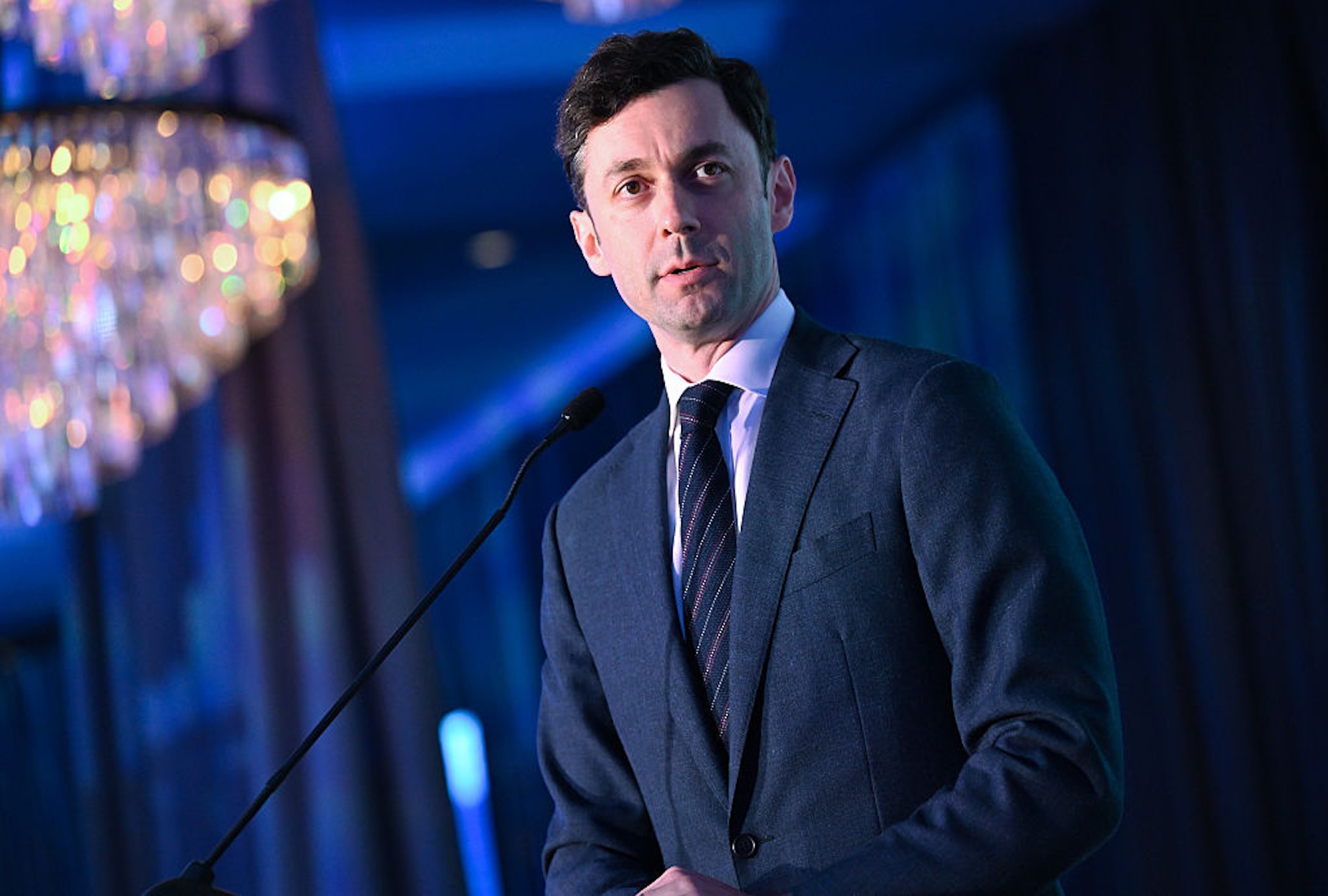
It was a punch delivered in Atlanta on Sunday and felt all the way in Washington, smooth and fluid, like one of Sugar Ray Robinson’s left hooks or Muhammad Ali’s left jabs. With one word — actually, one name: Natalie — Sen. Jon Ossoff stunned the Trump White House with a blow they didn’t see coming and caused the rest of the country to talk about what they had just witnessed.
“So [Trump] doesn’t want to do this job,” Ossoff, who is running for reelection in Georgia, said at a campaign event on Sunday. “He wants to build his ballroom and travel with Natalie on their apparently defenseless flying palace gifted by the Emir of Qatar.”
As special assistant to the president, 35-year-old Natalie Harp follows Trump everywhere: on Marine One, Air Force One, even on the links. She was also one of the chosen few selected to join Trump on a separate plane — and the catering truck that carried him to it — when he recently abandoned returning to the U.S. from Turkey on Air Force One after reportedly receiving threats from Iran. Platinum blonde and attractive in a Fox News sort of way, she is responsible for managing the president’s volatile moods and perhaps even his health, which she accomplishes in part by leaving him letters signed “With all my heart, Natalie.” Harp will never leave him, Trump has boasted, according to New York Times reporters Maggie Haberman and Jonathan Swan in “Regime Change,” even as others in the administration will inevitably depart for greener, more lucrative pastures.
While all of official Washington knew Harp’s name, few outside the Beltway did. That has now changed.
Following Ossoff’s speech, White House communications director Steven Cheung was beside himself, referring to the senator as “Jackoff Jon” and “the biggest cuck loser in politics.” Trump called him Pee-wee Herman — successfully, this time. (In a recent speech, the president had mangled the character’s name, referring to him as “Pinky Herman.”)
The fury and volume of the White House’s reaction to one sentence in the senator’s speech was telling. He obviously hit a nerve, which revealed there was, in fact, a story there waiting to be told. But it also proved that Ossoff knows what he’s doing.
The fury and volume of the White House’s reaction to one sentence in the senator’s speech was telling. He obviously hit a nerve, which revealed there was, in fact, a story there waiting to be told. But it also proved that Ossoff knows what he’s doing. And more than that, he’s good at it.
In this case, the “it” is the art of burning and baiting, a gift many people just tuning into the Georgia Senate race might be surprised to associate with the earnest 39-year-old, who is known in the Senate for his reserved demeanor, for keeping his head down and doing the work.
The right was predictably appalled, with the likes of CNN pundit Scott Jennings and podcaster Megyn Kelly crying foul, accusing Ossoff of misogyny and insinuating adultery between the president and Harp. (Others have pointed out that given Trump’s well documented track record of sexual liaisons, the speculation was already alive.)
But even former Obama adviser David Axelrod seemed shocked by Ossoff’s remarks, chiding him on X for invoking Harp, calling it “gratuitous and unnecessary.” The name drop likely “juiced the virality” of his comment, he wrote, “Probably thrilled some in the base, who figured it was just giving Trump a taste of his own nasty medicine. But they distracted and detracted from the power of the message.”
Axelrod might have had a point — in 2014. His words, unfortunately, belong to another time, before Trump wrung the last drops of decorum from our politics. Now, 12 years and many political lifetimes later, they read as quaint and out-of-touch, like a grandfather telling his grandson to never contradict his betters. They also ignore the strategy and skill that Ossoff brought to the task.
What sets the senator apart from others, including many likely 2028 contenders who troll Trump, is that he brings a forensic craft to his burn-and-bait and, from a writer’s perspective, the beauty of construction. (Ossoff has often said he writes his own speeches.) Overlooked in his comments was an Easter egg hiding in plain sight: his use of “their” in reference to Air Force One. As a plural possessive, the usage implies ownership — Trump wants to “travel with Natalie on their apparently defenseless flying palace” — a subtle and canny construction that underscored questions about why Trump needs Harp and the recent scandal involving Air Force One.
By cleverly placing the reference in the middle of a substantive critique of Trump’s behavior in office, Ossoff also ensured that the clip would be played in full, reminding viewers digesting it on social media and cable news alike about a spate of serious issues: the reported suicide attempts and appalling conditions of America’s sailor aboard the USS Lincoln, the nation’s dwindling supply of munitions and oil reserves, concerns about the aging president’s physical health, allegations of corruption by Trump and his family, the rushed construction of the massively unpopular White House ballroom and the gift of a plane from a foreign prince that was clearly designed to curry favor.
The brief mention of Harp in Ossoff’s speech led to a round of victory laps on MS NOW — Jen Psaki on Monday, Lawrence O’Donnell on Tuesday — that afforded the senator the opportunity to take his message to Democrats nationwide and, most likely, add to his campaign coffers.
Start your day with essential news from Salon.
Sign up for our free morning newsletter, Crash Course.
When asked by O’Donnell about his comments, he offered another burn: “Apparently, in the White House, the truth hurts.” That’s all. Then he pivoted to his real message. “They have lied us into war after promising peace,” he said. “They’ve driven inflation skyrocketing, thrown people off their health insurance, doubled health insurance premiums for more than a million Georgians after they promised to bring down prices on day one.”
From there he brought it home: “And the president’s done so, not just enabled by hangers-on and sycophants inside the White House, but also Republicans in Congress who have enabled him at every turn, and one of them is Congressman Mike Collins here in Georgia. The pro-war, pro-tariff, pro-cutting-your-healthcare, bigot congressman, Trump puppet who’s running for the U.S. Senate.”
But Ossoff is not just baiting the White House, or even Collins, in these appearances and remarks. He’s also enticing voters to join his campaign. “This is Georgia,” he reminded viewers during his interview with O’Donnell. “This is the most competitive battleground state in the country . . . I guarantee that within weeks the polling will be within the margin of error, and there is no path back to the Senate majority without winning this race in Georgia.” (The nonpartisan Cook Political Report has rated the race as “Lean Democratic.”) He then proceeded to invite people to donate by telephone — hey, he knows the primary audience for cable news is older voters — or using his website.
In recent months, Ossoff’s skill on the stump has stoked speculation about his aspirations for 2028. Those have led to a series of staunch denials. “I have zero interest in running for president in 2028,” he told the Atlanta Journal-Constitution in June, likening the talk to “fantasy football” that takes attention from the immediate task at hand: winning a Democratic Senate majority. But a poll released today by Emerson College shows his viability and will no doubt increase the chatter about a potential presidential bid. In hypothetical matchups, Ossoff defeats Vice President JD Vance and Secretary of State Marco Rubio by five and three points respectively.
There is ample evidence to believe Ossoff’s rebuffs that he might prefer his home in Atlanta to 1600 Pennsylvania Avenue. As Puck’s Leigh Ann Caldwell recently observed, he is seen as quiet and studious in the Senate, someone who rarely attends Washington social functions, who is professorial by nature. Then there’s the simple fact that he’s a politician, and ambitions for higher office are in his blood; after all, they are what propelled him to the Senate, and they might be part of what is taking him to the Hamptons this weekend on a fundraising swing.
The qualities that Caldwell described are also ones that were associated with another senator whose oratory attracted attention: Barack Obama. But the comparisons don’t end there. Whether by intention or accident — and few things are by accident in politics — Ossoff is swiftly turning into the Obama of this election cycle by channeling at least four attributes that will hold a premium in 2028: youth, vitality, a demonstrated willingness to fight and having an aspirational message.
Ossoff is wisely trying to harness the increased attention and direct it toward his immediate future: the midterms. Without a win in November, any presidential ambitions, whether real or projected, will be harder. But like it or not, he must learn to reckon with the heightened expectations and speculation that comes with simply being good at his current job.
Read more
from Jason Kyle Howard about the Democrats