
Trump’s catering-truck farce
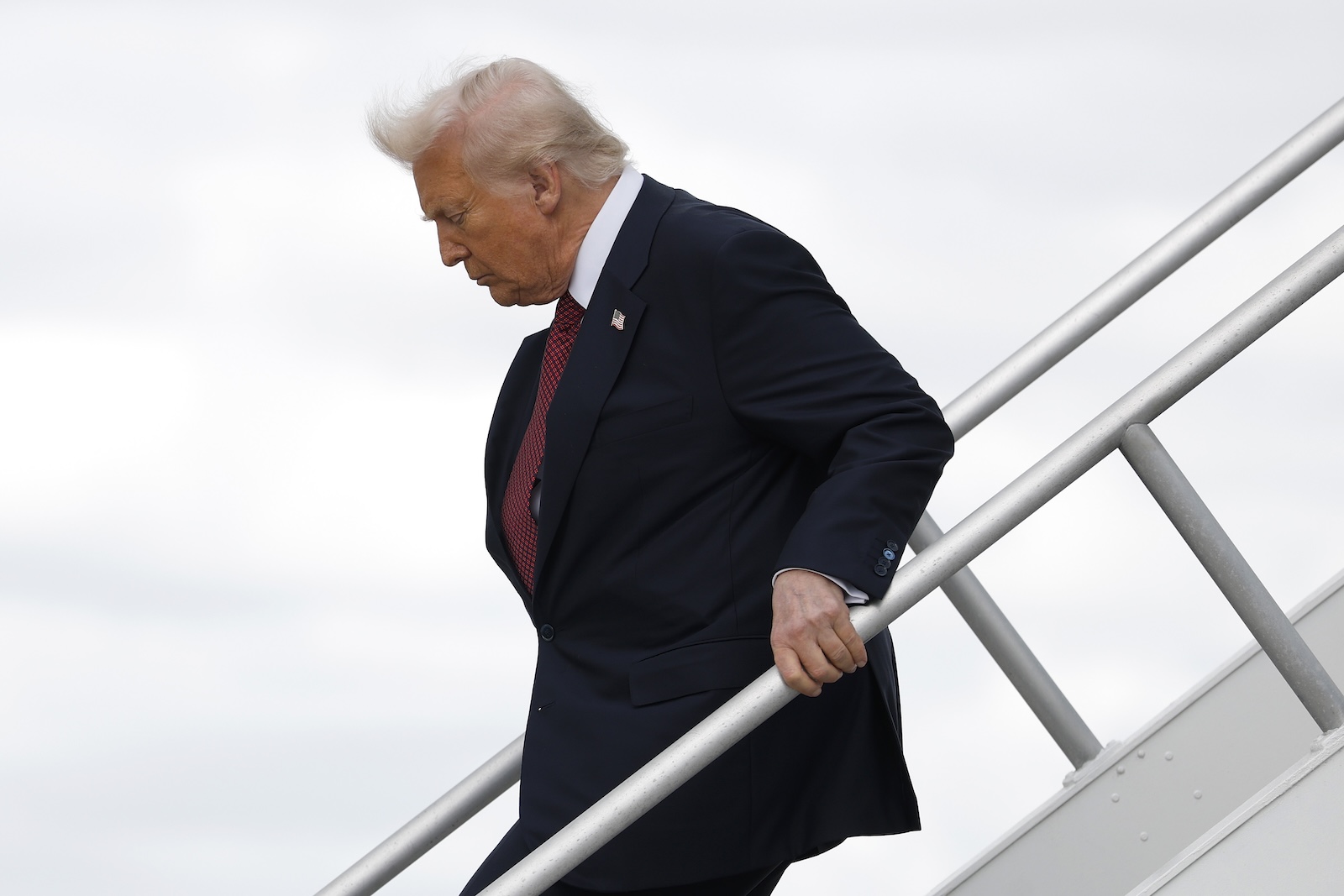
Perhaps it is because I’ve been nursing a slight and recent obsession with zany detective movies of the 1960s — prompted by “The Pink Panther,” then by following the Peter Sellers trail to “A Shot in the Dark” and “After the Fox” — but when I first heard that President Donald Trump had reportedly escaped Turkey in an “airport catering cart,” the scene arrived in my mind already blocked and costumed: a white-tableclothed trolley, steered by a nervous waiter in a bow tie, perhaps topped with a silver cloche. Beneath the linens, taking care that his shoes did not give him away, Trump crouched while he was wheeled past a succession of unfriendly eyes, their owners somehow oblivious to the president concealed at knee height.
The reality was, of course, considerably less cinematic.
The cart was not really a cart at all, but a truck: a large white box fitted with a hydraulic lift, the sort of airport machinery designed to rise neatly to the door of an aircraft. No tablecloth. No cloche. No perspiring waiter trying to look casual. Trump could, essentially, simply walk inside.
And, according to reports, that is more or less what happened. The BBC described footage from July 8 showing Trump boarding the presidential jet at Ankara airport; according to the Washington Post, he was then secretly transferred, by way of an elevated catering truck positioned on the aircraft’s far side, to a smaller C-32A military plane — a modified Boeing 757 more commonly used by the vice president. The operation was reportedly prompted by an Iranian assassination threat.
The internet, however, wasn’t particularly interested in this version.
Within hours of the original Washington Post report, social media had begun supplying its own: AI-generated images of Trump hunched in a cramped compartment over a small mountain of McDonald’s hamburgers; jokes that the operation was going to require “a bigger catering cart”; and, in perhaps the fullest realization of the bit, a mock announcement that, for the president’s “food truck extraction operation,” a team of top operatives had been assembled, all uniquely suited to the task. The operatives were Chef Boyardee, Ronald McDonald, the Burger King and Colonel Sanders.
It is worth considering why this particular image struck such a chord. In another context, a president being quietly transferred between aircraft in a service vehicle might register as little more than a piece of security choreography — unusual, perhaps, but hardly ready-made for farce. Trump in a catering truck was different. For years, he has made food part of his political stagecraft: something to display, serve, pose beside and use as shorthand for abundance, familiarity and a particular vision of American life.
The exquisite comic reversal of the Turkey episode was that, this time, he was no longer directing the tableau. He had been swallowed by the scenery.
Consider the hamburgers.
Want more great food writing and recipes? Sign up for Salon’s free food newsletter, The Bite.
One image from Trump’s first presidency still looms especially large for me. In the middle of the 2019 government shutdown, he filled the White House State Dining Room with McDonald’s, Wendy’s and Burger King to celebrate Clemson’s national-championship football team, telling the players that he had ordered roughly a thousand hamburgers — “everything that I like, that you like.” The photographs were almost absurdly theatrical: silver serving pieces and candelabras, the gilt-and-cream grandeur of the White House, and, arrayed beneath it all, mountains of branded fast-food packaging. The incongruity was the point. Trump stood behind the spread as host and Quarter Pounder impresario.
Five years later, he took his relationship with McDonald’s a step further. During the 2024 campaign, Trump appeared at a franchise in Feasterville-Trevose, Pennsylvania, where the restaurant had been closed to regular customers for the occasion. Instead of bringing McDonald’s into his political theater, as he had at the White House, Trump stepped into McDonald’s theater: apron on, fries in hand, leaning through the drive-thru window. The staging was unusually literal. The restaurant had become a set, the counter a stage, and Trump had given himself a part.
Even the strange little culture war over Cracker Barrel’s logo found Trump acting as something like both dramaturg and producer. When the chain’s 2025 redesign set off a backlash, Trump urged the company to restore its old logo and immediately translated the controversy into the language of show business: Cracker Barrel, he wrote, had received “a Billion Dollars worth of free publicity” if it knew how to use it. “Make Cracker Barrel a WINNER again,” he advised. Restore the old set. Bring back the familiar character. Capitalize on the attention. Trump wasn’t merely offering an opinion about restaurant branding; he was giving notes.
The White House soon made the conceit almost embarrassingly literal. Its official X account posted a doctored version of the familiar Cracker Barrel logo in which Trump had replaced the old man beside the barrel. The barrel itself now read “America First”; beneath it: “America is back.” Trump had not simply inserted himself into a debate over the restaurant’s iconography. He had been cast inside it.
There is, of course, nothing inherently funny about a catering truck, much less about the security concerns that reportedly put Trump inside one. But political imagery is not entirely under the politician’s control. Spend enough years standing behind pyramids of hamburgers, posing at fry stations and inserting yourself into the iconography of American restaurant chains, and eventually the props begin to accrue meanings of their own. McDonald’s becomes not merely something Trump eats or campaigns beside, but part of the visual vocabulary through which people understand him.
Which may explain why, when news broke that Trump had been spirited between planes in a catering truck, the internet required almost no time to dress the scene. The hamburgers were already there. So were Ronald McDonald, Colonel Sanders and the Burger King. Trump has spent years directing the food theater. The catering truck was funny because, for once, he disappeared backstage.
The only thing missing, really, was my nervous waiter in the bow tie.
Read more
about this topic