
Trump’s FIFA pal in trouble as plan to sell off World Cup collapses
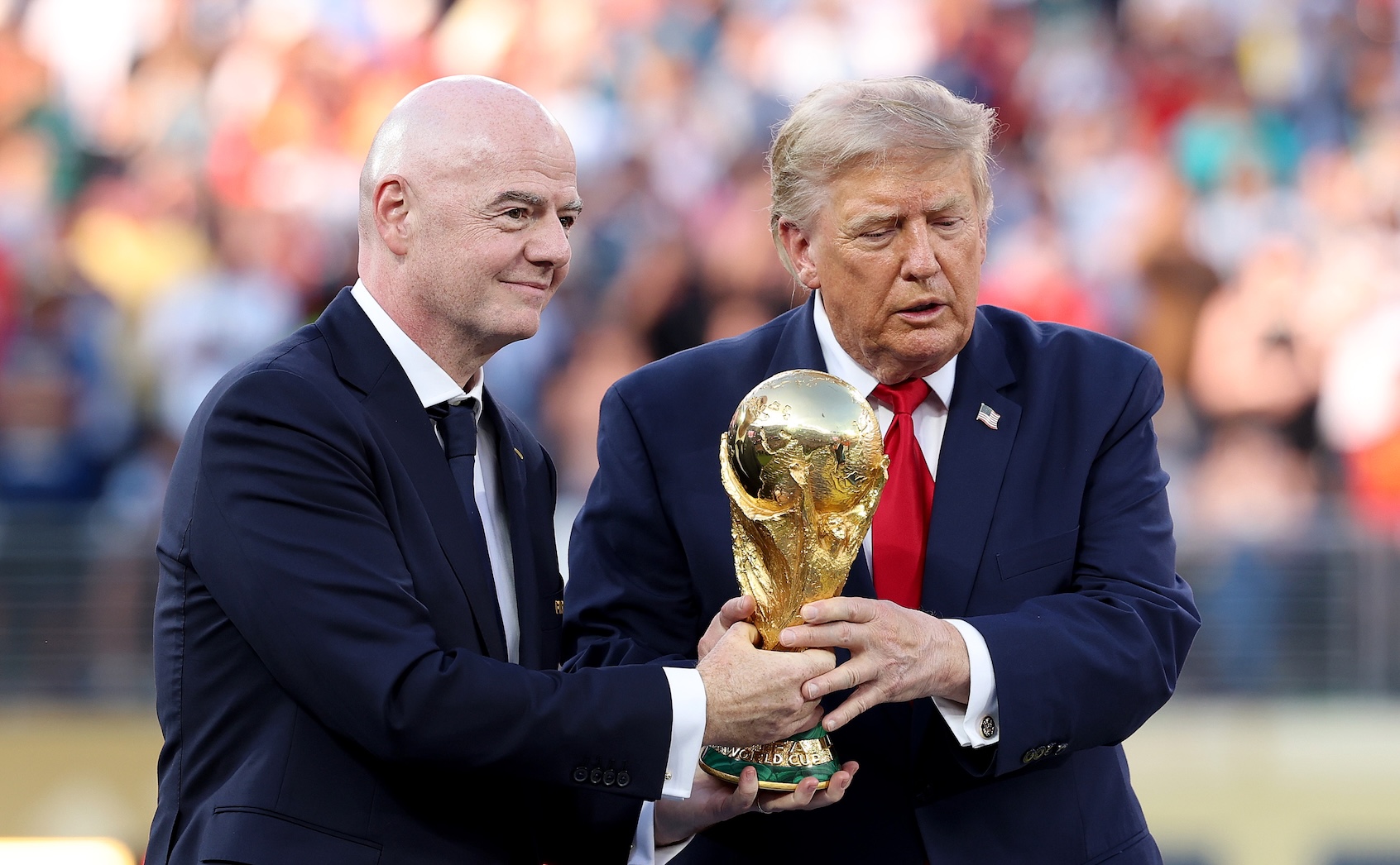
By most objective standards, the 2026 FIFA World Cup tournament — which concluded two weeks ago in New Jersey with Spain’s grueling 1-0 victory over Argentina — was a major success. Despite global anxiety over the collision between the world’s largest sporting event and Donald Trump’s “America First” regime, stadiums were mostly full across North America, fans and players from all sorts of large and small countries seemed to enjoy themselves (and tried to smuggle home large quantities of ranch dressing) and, of course, something like $15 billion flowed into FIFA’s coffers.
Just below the surface, however, the soccer world was seething with discontent. That erupted into all-out rebellion this week, which could finally bring down Gianni Infantino, the Swiss administrator who has served as FIFA chief executive for the last decade. Unpacking the byzantine history of alleged or actual corruption within FIFA and the numerous regional and national federations under its purview would be a dissertation-length project. But it’s definitely not wrong to say there’s a Trump angle, and that Infantino’s marriage of convenience and shared sensibility with the U.S. president may bring his downfall.
Even before this year’s tournament, Infantino stood accused of commercializing or “Americanizing” world soccer — a process he did not start but has certainly accelerated — and of shamelessly cozying up to Trump, whom he presented with the newly-invented FIFA Peace Prize, aka the “Temu Nobel,” last December. That was all inarguably true, and the guy has form, as they say on British cop shows. Back in 2022, while seeking to justify holding the World Cup in Qatar, an autocratic monarchy with a famously dreadful human rights record, Infantino launched a thousand memes with this memorable monologue:
“Today I have very strong feelings, I can tell you. Today I feel Qatari. Today I feel Arab. Today I feel African. Today I feel gay. Today I feel disabled. Today I feel a migrant worker.”
If it seems extraordinary that a major executive of any enterprise, anywhere in the world, could say stuff like that and still have a job four years later, you are beginning to appreciate the hallucinatory Infantino experience. Anyway, in 2026 Infantino seems to have swapped all those intersectional identities for an adjunct MAGA membership, and this year’s World Cup pushed the soccer world’s bizarre love-hate relationship with its leader into overdrive.
Even before this tournament, Infantino stood accused of “Americanizing” world soccer — a process he did not start but has certainly accelerated — and shamelessly cozying up to the current occupant of the White House. This was inarguably true.
Tom Burrows of the Athletic did a nice job this week of summarizing the indictment: Infantino drove World Cup ticket prices to previously unimagined levels, introduced “commercial breaks in each half [of matches] dressed up as hydration breaks” — a network-friendly innovation that global football had resisted for decades — capitulated to Trump in reversing a red-card suspension for U.S. star striker Folarin Balogun, and introduced a “surreal halftime show” featuring Madonna, BTS and Justin Bieber in the final match, in obvious (and inept) imitation of the Super Bowl.
All of that, mind you, came before Infantino’s big surprise this past week: Apparently without consulting any relevant stakeholders, he announced a plan to spin off commercial rights to the World Cup into a new for-profit company (FIFA is a nonprofit, like other international sporting federations) and then sell off a big chunk of that company to an investment consortium led by Joshua Kushner, the younger brother of Trump son-in-law Jared Kushner. So it’s not entirely accurate to say that Infantino wanted to sell world soccer’s biggest brand to the Trump family. But it’s not exactly false either.
To coin a phrase, you can’t make this stuff up. But the good news, or the kind-of good news, or the “why in God’s name did this take so long” news, is that Infantino has finally choked on an overdose of hubris. His proposal collapsed within 48 hours and as of this weekend has been abandoned completely. (Soccer fans will discern unmistakable echoes of the European Super League, a proposed NFL-style closed competition for Europe’s top club teams that was announced in 2021 and imploded within a few weeks.)
UEFA, the federation that governs European soccer and is by far the most powerful of FIFA’s regional subsidiaries, wasted no time in rejecting Infantino’s scheme and announcing that none of its 55 national teams would participate in any FIFA competitions until the proposal was ditched. That was almost certainly enough to torpedo this galaxy-brain plan, and other regional confederations — most notably Concacaf, which represents North America, Central America and the Caribbean, and therefore includes the U.S. — soon followed UEFA’s lead, if not as aggressively.
Donald Trump did not pick up the phone on this occasion. (“Johnny who? Really, I barely know the guy.”) Only the Confederation of African Football — whose member nations, fairly or otherwise, are perceived as Infantino supporters — remained silent. More on that shortly.
Anyone who follows world soccer already knows that UEFA has its own extensive history of political intrigue and internal scandal, and is not well positioned to play populist hero in this drama. But as is so often the case in world affairs, there are no good guys in the story and you have to pick your poison. One could draw a rough analogy with the European Union, a deeply flawed entity that nonetheless represents some degree of ideological or economic counterweight to Trump’s America. In this particular confrontation, Europe held nearly all the cards.
If Infantino somehow pushes through his scheme to sell shares in the World Cup, he will do so — believe it or not — by casting himself as a defender of the downtrodden and underprivileged. He feels gay and African and disabled, remember?
While the next men’s World Cup, FIFA’s biggest golden goose, is still four years away, the consequences of a European boycott would have been felt immediately. The under-20 Women’s World Cup begins in Poland about a month from now, and qualifying playoffs for FIFA’s second-biggest event, the Women’s World Cup (to be held next summer in Brazil) are set for October. Given his avowed commitments to promoting the women’s game and youth soccer at all levels, Infantino simply couldn’t afford to play chicken with UEFA and risk losing those tournaments. Joshua Kushner and his family, one imagines, will not starve.
This may be stretching the point, but there’s a thematic resemblance at work here to the worldwide pushback against Big Tech data centers, and against the opaque government processes that gets them built, as well as to the popular and legal resistance that has stalled the $110 billion merger between Warner Bros. and Paramount. It’s also true that Infantino is now understood, both to soccer fans and the world at large, as a proxy for Donald Trump, which looks like a much worse bet than it did a year ago. Infantino was cruising to likely re-election as FIFA president next year, but right now it’s an even-money bet that he can survive the next month.
Want more sharp takes on politics? Sign up for our free newsletter, Standing Room Only by Amanda Marcotte, also a weekly show on YouTube or wherever you get your podcasts.
Like his White House buddy, Infantino has thrived on a remarkable ability to weaponize greed and cynicism, both on an epic scale and at ground level. He fully intended to push through his scheme to sell shares in the World Cup by casting himself, believe it or not, as a defender of the downtrodden and underprivileged. He feels gay and African and disabled, remember? The uncomfortable truth is that he has ruled over a vast global sports and merchandising empire largely by fulfilling his promises to channel lots of money into regional and national federations in the Global South that have historically had few resources.
Under Infantino’s proposed plan, each of FIFA’s 211 federations — at least the ones who supported him! — would have received an immediate cash infusion of $40 million, with further annual installments to follow. That sum would barely make a difference to the football gods in England, Spain or France, but would been enormous in Malawi or Madagascar. Affluent European nations don’t need infusions of private equity capital to build new stadiums and support younger players, and can afford to stand up to Infantino’s Trump-flavored bribery scheme. For players, parents, coaches and local officials in sub-Saharan Africa, the equation might have looked very different. Why should they care where the money comes from? This particular grift may have failed, but in a world built on massive structural inequality, grifters tend to prosper.
Read more
from Andrew O’Hehir on our wonderful and terrifying world