
A hot, fractured birthday weekend: America at 250
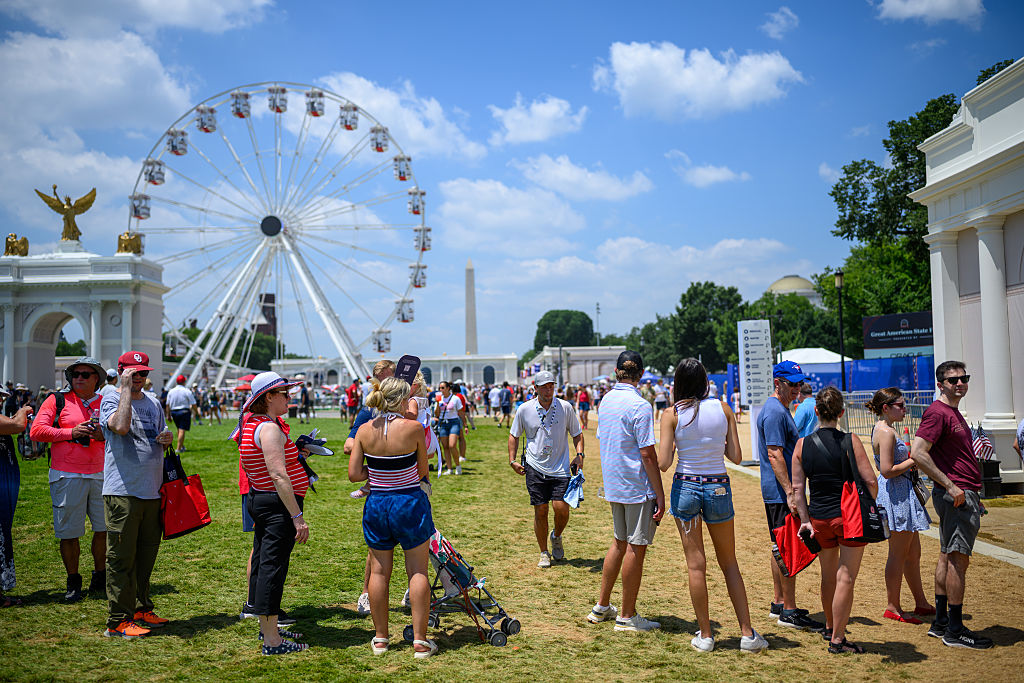
As Americans marked the 250th anniversary of independence, the nation’s largest planned celebration unfolded less like a unified commemoration and more like a stress test — of weather, logistics and competing visions of patriotism.
In Washington, D.C., the centerpiece “Great American State Fair” on the National Mall drew a few early crowds Saturday, but quickly became one of the most visible examples of how extreme heat is reshaping the holiday weekend. Temperatures climbed into the 90s with heat indices exceeding 100 degrees, forcing organizers to scale back outdoor programming, expand cooling stations and urge visitors to take frequent breaks. The full fair was canceled early on Friday and altered significantly for Saturday.
Attendees described long waits in exposed areas, limited shade and difficult conditions navigating a sprawling event designed to showcase the country’s semiquincentennial. The exhibit is on display until July 10 and has already been plagued in controversy. Some visitors left early as the heat intensified, while emergency crews monitored for signs of heat-related illness across the grounds.
The challenges in Washington were mirrored elsewhere, where holiday celebrations are unfolding under widespread heat alerts affecting roughly a third of the U.S. population. Public health officials have repeatedly warned that prolonged exposure in crowded outdoor settings can quickly become dangerous, particularly for older adults, children and people with underlying health conditions.
But the logistical strain was only one layer of a broader, increasingly complex holiday narrative.
At Mount Rushmore National Memorial in South Dakota, President Donald Trump’s holiday weekend appearance was delayed by severe weather before he delivered remarks. Trump delivered the politically charged address that set the tone for the holiday weekend, warning of what he called a “communist menace” in American politics and tying it to recent Democratic electoral gains.
Speaking at there as part of continued America250 celebrations, Trump framed the moment as a test of national identity, arguing that “you cannot be both a communist and a patriot,” while casting the anniversary as a defense of American values rather than a purely ceremonial milestone.
Across the country, those parallel interpretations are also reflected in the structure of the celebrations themselves. The official U.S. semiquincentennial effort, coordinated through the bipartisan America250 Commission, was designed as a national commemoration intended to emphasize shared history and civic unity.
But the rollout of parallel branding, including Trump-associated “Freedom 250” events and appearances tied to the anniversary theme, has created an overlapping set of celebrations that are not always aligned in tone or emphasis. Together, they form a layered national observance that blends official programming, political messaging and large-scale public spectacle.
The result is a July 4 weekend defined not by a single narrative of national unity, but by multiple celebrations unfolding at once — some formal, some political, yet all occurring under the same punishing summer heat.
Start your day with essential news from Salon.
Sign up for our free morning newsletter, Crash Course.
Even as fireworks displays are set to light up skies from Washington to New York City and beyond later on Saturday, officials continue to warn that conditions remain hazardous for large outdoor gatherings, with air quality concerns expected to rise after sunset as smoke and humidity linger in stagnant summer air.
Before the first fireworks explode, America’s 250th birthday has already revealed something less ceremonial: a national celebration being reshaped in real time by weather, infrastructure limits and competing visions of what, exactly, is being celebrated.
Read more
about America’s 250th celebrations