
The alarming split in the Supreme Court’s birthright citizenship ruling
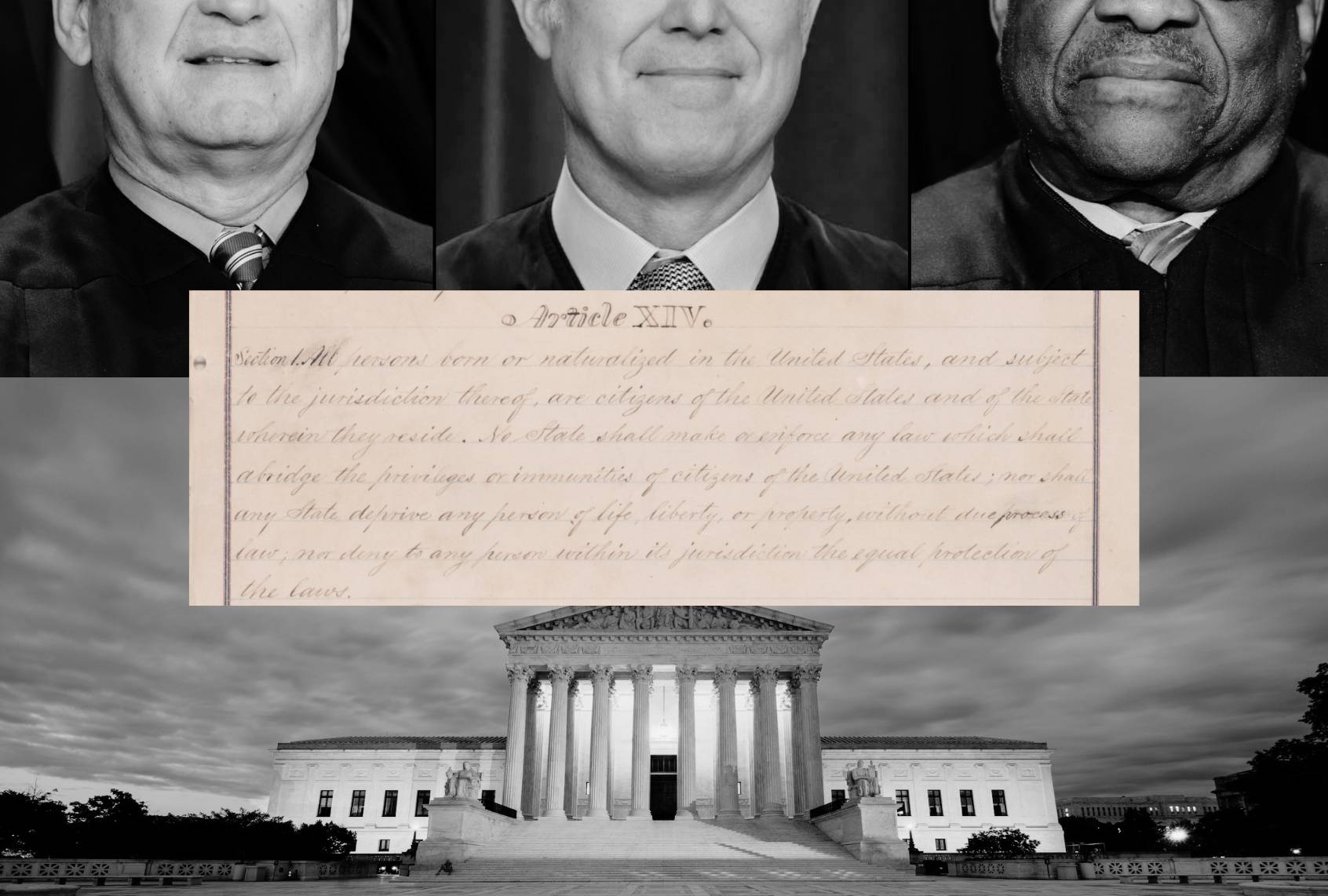
Relief flooded much of the nation on Tuesday morning as the Supreme Court released its decision upholding birthright citizenship, ending the 2025-26 session with a blow to President Donald Trump and his immigration policy.
The justices on Tuesday ruled 6-3 in the landmark case that called into question the very foundation of American citizenship and identity. Lawyers and advocates have lamented that this bedrock principle was even up for debate, let alone affirmed by anything less than unanimity among the justices. But a deeper look into the decision shows that only five of the justices ultimately upheld the Constitution — and that should concern every American.
In Trump v. Barbara, the justices had the task of determining whether Trump’s first-day executive order violated the 14th Amendment’s citizenship clause or federal law. The order declared that individuals born in the United States did not automatically receive citizenship if their parents had insufficient legal status and instructed federal agencies against recognizing citizenship claims of a child born after Feb. 20, 2025, if their parents lacked sufficient status.
In federal court last spring, three families challenged the executive order on behalf of themselves and others in their positions, arguing that the order unlawfully stripped their children of citizenship. Last July, a U.S. District Court judge for the District of New Hampshire blocked the order from taking effect during litigation and certified a class of affected children.
Chief Justice John Roberts authored the majority opinion, in which Justices Amy Coney Barrett, Sonia Sotomayor, Elena Kagan and Ketanji Brown Jackson joined, affirming the lower court decision and holding broadly that the 14th Amendment’s citizenship clause ensured that any child born in the United States had the guarantee of citizenship.
“Citizenship, then and now, was the right to have rights — to freely participate in our political community. The Framers of the 14th Amendment extended that promise to ‘every free-born person in this land,’” Roberts wrote in the opinion of the court. “We keep that promise today.”
“The idea that a president can rewrite the Constitution by executive order is a pretty radical one, and to have only five justices [agree] is surprising.”
That the decision to uphold the Constitution — to interpret the 14th Amendment’s “subject to the jurisdiction” language as within the boundaries of the U.S. — wasn’t unanimous startled several legal experts.
“This really should have been a 9-0,” Aarti Kohli, executive director for the Asian Legal Caucus, told me. “The idea that a president can rewrite the Constitution by executive order is a pretty radical one, and to have only five justices [agree] is surprising.”
Justice Brett Kavanaugh was the outlier in the decision, agreeing with the court’s judgment but disagreeing with its justification. Yes, the president’s executive order was unlawful, but not because it was unconstitutional, Kavanaugh essentially said, noting he did not find the order violated the amendment. Instead, it violated section 1401 of Title VIII, which reiterated the principles of the 14th Amendment alongside four exceptions established in the 1898 Supreme Court decision U.S. v. Wong Kim Ark.
“Wong Kim Ark’s treatment of the exceptions as a ‘closed set’ is incorrect, in my view,” he wrote. “Considering the four exceptions as a permanently frozen or closed set as of the 14th Amendment’s ratification in 1868 — such that there can be no subsequent exceptions recognized based on new developments after 1868 — is inconsistent with the Court’s longstanding approach to constitutional interpretation in a variety of areas.”
The Trump administration’s excluding children born to parents with temporary or undocumented status from birthright citizenship could be an additional exception under the Constitution if the court had chosen to rule narrowly and follow that approach, Kavanaugh asserted.
But Kavanaugh’s interpretation of the law, should it have been the majority’s, would have opened the door for more legal challenges to birthright citizenship because it expressly denied it as a constitutional right, Kohli said.
Start your day with essential news from Salon.
Sign up for our free morning newsletter, Crash Course.
The majority opinion, however, ensures that lawmakers can’t just end the citizenship provision without having the support needed to pass a constitutional amendment, and the current makeup of Congress means such an outcome is incredibly unlikely. As it stands, Kavanaugh’s opinion still serves as a reminder to federal lawmakers that, should they seek to impose more exceptions on birthright citizenship through proposed legislation amending the statute, they could.
As Kavanaugh noted, however, “Over the last 30 years, Congress has considered numerous proposed bills to alter birthright citizenship, but Congress has never actually passed such legislation.”
Still, a wide gap separates Kavanaugh’s dissent from those of his other conservative colleagues — Justices Clarence Thomas, Neil Gorsuch and Samuel Alito — who denied altogether that the Constitution guaranteed birthright citizenship to children born in the U.S. to parents with temporary or undocumented status.
While Alito and Thomas’ opinions both repeated Trump administration claims about the Constitution requiring one to domicile — or maintain legal, long-term residence — in the U.S., they differed in the concerns they raised surrounding birthright citizenship.
During oral argument on April 1, the Trump administration claimed that the 14th Amendment had never been interpreted to guarantee citizenship to children born to parents with undocumented or temporary status because those children are not exclusively “subject to the jurisdiction” of the U.S. as described in the Constitution. Counsel for the administration argued that that language describes “owing direct and immediate allegiance” to the country.
The four disagreeing justices, and the potential for the court to lean more conservative in the future, add fuel to a fire that could further push the nation back into a discriminatory sociopolitical climate multiple generations of Americans have fought to topple.
Alito’s dissent contended that a child could only not “be subject to any foreign power” if no other country would “automatically” render them a national, asserting that many children born to undocumented immigrants also enjoy blood-based citizenship through their parents. The current birthright citizenship policy also “encourages ‘birth tourism’ — the practice of traveling here with temporary authorization solely to give birth and obtain citizenship for one’s children, then returning to raise them in another country,” Alito alleged.
In the more than 90-page principal dissent, in which Gorsuch joined, Thomas also argued that the original goals of the 14th Amendment limited its application to only newly freed African Americans in 1868.
“Blacks were entitled to citizenship because they were Americans. They had no other homeland, owed no allegiance to any foreign power, and were subject to no other authority,” Thomas wrote, adding: “The Citizenship Clause thus guaranteed them the ‘dignity and glory of American citizenship,’ so as to ensure that they would never be treated as second class under the law. The same could not be said for the children of foreign temporary visitors.”
The majority opinion roundly rejected Alito and Thomas’ arguments about domicile.
“If Congress intended to limit American citizenship to the children of those domiciled in the United States, nothing in the succinct language of the Citizenship Clause conveyed that design,” Roberts wrote in the majority opinion. “Words appearing frequently in the Executive Order — ‘mother,’ ‘father,’ ‘lawful,’ ‘temporary’— are absent from the Clause. For a simple reason: they did not matter.”
And that rejection was for good reason, Betsy Fisher, advocacy counsel for national nonprofit United Stateless, told Salon. “It would be both extremely harmful,” likely rendering thousands of children nationwide stateless because they wouldn’t have citizenship in the U.S. or their parents’ home country, and “deeply unadministrable, extremely complicated and inefficient to apply in practice.”
Jackson also issued a scathing rebuke of Thomas’ dissent in her concurrence, noting the irony that Thomas, who has long taken a colorblind perspective in rulings, thought the framers of the Constitution sought to limit the application of the 14th Amendment along racial lines.
“This alternative account pitches Black Americans against immigrants when the advocates who promoted the 14th Amendment did no such thing,” Jackson wrote. “Freed Blacks fought for the shared humanity of all people. And the Great Emancipator eventually foresaw that the only path forward that could prevent a return — in any form — to slavery and race-based subordination was to link the fates of all.”
Jackson’s latter point is, in large part, what makes the fact that the court ultimately made a constitutional determination and upheld the 14th Amendment so important — and the number of justices who disagreed alarming. The crop of Americans seeking to end birthright citizenship and advocate for similar changes to the country show no signs of changing course, even in the face of this ruling. The four disagreeing justices, and the potential for the court to lean more conservative in the future, add fuel to a fire that could further push the nation back into a discriminatory sociopolitical climate multiple generations of Americans have fought to topple.
“The birthright citizenship executive order is part of a bigger attempt to change who Americans are and who belongs and who decides,” Fisher said. “Really emphatically rejecting that [precedent] is important to maintaining this idea that the United States is a place where people can belong, where we can live with each other across difference, and that’s what birthright citizenship does for us.”
Read more
about the Supreme Court