
How to fire up 2026’s hottest House race
New York City’s hottest club is the Democratic primary for the 12th congressional district. This race has everything. Never Trump poster-boy George Conway has joined a famous legal pundit, a big-time finance guy, the hottest politicians and even a Kennedy. Best of all, one of them will get an automatic ticket to an even more exclusive room: Congress.
Yes, even “Saturday Night Live’s” Stefon would appreciate the crowded primary to succeed the retiring Rep. Jerrold Nadler, who has held this seat since 1992, back when the hottest spots in New York were the Limelight and Palladium. The open seat covering some of the most reliably blue neighborhoods in the nation is close to a once-in-a-lifetime opportunity; some of the hopefuls weren’t even born when Nadler was first elected.
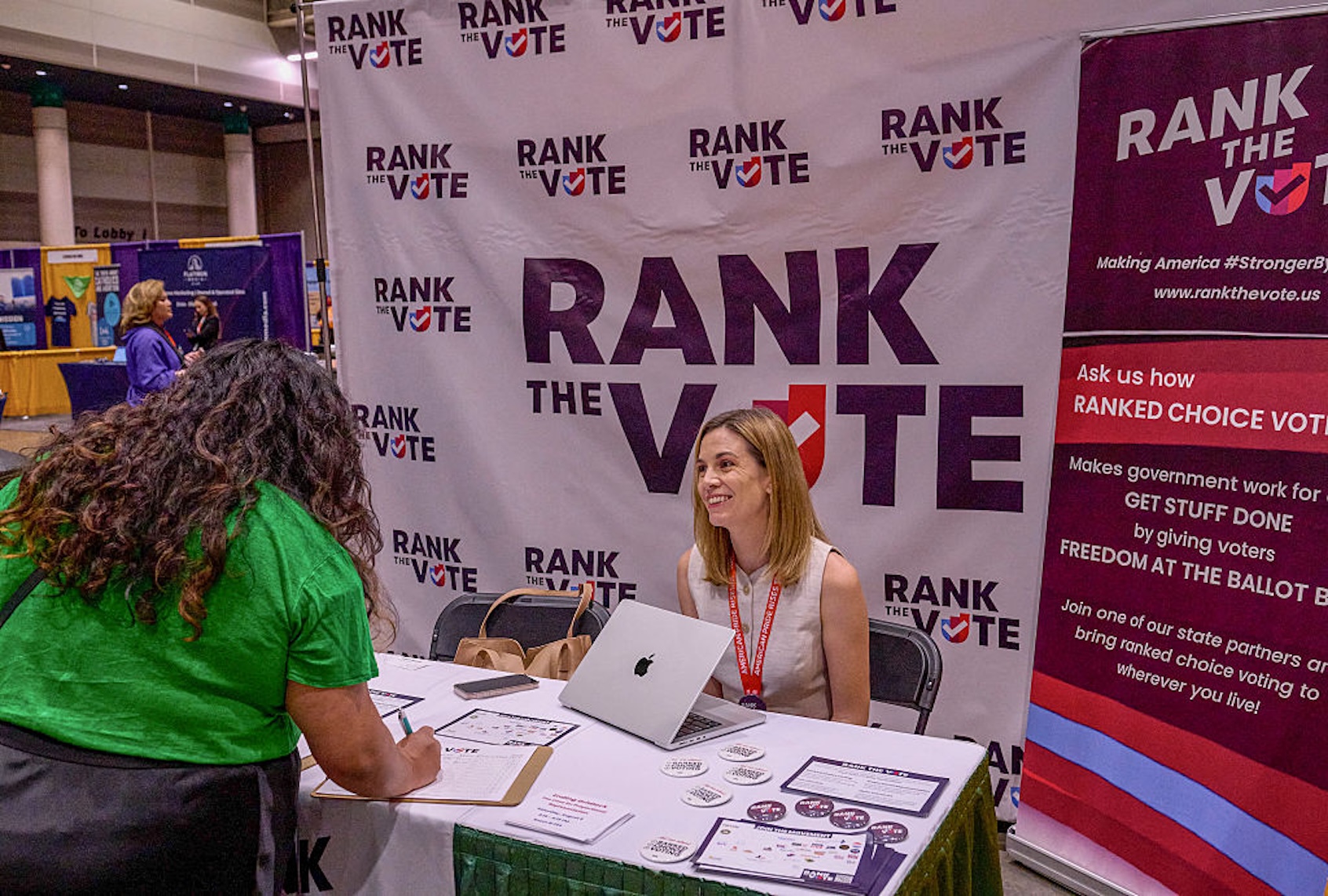
Voters will have a rich choice from a group of interesting candidates representing many different backgrounds and generations. All these options would be better still — and produce a more representative result — with ranked choice voting.
The large and growing field — which includes JFK’s grandson Jack Schlossberg and now Conway, one of the most prominent conservatives to depart the GOP over Donald Trump — should be great news. Voters will have a rich choice from a group of interesting candidates representing many different backgrounds and generations.
All these options would be better still — and produce a more representative result — with ranked choice voting.
The winner of this primary, after all, will coast into Congress, and maybe even stay there until “SNL” celebrates season 75. Yet this crowded race, which is overstuffed with well-funded candidates equipped to go the distance, might be won with as little as 15% of the primary electorate. That’s bad for voters and bad for representation.
Ranked choice voting fixes this problem and would ensure that the winner has majority support. New York uses this method in primaries for citywide offices. It should be expanded for state and federal offices as well.
In a ranked choice election, voters have the power to rank the field in order: first, second, third and so on. If someone wins 50% of first choices, they win, like any other election. If no one does, an “instant runoff” takes place. The candidates at the bottom are eliminated. If your candidate remains, your vote stays with them. If they’re at the bottom, then your second choice comes into play. This continues until someone reaches a majority.
New Yorkers know it works because they just saw it in action. Democrats nominated Zohran Mamdani for mayor last summer using ranked choice voting. Under this system, Mamdani won a clear majority mandate — 56% — in an 11-candidate field. But this time last year, Mamdani was running at the bottom of polls with just one percent support. There would have been calls for him to drop out and consolidate the non-Andrew Cuomo candidates behind another progressive, rather than risk playing a spoiler, all before voters had even tuned into the race.
Instead, the mayoral race looked entirely different. Because candidates had to compete for second- and third-choice votes, they were incentivized to visit communities citywide. No one could win simply by turning out a small base and ignoring everyone else. Then, we saw like-minded candidates team up and cross-endorse each other, and even hold joint events. In a single-choice system, they’d be going negative and trying to elbow the other person out as a spoiler — or as we observed during the mayoral election, alleged efforts to bribe Republican nominee Curtis Sliwa out of the race.
Want more sharp takes on politics? Sign up for our free newsletter, Standing Room Only, written by Amanda Marcotte, now also a weekly show on YouTube or wherever you get your podcasts.
It’s easy to imagine this congressional race looking much more like the nastier November election than the superior, issue-focused primary. The candidates will be well-funded. The primary can be won with a small sliver of voters. This will play to the natural instinct to drive up an opponents’ negatives rather than make the case for oneself. And it is also easy to imagine that interesting candidates with less name recognition and fewer wealthy friends will be under a lot of pressure to get out of the race, maybe long before anyone other than MSNOW starts paying attention. Ranked choice voting would let voters decide.
The New York 12th isn’t even the only one in Manhattan. Look south to the 10th congressional district, where Democratic Rep. Dan Goldman bested a crowded field with just 26% of the vote to win his seat in 2022. This year, multiple candidates have considered primarying him; there’s an early effort to consolidate around just one so as not to fracture the progressive vote.
It’s an issue that extends nationwide and could hurt Democrats in seats they need to win this fall. In New Jersey, where one Democratic member, Rep. Bonnie Watson, is retiring, and another, former Rep. Mikie Sherill, just got elected governor, two blue seats will be determined by what are shaping up to be primaries as crowded as a Springsteen show at The Stone Pony.
Meanwhile, in Michigan’s Democratic Senate primary, three young Democrats with distinct bases are locked into a race with the potential to turn divisive. The contenders include incumbent Rep. Haley Stevens, a rising star in State Sen. Mallory McMorrow and the Bernie Sanders-endorsed former public health official Abdul El-Sayed. Democrats must hold this seat to have any chance at capturing the Senate. The winner of this primary might have earned little more than a third of the vote, and will enter the fall’s general election bloodied from high-profile slings and arrows from their own side. And two of these strong Democrats will be damaged from friendly fire.
Of course, ranked choice voting doesn’t favor any ideology or party. It’s a tool to let more candidates run and deliver majority winners. But one thing is clear: All of these eventual nominees would be in a far stronger position with voters, and for November, if our elections used ranked choice voting to determine a majority winner.
The simple truth is that more and more candidates are going to jump into party primaries moving forward. New voices are tired of standing on the sidelines. New generations are ready to lead. The time is now and the moment has arrived. Ranked choice voting is the tool to ensure that voters nominate the strongest candidates, someone with the widest and deepest support, and best situated to win. Then maybe come November, the nation’s hottest club — or Congress, at least — will have a different vibe. Stefon might call it majority rule.
Read more
about the 2026 midterms