
Patrick Stewart, the “Star Trek” captain who elevated television
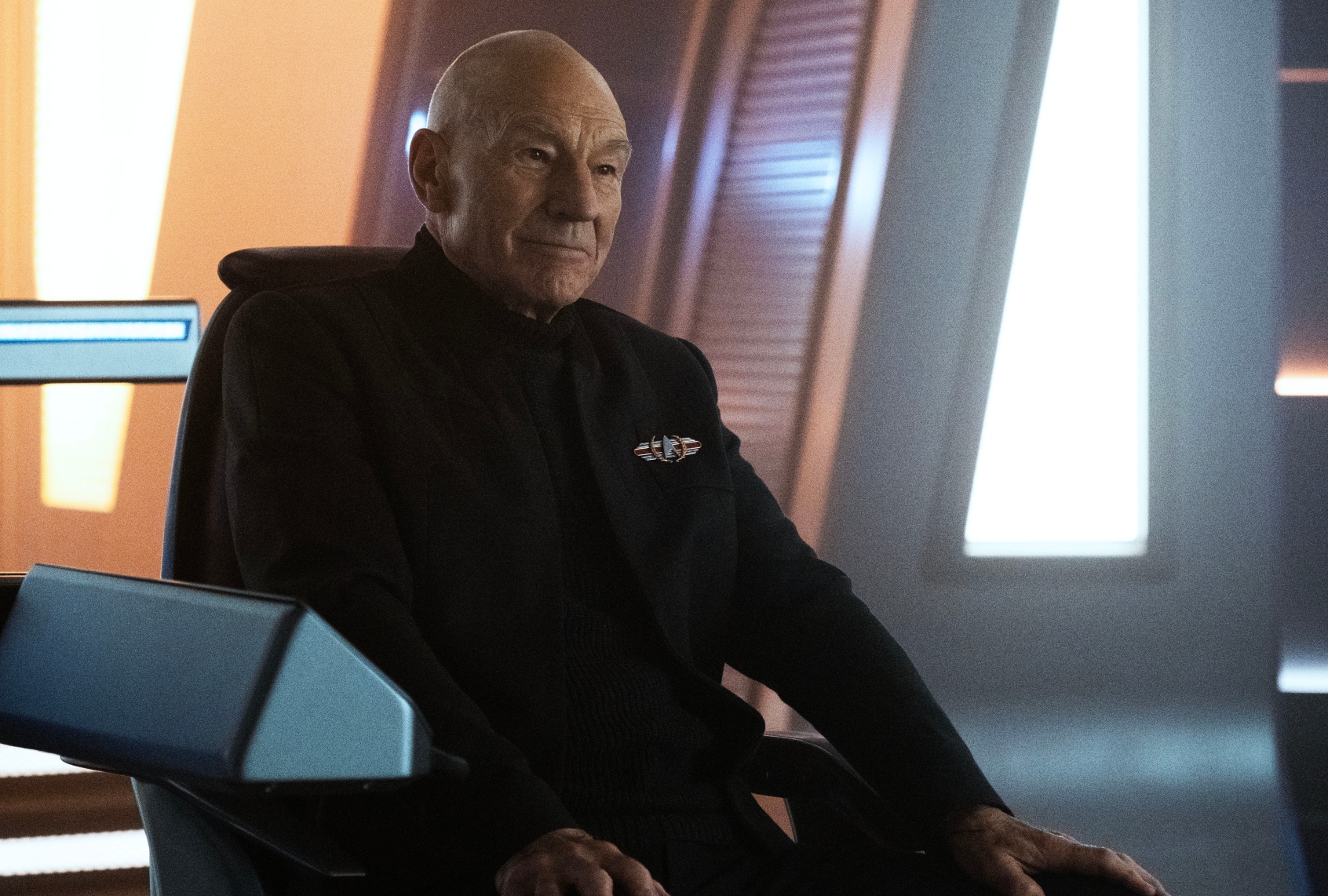
Before the prestige drama era, people rarely associated nobility with the small screen. In old Hollywood’s thinking, television was cinema’s inferior cousin. Syndication ranked even lower. And syndicated science fiction shows? Total jokes.
Sir Patrick Stewart, who died Wednesday in Los Angeles at 86, changed these impressions when he accepted the seven-year mission of “Star Trek: The Next Generation.” As Jean-Luc Picard, the captain who inherited the helm of USS Enterprise from William Shatner’s James T. Kirk, Stewart embodied franchise founder Gene Roddenberry’s humanist outlook.
Picard, the actor’s greatest TV legacy, is a paragon of grace: empathetic, dedicated to a mission of understanding and devoted to preserving what is best about Starfleet. And Stewart’s shaping of the character ennobled television in ways cosmic and small.
By treating his Starfleet commander as if he were a Shakespearean protagonist, Stewart transformed a franchise at a crossroads into a fresh, thoughtful look at human possibility. This guiding principle traveled through “The Next Generation” and subsequent movies, along with the recent Paramount+ “Star Trek” spinoff, “Star Trek: Picard.”
By the time Stewart’s final voyage with “Star Trek” debuted in 2020, Picard was less of a Starfleet hero than a wise man exhausted by politics and cruelty. And “Picard” was as much a response to Trumpian callousness as “The Next Generation” was to our culture’s fatigue with materialism by 1987, when it premiered.
“If the ‘Trek’ universe presented a leader like Picard, it may be because back then, we all thought we were just shy of getting to a better place with regard to how we treat each other,” I recalled in 2018. “Of thinking beyond ourselves, our immediate desires and thirst for gratification, and embracing our differences as strengths. It was a lovely illusion.”
When Stewart joined the Trek universe, he was largely unknown to Americans – save for the eagle-eyed nerds who recognized him, perhaps, from John Boorman’s “Excalibur” or David Lynch’s “Dune.” His Starfleet captain eschewed Captain Kirk’s swagger, though that didn’t mean he was all business. Picard is a man given to philosophical debates and genteel pursuits like horseback riding and fencing. He isn’t infallible, but he constantly demonstrates all the ways people could be better, not than others, but than we ourselves once were.
This is the essential definition of nobility, expanded upon over 178 episodes of “Star Trek: The Next Generation.”
Many factors contributed to that syndicated series’ success and Stewart’s resultant popularity as the man behind one of TV’s most beloved characters. “The Next Generation” ensemble featured some of TV’s most adored talent, including Jonathan Frakes and LeVar Burton, on a crew steered behind the scenes by Roddenberry himself. It went on to win 17 Emmys and a Peabody.
But Stewart’s gravitas, honed over many years of British stage performance, made Picard the show’s gravitational center, and he was proud of that. Long after TV catchphrases became associated with hackneyed scripting, Picard unironically claimed a few of the best, including “make it so” and “engage,” delivering them each time with an air of aristocratic confidence.
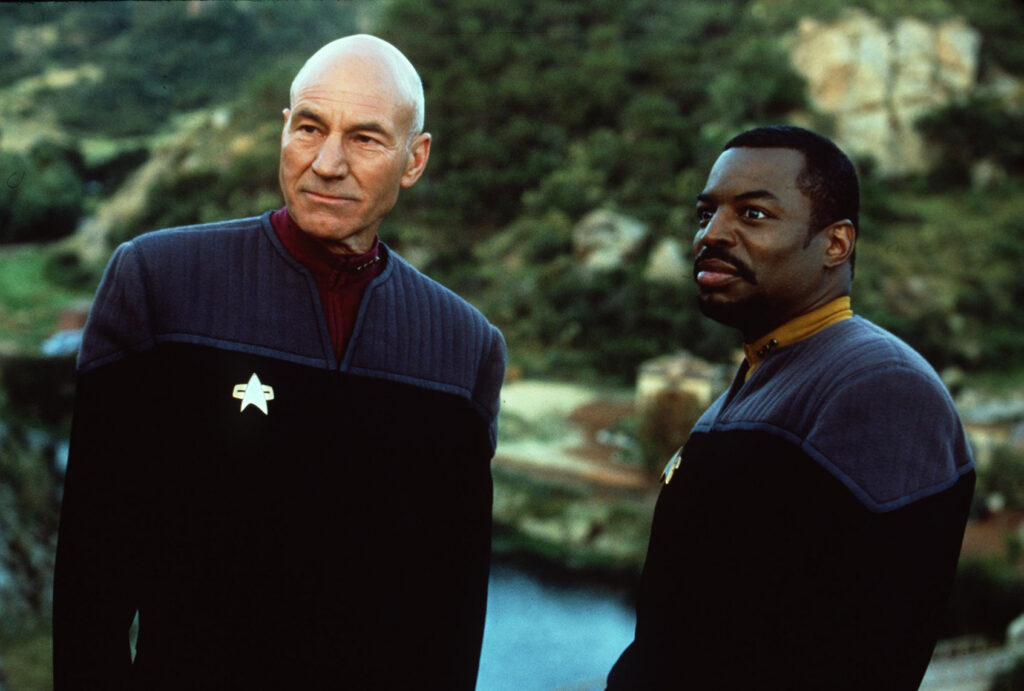
(Paramount Pictures/Getty Images) Patrick Stewart, left, and LeVar Burton in the 1998 film “Star Trek: Insurrection.”
Stewart came from humble origins, however: He was born on July 13, 1940, in a West Yorkshire industrial town, and raised in a house lacking an indoor toilet or running hot water.
“What identifies an individual as a king is how other people behave towards him,” says a quote attributed to the actor. “All authority is assumed, and if other people don’t accept your authority then you don’t have it. Perhaps the critical thing to being a convincing figure of authority is actually not to try too hard.”
That understanding gives fresh insight into the passion he brought to his greatest starring roles and the smallest.
The authoritative voice we associate with Picard ordering his tea “Earl Grey, hot,” was fine-tuned over a career that began with training at the Bristol Old Vic Theatre School, where he enrolled in 1957. Shedding his working-class Yorkshire accent during his studies, Stewart’s regal elocution won him his stage debut in 1959 in an adaptation of “Treasure Island.” From there, his career was largely defined by his 16 years with the Royal Shakespeare Company, where he started in 1966, before joining the Royal National Theatre in 1984.
As The Independent cited in a 2003 story, when a reporter once implied the two-time Laurence Olivier Award winner was slumming it by linking himself to the Trek universe, Stewart replied, “Sitting in the Captain’s chair of the Enterprise is rather like sitting on the throne of England, though marginally more important.”
The Crown didn’t take offense; Queen Elizabeth II conferred Stewart’s knighthood in 2010.
We can credit the actor’s innate emotional agility for his commitment to every part, or a versatility earned over decades of playing many major heroes and villains the Bard scribbled onto parchment. Whatever it was, Stewart’s charm was in his refusal to let snobbery dictate his life or career path. While most of his career was spent onstage, you’ll find his name in the credits of many films and shows and hear his baritone in a slew of video games and animated work.
Although his association with “Star Trek” and Picard came to define how people perceived him, Stewart’s merry attitude about his claim to fame let us appreciate his range. While his casting as the mutant telepath Professor Xavier in the “X-Men” cinematic franchise resulted from his time in the starship captain’s chair, his multiple collaborations with “Family Guy” creator Seth MacFarlane showcased his playful side.
Want more from culture than just the latest trend? The Swell highlights art made to last.
Sign up here
People who have never watched a single “Star Trek” episode can easily pick out his voice from every other guest on “Family Guy” or know him as Stan Smith’s self-important CIA boss Avery Bullock on “American Dad!” The sheer joy of watching Stewart’s comic turns in shows like “Extras” or hearing his voice in ludicrous contexts was magnified by the majesty he lent to his dramatic work. He owned his portrayal of Gurney Halleck in “Dune” so completely that nobody blinked when he dashed into a battle scene bellowing mightily while clutching a pug, of all things.
But it was Picard—who retired as an admiral— that forever landed Stewart in our minds and hearts. He never minded that fact.
“Halfway through season 3 of ‘Next Generation,’ I no longer knew where Jean-Luc started and Patrick Stewart left off,” he told reporters at a Television Critics Association press conference in 2020. “We became melded, and he has never left me . . . He has always been there, and it’s a relationship that I am happy to continue with.” Thanks to his prolific presence in movies, shows and on screens large and small, we can keep that relationship alive too.
Read more
about Jean-Luc Picard and Patrick Stewart