
Ebola won’t be used as political weapon — NCDC chief
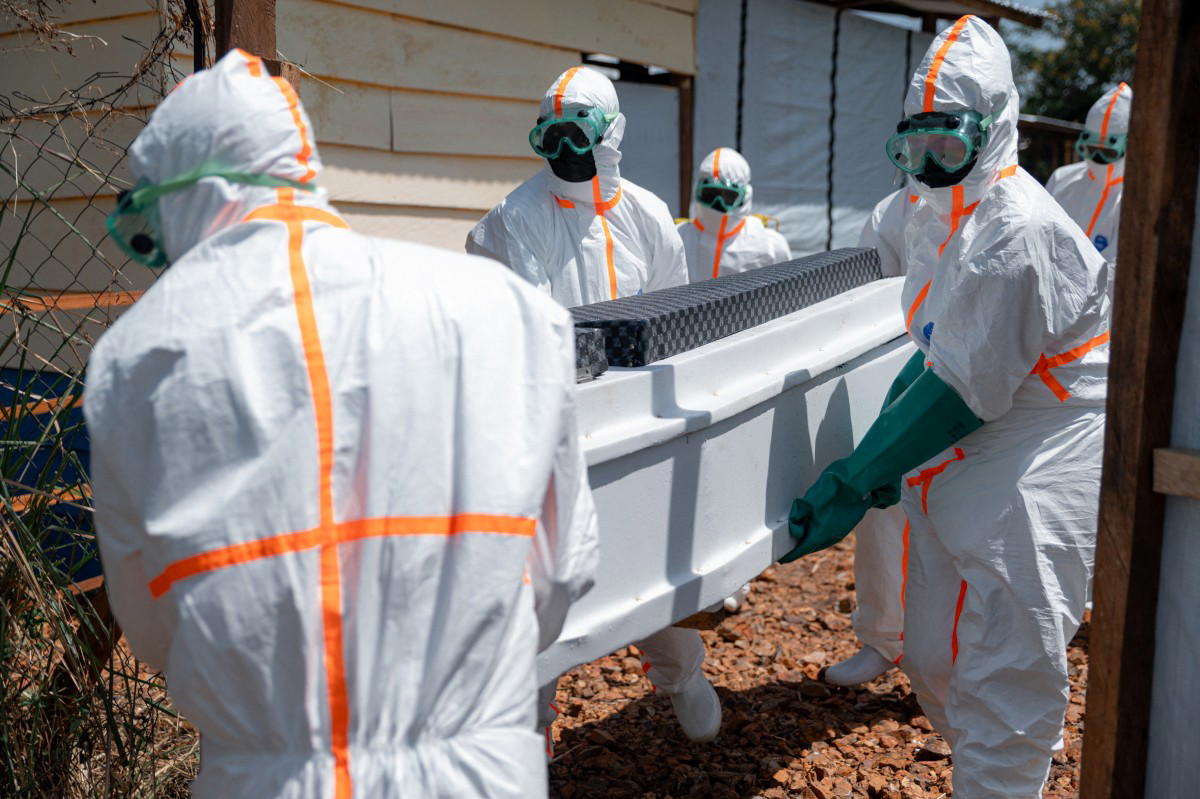
Volunteers of the Democratic Republic of Congo Red Cross wearing personal protective equipment carry the casket containing the body of an Ebola virus disease victim at the morgue of the Rwampara health centre, Ituri Province, Democratic Republic of Congo, on June 8, 2026 before loading it into a vehicle for transfer to a cemetery as part of safe and dignified burial operations aimed at preventing the spread of the virus. The head of the World Health Organization visited Uganda on Monday and praised its efforts to limit the spread of an Ebola outbreak from neighbouring Democratic Republic of Congo. The WHO has declared an international health emergency over the outbreak which has caused 515 confirmed infections in the DRC, including 91 deaths, since it was announced on May 15 in northeastern DRC.
Uganda has recorded 19 cases and two deaths. All but five have been Congolese nationals who crossed the border. (Photo by Jospin Mwisha / AFP)
By Adegboyega Adeleye
The Director-General of the Nigeria Centre for Disease Control and Prevention (NCDC), Jide Idris, has dismissed suggestions that the Ebola outbreak could be used as a political weapon, insisting that disease concerns would not be exploited for political purposes.
Speaking on Channels Television’s Politics Today on Monday, Idris said the health sector would not use the outbreak for political ends, adding that any decision on a possible election postponement would depend on the situation.
“We in the health sector will not use disease issues as a political weapon,” he said.
“When it came, when it came, it came and we were not even sure whether it would be out of the budget…..so no government will use Ebola as a political weapon,” Idris added.
On whether the Ebola outbreak could lead to a postponement of the election, the NCDC chief said he hoped such a measure would not become necessary, stressing that the decision was not his to make.
“That is not my decision, we hope not because if the thing gets wide enough. As at now there is no need for that,” he said.
Explaining Nigeria’s preparedness for the outbreak, Idris said health authorities had been monitoring developments in the Democratic Republic of the Congo (DR Congo) and anticipating the possibility of the virus reaching Nigeria through international travel and population movement.
He said the authorities had tracked the outbreak and committed resources to preparing for the risk of an imported case.
“But again you know this Ebola started in DR Congo a couple of months ago and we were tracking and they said we need to track again, that there is a possibility for many reasons that it can get here. A population movement, flight into this country and that side again, we spent funds on it,” Idris said.
The NCDC confirmed Nigeria’s first case of the current outbreak in Abuja on October 20, with 53 contacts identified for monitoring. The confirmed patient was subsequently medically evacuated to Switzerland on Monday, while health authorities continued monitoring contacts.
Idris also urged Nigerians to observe regular handwashing, describing the practice as an important measure for reducing the spread of infections.
“Most of these infections, handwashing alone can reduce the incidence by almost 40%,” he said.
The United States Centers for Disease Control and Prevention (CDC) says handwashing education can reduce diarrhoeal illnesses by 23 to 40 per cent and respiratory illnesses by 16 to 21 per cent.