
South Africa’s Biodiversity Plan: Will It Protect Life, Or Protect Business As Usual?

By Mariam Mayet, Director at African Centre for Biodiversity
Biodiversity may sound technical, but it names something deeply familiar: the living world that makes life possible. It is the seed in a farmer’s hand, the soil beneath our feet, the insects that pollinate food crops, the wetlands that store water, the grasslands that feed cattle and wildlife, the rivers, oceans, forests, fynbos, medicinal plants, and the knowledge communities have built over generations.
South Africa is one of the world’s great biodiversity countries—and that is exactly why the warning lights matter. We are one of only 17 megadiverse countries, with extraordinary plant, marine, and ecosystem diversity, much of it found nowhere else on Earth. Yet this living wealth is being worn down by the way our economy uses land, water, minerals, forests, oceans, and food systems. Official assessments identify the main pressures: habitat loss from croplands, settlements, infrastructure, mining, plantations, and dams; invasive species; overuse of rangelands; pollution and waste; unsustainable use of biological resources; and climate change. Nearly a third of terrestrial ecosystem types are threatened, and more than two-thirds of coastal ecosystem types are under threat.
But this is not simply a story about “nature in trouble”. It is a story about power: who controls land, water, seeds, and investment; who profits from extraction and industrial food systems; and who is left with poisoned water, damaged soils, lost livelihoods, climate shocks, and shrinking local food systems.
From broken promises to real action
South Africa’s new National Biodiversity Strategy and Action Plan, or NBSAP, is meant to be the country’s biodiversity roadmap for the next decade. It is where international promises are meant to translate into national action. But we have been here before. Governments have signed biodiversity agreements, set targets, and missed them. The Kunming-Montreal Global Biodiversity Framework now sets 23 targets for urgent action by 2030, including restoring degraded ecosystems, conserving land and seas, and reducing the pressures driving biodiversity loss. That gives the public a political yardstick. But targets do not restore wetlands, stop pollution, protect seeds, or hold powerful actors accountable. People, institutions, and movements do.
That is why the third draft of South Africa’s NBSAP deserves close public attention. It can become another well-meaning policy document: strong on concern, weak on delivery. Or it can become a turning point. For that to happen, it must name the real drivers of biodiversity loss, show who will act, by when, with what money, and make it possible for communities to hold government and business to account. Above all, it must not turn biodiversity into a new frontier for markets, offsets, and private profit.
The timing gives this plan added weight. COP 17—the next United Nations Biodiversity Conference—will take place in Yerevan, Armenia, in October 2026 and is expected to be the first global review of whether countries are actually implementing the Kunming-Montreal Global Biodiversity Framework. South Africa’s NBSAP will therefore be part of the evidence. It will show whether government is turning promises into action, or arriving at COP 17 with another plan that avoids the hard questions of power, money, land, food systems, rights, and accountability.
Nice words will not save ecosystems
The draft does contain important openings. It recognises that biodiversity cannot be protected by one department alone. It speaks about municipalities, communities, farmers, fishers, traditional knowledge holders, young people, and civil society. It uses language that matters: duty of care, Ubuntu, restoration, sustainable use, and the need to bring biodiversity into wider decision-making.
But warm language will not repair broken ecosystems. The draft still risks treating biodiversity loss as a technical management problem, rather than a political and economic crisis. Biodiversity is being destroyed by choices—but these are not accidental choices. They are built into economic policies that favour extraction, export earnings, private investment, industrial agriculture, mining, infrastructure expansion, and corporate control over food systems, land, seed, water, knowledge, and finance.
They are reinforced by a culture of government that too often manages crisis instead of transforming the systems that create it; consults communities without shifting power; speaks the language of justice while leaving inequality intact; and treats democracy as a process of participation rather than real public control over decisions that shape people’s lives and the living world.
In South Africa, these failures are inseparable from racialised inequality and unfinished transformation: the same communities historically dispossessed of land and excluded from decision-making are still more likely to live with polluted air and water, insecure tenure, weak services, climate shocks, and rising food costs, while powerful interests continue to benefit from extraction and ecological harm. This lack of transformation is itself a driver of biodiversity loss. It allows industrial farming systems built on chemicals, monocultures, and corporate control to continue; permits mining and infrastructure projects that sacrifice land and water; tolerates poorly regulated pollution, harmful subsidies, and weak enforcement; and protects a development model that treats ecosystems as raw material for growth.
These choices do not harm everyone equally. They fall hardest on people with the least power to stop them: farm workers exposed to toxic pesticides; rural communities losing clean water, grazing land, and secure livelihoods; smallholder farmers pushed into dependence on costly inputs and uniform seeds; small-scale fishing communities facing declining marine life and restricted access to the waters they depend on; township and urban communities living with polluted air, unsafe water, flooding, heat stress, and rising food prices; women carrying heavier burdens when food, fuel, medicines, and water become harder to access; and young people inheriting damaged landscapes, unstable food systems, and fewer livelihood options. Meanwhile, those with the greatest economic and political power are often the most able to profit from extraction, shape policy, avoid accountability, and pass the costs of ecological destruction onto marginalised communities and future generations.
Biodiversity is a commons—not a new frontier for profit
This is where the African Centre for Biodiversity (ACB)’s critique of the third draft begins. Biodiversity is not an asset waiting to be priced, traded, or packaged for investors. It is the shared living foundation of food, water, seed, soil, culture, health, livelihoods, and future generations. The draft uses important language from South Africa’s Biodiversity White Paper, including duty of care, Ubuntu, sustainable use, and transformation. But it does not yet fully carry these ideas through into a plan that shifts power. A commons approach would ask harder questions: who controls land, water, seeds, data, and finance; who has historically cared for biodiversity; who has been dispossessed or excluded; who profits from damage; and how public policy can defend life rather than turning it into another market opportunity.
The draft does include useful building blocks: organised around 12 thematic areas, 79 national indicators, and 125 activities. It tries to align South Africa’s response with the Kunming-Montreal Global Biodiversity Framework, giving more attention to rights-holders, genetic diversity, restoration, planning, financing, and implementation. These are important gains. But the problem is that the draft too often remains cautious where it needs to be transformative. It recognises biodiversity loss, but does not sufficiently confront the economic model driving it: industrial agriculture, mining, pollution, destructive land-use change, harmful subsidies, corporate concentration, weak enforcement, and the attempt to turn nature into financial products.
The implementation weaknesses are especially serious. ACB’s submission points out that three global headline indicators are missing from the draft: the value of subsidies and other incentives harmful to biodiversity; international public funding for conservation and sustainable use; and land-use change and land tenure in the traditional territories of Indigenous Peoples and local communities. South Africa can currently report reliably on only nine of the 27 global headline indicators. Many of the draft’s indicators lack data or clear data sources, and actions do not always clearly correspond to national targets. This matters because a plan without baselines, budgets, timeframes, responsible institutions, and public monitoring is not a plan communities can use to hold power accountable. It is a list of intentions.
The financing picture makes this even clearer. The draft’s Financial Needs Assessment tentatively costs only 17 priority activities at about R656.71 million over 10 years, while major high-cost areas still need proper costing and validation. These include large-scale ecological restoration, expansion of protected and conserved areas to meet the global 30% by 2030 goal, full species recovery, pollution-control infrastructure, biodiversity-economy activities, and ecosystem-based climate adaptation. This means the NBSAP is being asked to promise transformation without yet showing how it will be paid for, who will pay, and how harmful flows of money will be stopped.
The draft also weakens key global commitments. On protected and conserved areas, the global target is to conserve 30% of land, inland waters, marine, and coastal areas by 2030. South Africa’s draft target is lower: 21% of land-based areas and 20% of marine areas by 2035. The draft says further expansion depends on additional resource mobilisation. This is honest about money, but it also shows the danger of weak ambition: without clear public finance, equitable governance, and the protection of community rights, conservation targets can either remain too low or be pursued in ways that exclude people from the land and waters they depend on.
This is why conservation cannot be separated from livelihoods. South Africa needs ambitious protection and restoration of ecosystems, but not through old models that fence people out, criminalise customary use, or treat communities as threats to nature. Many rural, coastal, and forest-dependent communities have protected biodiversity through farming, grazing, fishing, harvesting, healing, ceremony, and everyday care—often despite dispossession, underinvestment, and exclusion from formal conservation decisions. A stronger NBSAP must therefore link conservation targets to land and tenure security, fair access to natural resources, decent livelihoods, community-led stewardship, co-governance, local benefits, and the right of communities to say no to destructive projects. The real test is not only how many hectares are counted as protected, but also whether protection repairs ecosystems while addressing the historical injustices that have separated people from land, water, and decision-making power.
The treatment of climate change also needs sharper safeguards. The draft usefully refers to ecosystem-based adaptation and nature-based solutions. But these terms can be stretched to cover very different activities, including projects that look green on paper while creating new risks on the ground. Large-scale plantations, carbon offset projects, poorly planned renewable energy infrastructure, bioenergy schemes, or conservation enclosures can harm biodiversity, concentrate land ownership, restrict access, or displace local priorities if they are not carefully governed. The NBSAP should make it explicit that any climate or nature-based intervention must protect human rights, secure land tenure, require Free, Prior and Informed Consent, ensure fair benefits, and demonstrate real biodiversity gains.
Fix the food system to protect biodiversity
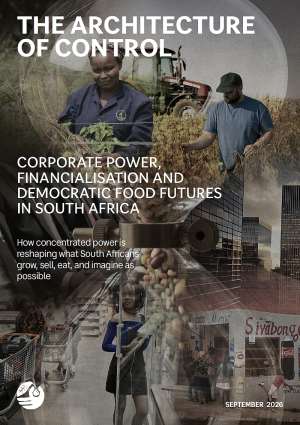
One of the biggest gaps is agriculture—but agriculture cannot be treated as only what happens on farms. South Africa’s food system is shaped by concentrated corporate power from seed to shelf: seed, fertiliser, and pesticide companies that lock farmers into costly input packages; banks and insurers that decide who can farm and on what terms; grain silos, logistics firms, processors, and retailers that control access to markets; and supermarkets that increasingly decide what food is sold, who supplies it, and at what price. This is the architecture of power in the food system. It shapes what farmers plant, how land and water are used, whose knowledge counts, whose labour is exploited, what food reaches communities, and why a country that produces enough food can still have deep hunger and unaffordable healthy diets.
This is why the NBSAP must go beyond polite references to sustainable agriculture. It must confront the industrial food model itself: monocultures that simplify landscapes; synthetic fertilisers and pesticides that damage soils, insects, water, and health; uniform commercial seed that narrows genetic diversity; livestock and feed systems tied to land degradation and emissions; and supply chains that externalise ecological and social costs onto farm workers, rural communities, consumers, and ecosystems.
Biodiversity is lost when farmers are pushed towards debt, chemical dependence, patented or uniform seed, contract farming, and buyer-controlled markets; when local and informal food systems are neglected while large retailers and processors dominate; when public breeding, extension, and seed systems are weakened; and when food is treated mainly as a commodity rather than a right.
In South Africa, many people cannot afford enough nutritious food, while the dominant food system still passes hidden costs onto exhausted soils, polluted rivers, declining pollinators, farm workers exposed to toxic chemicals, rural poverty, household hunger, diet-related illness, unpaid care work, public health systems, and the loss of seed and crop diversity.
A stronger NBSAP must recognise and support the people already protecting biodiversity through everyday work, knowledge, and care—not as a romantic add-on, but as the backbone of living food systems. This includes smallholder and family farmers who save, select, and exchange seed; women who maintain food, seed, medicinal plant, and nutrition knowledge; farm workers whose labour keeps farms running but whose health and rights are often ignored; pastoralists who manage grazing lands and animal diversity; small-scale fishing communities who defend coastal and inland waters; informal traders, street vendors, and local markets that keep diverse foods moving through communities; and community-led conservation in practice—seed banks and seed fairs, farmer field schools, community food gardens, wetland and river clean-ups, locally managed grazing systems, coastal monitoring, indigenous tree nurseries, medicinal plant gardens, school food gardens, cooperatives and seed networks that restore soils, protect water, conserve useful plants, and keep local knowledge alive. It should reduce dependence on synthetic fertilisers and pesticides, rebuild public-interest breeding and extension, protect indigenous and farmer varieties, support agroecology and territorial markets, strengthen labour and community protections, secure land and tenure rights, and shift public money away from practices that deepen corporate dependence and ecological harm.
Do not turn nature into the next market
Resource mobilisation is one of the most political parts of the NBSAP. Everyone agrees that protecting biodiversity needs money. But the real question is: what kind of money, from whom, under whose control, and for whose benefit? The global biodiversity framework calls for at least US$200 billion a year for biodiversity by 2030, and for harmful incentives and subsidies to be reduced by at least US$500 billion a year. These figures show that the finance crisis is not only about raising new funds. It is also about stopping public and private money from fuelling biodiversity destruction.
This is where the draft must be much stronger. It places too much hope in “innovative finance”, private investment, blended finance, biodiversity credits, offsets, and other market-based tools. These instruments are not neutral. They can shift control over land, water, seeds, data, and ecosystems towards corporations, banks, consultants, and conservation finance actors. They can also create the dangerous idea that destruction in one place can be made acceptable by paying for protection or restoration somewhere else.
In South Africa, with its history of racialised land dispossession and unequal access to land and water, this is especially dangerous. Biodiversity finance must not become a new form of enclosure: communities consulted but not empowered; nature measured for investors rather than protected as a commons; and people already harmed by mining, industrial agriculture, pollution, and climate shocks asked to carry new restrictions while powerful actors continue business as usual. A credible finance plan must start elsewhere: public finance, fair international finance, debt justice, transparent budgets, stronger regulation, polluter accountability, and the redirection of harmful subsidies away from fossil fuels, industrial agriculture, destructive infrastructure, and pollution-intensive activities. The test is simple: does the money repair ecosystems and shift power to the people who defend them, or does it open another door for profit-making from nature?
Real ambition means confronting power
Real ambition would not hide behind vague commitments. It would name the industries, policies and power relations driving biodiversity loss—and change them. It would put agroecology, farmer-managed seed systems, land and tenure rights, public-interest research, food sovereignty, and community-led restoration at the centre of biodiversity policy. It would protect ecosystems by protecting the people whose lives, labour, and knowledge are bound up with them. It would set clear targets, budgets, timelines, and responsibilities, so communities can hold government and business to account. And it would measure success not by how much nature can be priced, offset, or traded, but by whether ecosystems are recovering, harmful activities are being stopped, and communities have more power, security, and dignity.
The choice: life or business as usual?
South Africa is at a crossroads. The NBSAP can become another policy that speaks beautifully about biodiversity while mining, pollution, industrial agriculture, weak enforcement, market schemes, and unequal development continue to destroy the conditions for life. Or it can become a turning point: a plan that names power, shifts resources, strengthens public accountability, protects community rights, and treats biodiversity as the living basis of food, water, health, culture, and future generations.
For ACB, the choice is clear. Biodiversity is life: seed, soil, water, food, medicine, culture, memory, and future. Protecting it means more than setting targets. It means confronting the systems that destroy it, stopping public money from fuelling harm, holding polluters and powerful actors accountable, and supporting the farmers, fishers, workers, women, young people, Indigenous Peoples, local communities, and movements who defend life every day. South Africa does not need a biodiversity plan that manages decline or sells nature back to us. We need one that restores ecosystems, repairs injustice, and defends the commons.
Download the submission here.