
“I’d be the greatest communist in history”: Trump tells evangelicals
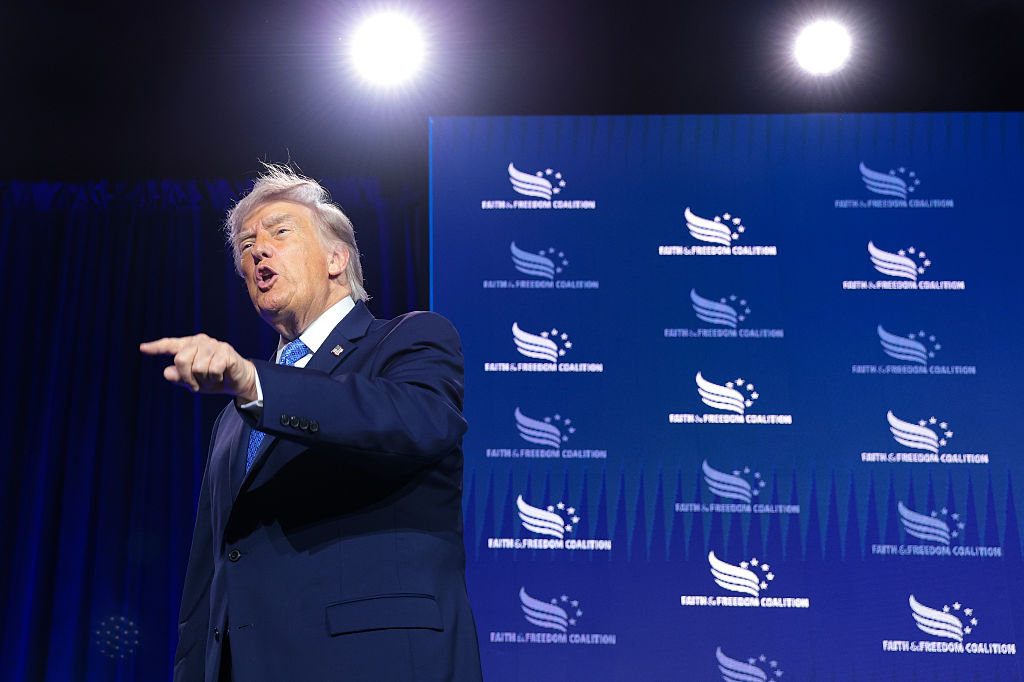
President Donald Trump told an evangelical audience this week that he would be “the greatest communist of all time,” before immediately using the remark to launch into an attack on Democrats and his interpretation of American politics.
Speaking at the Faith & Freedom Coalition conference, Trump framed “communism” not as a political or economic system, but as a set of campaign promises centered on government-provided benefits.
“I’d be the greatest communist in history,” Trump said, before describing communism as a system in which politicians promise “free rent, free houses, free food, everything is free.” He added that such systems ultimately fail, arguing they lead to economic collapse and social breakdown.
Trump previewed this topic in a Truth Social a few minutes before taking the stage.
The characterization departs from how political scientists typically define communism, which is generally understood as an ideology centered on collective ownership of the means of production and the elimination of private ownership of productive assets. Trump’s framing instead collapsed the term into a shorthand for expansive government redistribution programs.
The remarks came as part of a broader pattern of talking points in which Trump repeatedly described Democrats as “godless communists” and warned that their policies posed an existential threat to the United States. Working on some new messaging leading up to the midterms, he told the audience that the country faced “the most serious threat since its existence,” language he often uses to describe political opposition.
Trump also tied his message to religious themes throughout the speech, telling attendees that Christianity itself was under threat from political opponents. The blending of religious language and campaign rhetoric is a recurring feature of his appearances before evangelical audiences, where he has increasingly positioned himself as a defender of Christian identity in American politics.
The Faith & Freedom Coalition has long served as a key organizing hub for conservative evangelical voters, particularly in presidential and midterm election cycles. Trump’s remarks appeared aimed at reinforcing that alignment while sharpening his message ahead of the 2026 political landscape.
Start your day with essential news from Salon.
Sign up for our free morning newsletter, Crash Course.
The speech also underscored a familiar rhetorical pattern: Trump’s tendency to elevate political messaging through superlatives. Whether describing himself as the “best,” “greatest,” or in this case, the “greatest communist,” the language functions less as ideological positioning than as amplification of political contrast.
Still, the use of communism as a catch-all term for expansive government policy, combined with religious framing, placed the speech at the intersection of ideology and faith-based politics — two themes that have increasingly converged in Republican campaign messaging.
Read more
about faith and politics