
Cardoso living up to his promise 1
By Dele sobowale
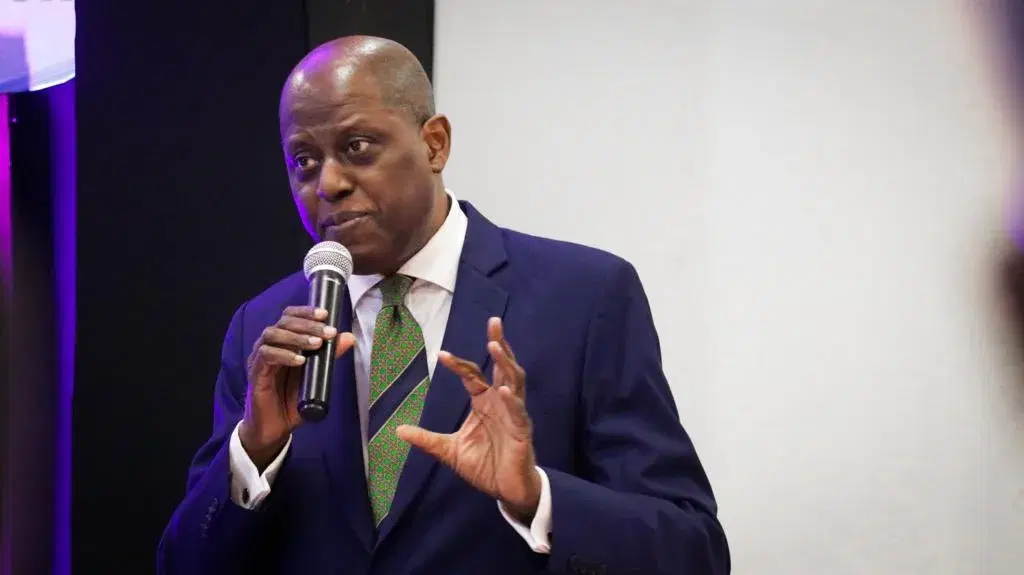
CBN Governor Yemi Cardoso, during his confirmation hearing, September 2023.
Thank God, there is one silver lining in a predominantly dark sky over Nigeria. The current Governor of the Central Bank of Nigeria, CBN, has returned the institution to its former glory. Four Governors have managed the affairs of the bank, before him, since 1999 – Joseph Sanusi, 1999-2004, Charles Soludo 2004-2009, Sanusi Lamido, 2009-2014 and Godwin Emefiele, 2014-2023. The two Sanusis, Joseph and Lamido, were thorough bred professionals. To them managing monetary policy was a sacred duty to be discharged with intelligence and integrity. There was no compromise with the Presidents they served to subvert policy. That mostly explained why they did not last longer.
Two other former Governors, Soludo and Emefiele, left the CBN and the Nigerian economy a lot worse than they found them. Nigeria is still reeling from the impacts of their individual and collective stewardship. Emefiele was reserved but Soludo was garrulous, media-focussed, hyperbolic and complacent. As the Greatest, Mohammed Ali…. had warned us: “the bigger they come, the harder they fall.” He was unraveled in just three years; after hoodwinking everybody including those who gave him Banker of the Year Award; before the roof caved in on the consolidated banks he approved to operate in January 2006.
Because character is destiny, Soludo and Emefiele’s poor performance followed two different paths. Briefly stated, this is how they went from the sublime to the ridiculous.
SOLUDO: THREE SHOTS, THREE BLANKS“It is better sometimes not to follow great reformers …beyond the threshold of their homes.” George Eliot, 1819-1880, VANGUARD BOOK OF QUOTATIONS p 210.Soludo was a great reformer; at least on paper. And, most Nigerians trooped after him. Nigeria never had a CBN Governor who was photogenic, had stage presence and a baritone voice to complete the irresistible image – unless you remember to take your thinking cap along when he was on stage. Such obvious towering intelligence! Such captivating delivery of the messages intended to obtain approval without doubt.Professor Soludo took the nation by storm when President Obasanjo, starting his second term in 2003, first appointed the brilliant economist as Chief Economic Adviser, CEA. The ambitious former academic had other things in mind; other than the sterile CEA office. Within six months, he had produced a document titled NATIONAL ECONOMIC EMPOWERMENT AND DEVELOPMENT STRATEGY, NEEDS, which was supposed to last for four years – 2003 to 2007. It was voluminous, about 385 pages long, full of graphics, beautifully packaged and promising to deliver Gross Domestic Product, GDP, growth of 6% by 2004, 7% by 2005 and about ten per cent by 2007 during the first phase. The second phase promised to sustain the GDP growth rates which would propel Nigeria to a top 20 economy by the year 2020. Everybody was entranced; because few people, including Obasanjo, read the document carefully. I did, because VANGUARD paid me to read such things before writing my columns. My verdict, which was a minority view, was simple. “It is a salad bowl of illusions, long on theory, short on practical experience and it will never be implemented.” It was never implemented. Tucked in the mountain of questionable assumptions and data was one recommendation; from which Soludo would profit immensely. There were about 73, admittedly, under-capitalised banks operating in Nigeria. They should be reduced and strengthened.“It ain’t the things that you don’t know that cause the problem; it’s the things that you think you know that ain’t so. “ Ralph Waldo Emerson, 1803-1882, VBQ p 117.
To become a top 20 economy, the nation required a few strong banks; and Prof alone knew exactly how that could be done. Obasanjo must have been persuaded. Out went Joseph Sanusi, a professional but conservative banker; in came Professor Soludo, economist, with no experience in banking whatsoever. He immediately proceeded to lecture the bankers about banking. Minimum share capital was raised to N25 billion to operate a bank in Nigeria; and seven months were the deadline to comply. All CBN Governors, even in democratic Nigeria, are dictators, invested with near absolute powers and immunity from the consequences the exercise of power induces. Attempts to get Soludo to extend the time were derisively dismissed. The suggestion to create two or three categories of banks – those with N25 billion and those with less – were rejected with contempt. Thus began the race for the greatest capital acquisition in Nigerian history. Winners were announced in January 2006; and a self-congratulatory Governor announced to Nigerians that “Nigerians can now keep their money in banks and go to sleep with their two eyes closed”. For two years, 2006 and 2007, consolidation appeared like the work of a genius. Soludo collected every banking award available globally – until the banking crisis of 2008 which caught the world by surprise. Those of us who had misgivings about the unsafe speed of consolidation were the first to raise alarms about Nigerian banks. Soludo responded with assurances that Nigerian banks were insulated from the global contagion. It was false and the repercussions were soon felt nationwide. By August 2008, sleeping with two eyes closed turned to nightmares for shareholders and depositors. Consolidation was crumbling faster than the CBN could rescue the banks – which had all been mismanaged in various ways.By early 2009, Soludo, like a magician who lost his bag of tricks, was desperate to save his imperiled legacy. His tenure was drawing to a close; with failure staring at him in the mirror. He sought to be re-appointed by President Yar’Adua. Two inextricably linked measures were introduced – decimalization of currency and Financial System Strategy, FSS, 2020. The first initiative, aimed at controlling galloping inflation, entailed reducing the face value of existing currency notes, N1000, N500, N200 and N100 would change to N100, N50, N20 and N10 respectively. All other currencies were to be coined and also decimated appropriately. The new notes and coins were already ordered and were being actively promoted before someone remembered to seek the President’s permission for all the changes involved. One change, which ultimately torpedoed the scheme, and which was ignored in Soludo’s theories, was the status demotion Nigeria’s rich and wealthy people would suffer. Billionaires would become millionaires and millionaires would fall into “thousandnaires” (I just made that up). A volcanic eruption followed – for which the Governor was ill-prepared. The idea fell flat.
Resourcefulness, at least in coming up with novel schemes, was one of Soludo’s strongest attributes. Led by the Minister of Finance, Dr Shamsudeen Usman, a few die-hard economists, had revived the moribund VISION 2020; promising to propel Nigeria to the top 20 rank. Seeking their support, Soludo launched the Financial System Strategy, FSS, 2020, which would make Nigeria the financial hub by 2020; when Nigeria would have become top 20. History would record that none of the dreams turned to reality. Soludo was removed in 2009 and Sanusi Lamido inherited a monumental mess. LAMIDO INHERITS BANKING SECTOR ON BRINK OF COLLAPSE..To be continued …Follow me on Facebook @ J Israel Biola