
VAR review: Liverpool anger justified in no red card for Man City?
Video assistant referee causes controversy every week in the Premier League, but how are decisions made and are they correct?
This season, we take a look at the major incidents to examine and explain the process both in terms of VAR protocol and the Laws of the Game.
Screenshot credit: NBC
 Andy Davies (@andydaviesref) is a former Select Group referee, with over 12 seasons on the elite list, working across the Premier League and Championship. With extensive experience at the elite level, he has operated within the VAR space in the Premier League and offers a unique insight into the processes, rationale and protocols that are delivered on a Premier League matchday.
Referee: Craig Pawson
VAR: John Brooks
This was a thriller that saw Liverpool take the lead, only for Man City to score two answered goals to complete a 2-1 comeback. The win for Man City changed the dynamic of the Premier League title race, while the loss for Liverpool marked a setback in their bid to qualify for the Champions League.
Suffice to say, this was a huge match with high stakes, and a number of penalty calls and non-calls had a major impact on how the game played out. There were three key incidents where the referee and VAR had to make big calls, so let’s review them all …
Time: 68th minute
Incident: A possible red card to Man City’s Marc Guéhi for DOGSO (denial of a goalscoring opportunity)
What happened: Mohamed Salah was played in by teammate Dominik Szoboszlai beyond the Manchester City back line, and Guéhi pulled Salah to the ground as he advanced on goal. Referee Pawson awarded a free kick and issued a yellow card to Guéhi. Liverpool shouted for a red card, but the VAR agreed with the call on the field.
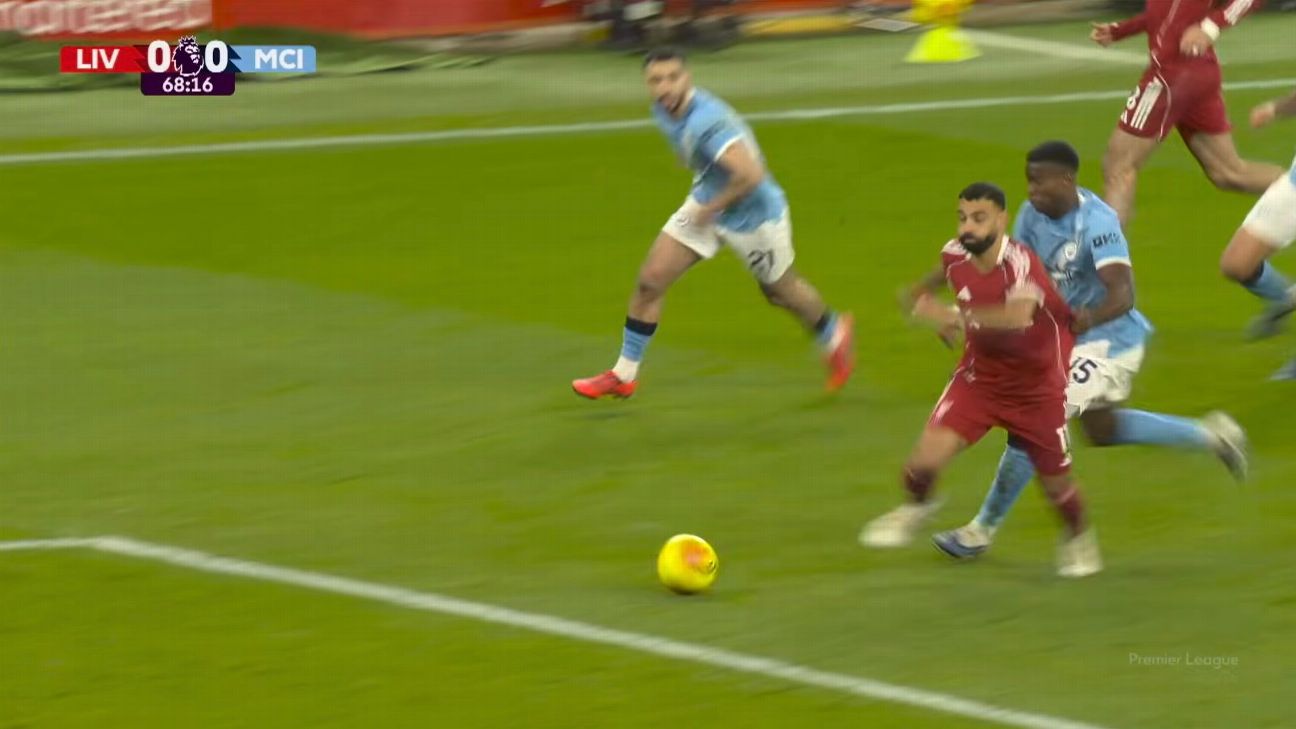
VAR decision: The referee’s call of a free kick and yellow card to Guéhi for the challenge on Salah was checked and confirmed by VAR. As the challenge came outside of the penalty area, they deemed it not to be DOGSO as there was a covering defender.
VAR review: The on-field decision and their descriptive rationale would have been the foundation of this review. For any possible overturn in this situation, the VAR would have to have absolute evidence that the holding offence denied an obvious goalscoring opportunity as opposed to a probable one. The angle that Salah was travelling and the positioning of the City defender created a level of doubt for the VAR and therefore the on-field decision was checked and cleared.
Verdict: When you analyse the details of this situation, it’s marginal and I’m confident this should be a “ref’s call” as it was on the day.
Two key considerations for the on-field officiating team that would have created an element of doubt are Salah’s ability to shoot instantly if the hold had not occurred, along with the position of the covering defender.
In a DOGSO situation when the outcome is not a clear cut, the refereeing team will have a gut feel about what the decision should be — this moment was no different.
The outcome could’ve gone either way, but VAR was correct not to intervene in this decision.
Time: 90th+1 minute
Incident: A penalty kick is awarded to Manchester City
What happened: Man City’s Matheus Nunes was clattered by Liverpool goalkeeper Alisson Becker after Nunes clipped the ball over the advancing keeper.
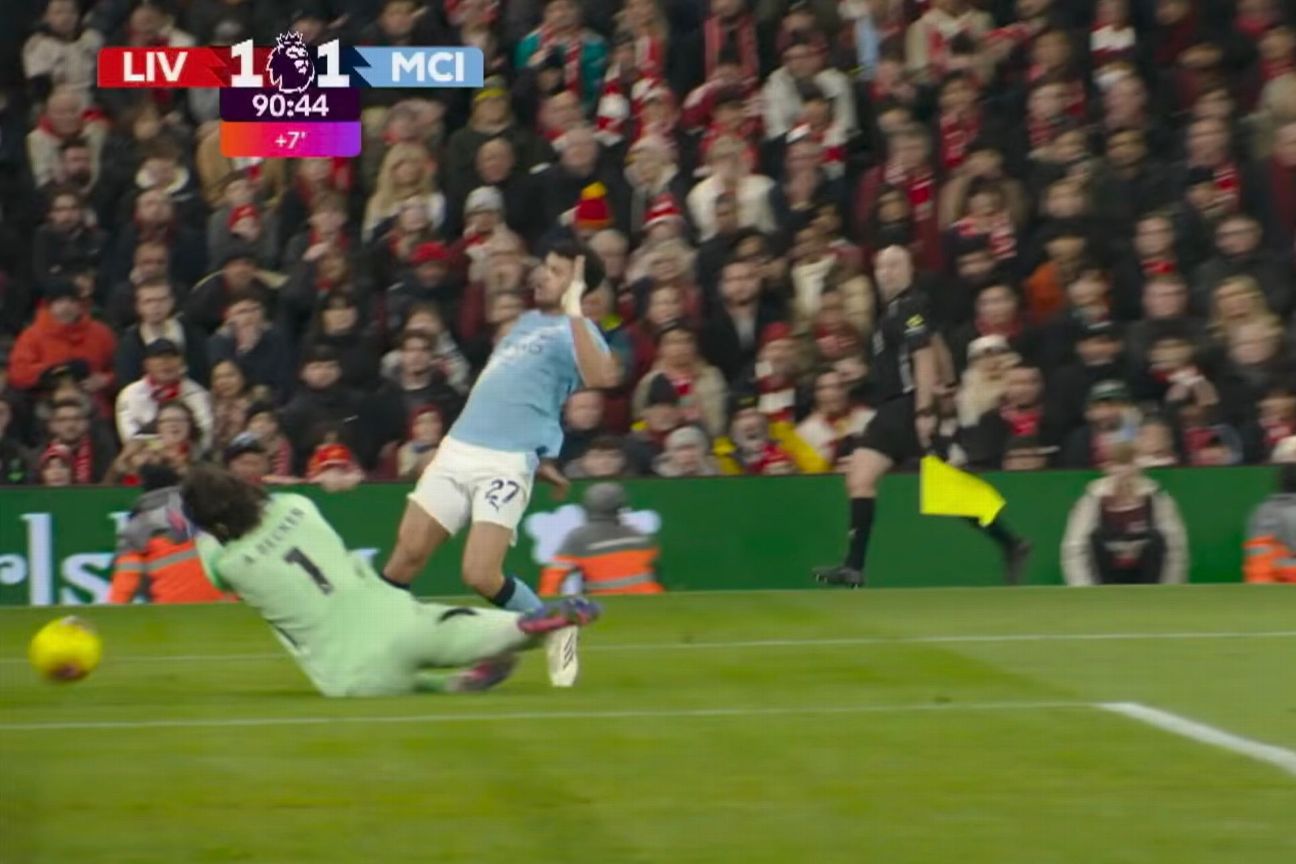
VAR decision: The referee’s call of penalty was checked and confirmed by VAR, with Alisson deemed to have not played the ball and made heavy contact on Nunes.
VAR review: This was a straightforward check for John Brooks, the video assistant referee. The on-field communication between referee Pawson and his assistant would have explained exactly what the replays showed and therefore it was a simple check complete. The only element that required confirmation by Brooks was to ensure that the ball was still in play when contact was made by Alisson on Nunes.
Verdict: It was the correct decision by the referee to award a penalty to Man City after Alisson clattered into Nunes. Alisson was late, made no contact on the ball and a penalty was the correct and expected outcome.
Time: 90th+10 minute
Incident: VAR intervened to disallow a Man City goal and send off Liverpool defender Dominik Szoboszlai for DOGSO.
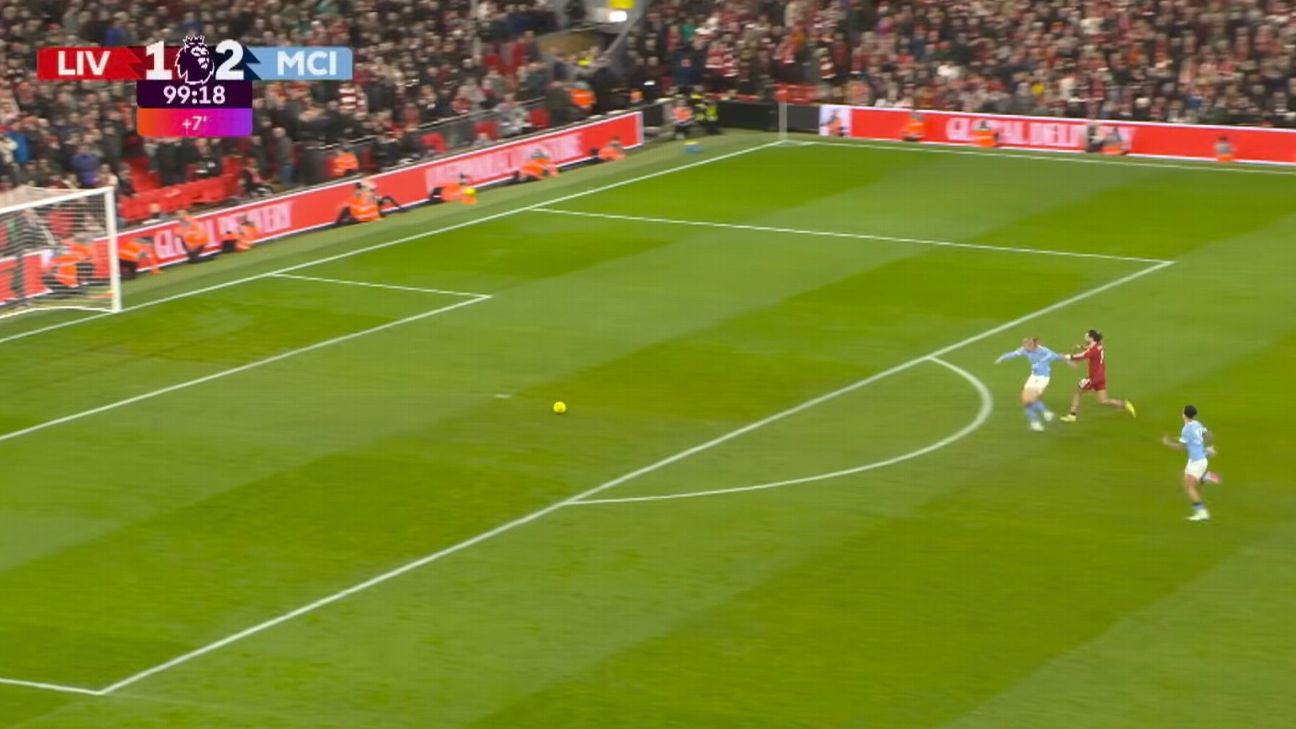
What happened: With Liverpool’s goalkeeper upfield and chasing a late equaliser, Manchester City attacker Rayan Cherki struck the ball towards an empty net. Man City’s Erling Haaland and Liverpool’s Szoboszlai competed in a one-on-one foot race to the ball, a race Haaland looked certain to win.
The City striker had outpaced Szoboszlai while entering the final attacking third when he was pulled back by the Liverpool defender, a clear illegal act to stop Haaland from retrieving the loose ball.
The foul was obvious and recognised by referee Pawson – however, the referee allowed the game to play on as the ball was about to enter the goal regardless of any offence.
With the ball rolling towards an empty net, the now advanced Liverpool defender attempted to slide in and clear the ball, however, before Szoboszlai could do so, Haaland in-turn pulled him back, stopping Szoboszlai from playing the ball and the ball trickled into the empty net.
Referee Pawson awarded the goal scored by Man City.
VAR decision: After VAR review, the referee overturned the original decision of goal to Manchester City.
Here is then referee’s exact announcement: “After review, there is a careless foul by Erling Haaland that pulls the shirt of Dominic Szoboszlai. Prior to that, Szoboszlai commits a holding offence that denies an obvious goal scoring opportunity. The final decision is a direct free kick to Manchester City and a red card.”
VAR review: VAR John Brooks would have known quickly that this was going to be a complex review given the circumstances that occurred.
Each of the two holding offences would have been broken down individually by Brooks with the on-field rationale to ultimately award the goal by the on-field team, applied against the factual replay.
The holding offence by Haaland was the starting point, as a goal cannot be allowed to stand after a such clear foul has been committed by an attacker — so an on-field review was to be recommended for the City goal to be disallowed for a clear foul.
Secondly, once the goal had been disallowed by the referee at the screen, the VAR would show Pawson replays of the clear holding offence by Szoboszlai, which denied Haaland an obvious goal scoring opportunity, recommending a red card for the Liverpool defender.
The sequence of events were packaged up for Pawson to review once at the screen and, having considered the information and replays offered by the VAR, Pawson agreed with Brooks, correctly disallowing the goal and sending the Liverpool player off.
Verdict: This is a unique situation and one that football fans won’t necessarily like or understand. However, the laws of the game left the VAR and ultimately the referee with no other options.
The pull by Haaland, denying Szoboszlai the chance to clear the ball, has to be penalised and this naturally leads to the original offence being considered and a red card, correctly given to the Liverpool defender.
This would have undoubtedly been a difficult situation for both the VAR and referee to find themselves, as the fallout post-match would have been obvious to them at the moment. However, to ignore law in favour of the most acceptable and understandable outcome in such a complex situation with Man City already winning the game was not an option and, who knows, that goal may be all important come the end of the season.