
Why Pulisic might be in the midst of his best season as a pro — and why it might not last
-

Ryan O’Hanlon
If you’re trying to find any silver lining from the U.S. men’s national team captain picking up his second muscle injury of the season just seven months shy of the World Cup, I’ve got you covered.
The site FBref calculates a number of basic and advanced stats for Europe’s Big Five leagues and beyond. To qualify for any of their leaderboards for minutes-adjusted numbers, a player needs to have featured in at least a third of his team’s minutes. And although he already has sat out five games for AC Milan after tearing his hamstring in a friendly against Australia, Christian Pulisic still qualifies for all the leaderboards.
So, even though he didn’t play in AC Milan’s 1-0 win over Lazio on Saturday, the injury allowed Pulisic to maintain his place atop a hierarchy that only a handful of people with very specific occupations and/or very specific web-browsing habits are even aware of. He’s currently averaging 1.5 non-penalty goals+assists per 90 minutes. That’s better than Erling Haaland, Lamine Yamal, Harry Kane, Kylian Mbappé, and everyone else.
Among all players across the Big Five leagues who have featured in at least a third of their team’s minutes, Pulisic has been the most productive attacker.
Last year, USMNT manager Mauricio Pochettino raised some eyebrows when he hailed Pulisic as “one of the best offensive players in the world.” And while the 27-year-old is unlikely to keep producing stats like peak Lionel Messi for the rest of the season, if he can bounce back from this new injury fast enough, then Pulisic will be on track to do the thing that most USMNT fans have been dreaming about since he burst onto the scene as a teenager.
The best American soccer player we’ve ever seen might be having the best season of his career — right before the United States hosts the 2026 World Cup.
– Predicting the USMNT’s starting lineup at the World Cup
– USMNT 2026 World Cup Big Board 3.0: Who’s back?
– Why Liverpool are struggling to repeat as Premier League champs
Why Pulisic won’t keep this up
But first, we must pump the brakes.
From a raw-total perspective, Pulisic isn’t close to Mbappe, or Haaland, or Kane, or even Yamal. He has scored five non-penalty goals and assisted on two others. Fifteen-plus players have more non-penalty goals, and over 100 have more assists.
Haaland leads the way with 14 non-penalty goals, and Mbappe and Kane are second with 10. Yamal, meanwhile, is pacing the chance-creation pack with seven assists.
Of course, they’ve all done it in way more minutes: Mbappe and Haaland are north of 1,000, Kane is just 27 minutes away from that mark, and Yamal has 188 left to go. Mostly because of his injuries, Pulisic has played only 421, featured in eight total Serie A matches, and made only five starts. He has played 90 minutes in only one league match, and that obviously helps to inflate your per-90-minute production.
Against Udinese, Pulisic scored twice and notched an assist but was substituted after 62 minutes. That makes his numbers look better than if he played the full 90 without scoring or assisting again. More minutes could also mean more goals and assists, but across all sports, almost every player gets less efficient the more time they spend on the field.
And then there’s the randomness of the ball being kicked into the goal. Pulisic’s assists are almost exactly in line with the quality of the chances he has created: two from 1.9 expected goals assisted. But he’s currently scoring goals at a rate of more than twice his expectation: five goals from 2.2 expected.
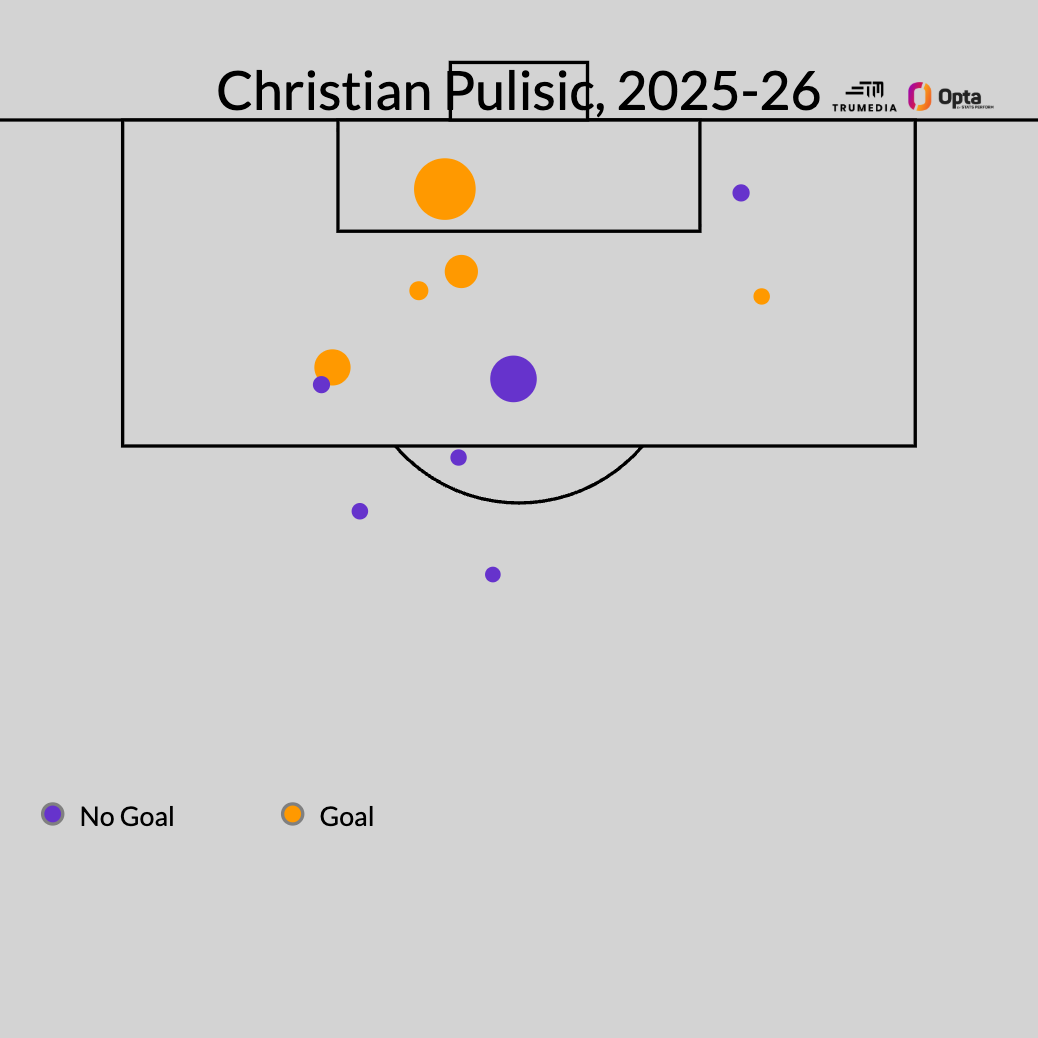
Across his nine professional seasons, Pulisic has been an average finisher for an attacker. Per FBref, he has scored 53 goals from 50.9 xG (expected goals) since the 2017-18 season. Since xG models are built around shots from all players, including defenders and midfielders who don’t score goals for a living, a slightly-better-than-expected conversion rate is considered average for an attacker.
So, we can definitely expect Pulisic to slow down in front of goal. While he has produced goals and assists at a rate of 1.5 per 90 minutes, his expected rate is just a little over half of that. Through the first 3½ months of the season, he’s averaging 0.86 non-penalty expected goals and assists per 90 minutes.
Why Pulisic might still be in the middle of a career year
OK, now let’s rev the engine.
That mark of 0.86 non-penalty expected goals and assists? It would easily be the highest of Pulisic’s career. Last season, only seven qualified players reached that mark across the Big Five leagues. And this season, only eight are there — one of which, of course, is Pulisic. If we assume he finishes his chances at a slightly-above-average rate, then we could project him to finish the season around 0.9 non-penalty goals+assists per 90 minutes — a genuinely elite level of output.
For that to happen, though, he has to actually play.
Since the 2017-18 season, he has averaged 12.5 games missed for club and country because of injury, per Transfermarkt data. But since moving to Italy, he sat out only 14 games total across his first two seasons: six in 2023-24 and eight in 2024-25. He never sat out fewer than 13 in any of his four seasons while playing in the Premier League. Some of that is a slower pace of play in Italy, some of that is Pulisic becoming smarter and drawing less contact than when he was younger, and some of it is random.
This year, he’s already missed five matches. If we take his career average, we’d expect him to sit out round eight more games over the rest of the season. If we take his Milan average, we’d expect him to sit out about four more. As always, the most likely outcome is probably somewhere between the two.
But if he’s on the field for the rest of the season, what could still cause him to slow down?
Pulisic’s superpower has always been his ability to get on the ball inside of the box despite playing on the wing. Outside of his first season in Milan and his last season with Chelsea, he has never averaged fewer than 0.14 xG per shot. (The league average in Serie A is 0.09.) Last season, he attempted 1.9 shots per game — his lowest since leaving the Bundesliga — but he offset that drop in attempts by averaging 0.17 xG per shot.
This season, he has added nearly an extra half-shot per game — up to a per-90 rate of 2.4, which would be the second most of his career, after his first season with Chelsea. Not only that, he also has managed to improve his shot quality, up to 0.20 xG/shot.
That kind of per-shot quality is typically reserved for penalty-box strikers such as Pierre-Emerick Aubameyang and Robert Lewandowski, so I can’t imagine Pulisic will stay all the way up there. One huge chance, like the goal he scored against Inter Milan, can massively influence these numbers this early in the season. But the main way for Pulisic to improve on last season was to start taking more shots, and he has been able to do that so far without having to rip a bunch of no-hopers from long range.
Beyond the goalscoring, just about everything else also has improved. His expected assists are higher than ever, and that’s accompanied by three chances created per game, which would easily be the highest mark of his career. He’s already completed more through balls than he did in his entire first season in Italy.
Pulisic is putting over two passes into the penalty area per 90 for the first time in his career, and his 4.98 progressive passes per 90 would also be a career best. He’s attempting more than five take-ons for the first time in six years, and he’s over six touches inside the box per 90 for the first time in seven years.
Though I do think we have a tendency to discount how often players simply just play better without there being any kind of structural or systemic explanations, that’s not the case here. Despite playing for the notoriously defensive Massimiliano Allegri, his fourth manager in three seasons, Pulisic has not been asked to work too hard without the ball this season.
Gradient Sport tracks a number of physical metrics, including high-speed runs (between 20 and 25 kph) and sprints (above 25 mph). Per this data, Pulisic’s output per 90 minutes in possession isn’t drastically different from last season to this season. But here’s how it looks for every 90 minutes when Milan are out of possession:
2024-25: 108 high-speed runs, 19 sprints
2025-26: 76 high-speed runs, 10 sprints
On top of that, Pulisic has spent much more time on his preferred side of the field under Allegri — able to cut inside onto his right foot from the left.
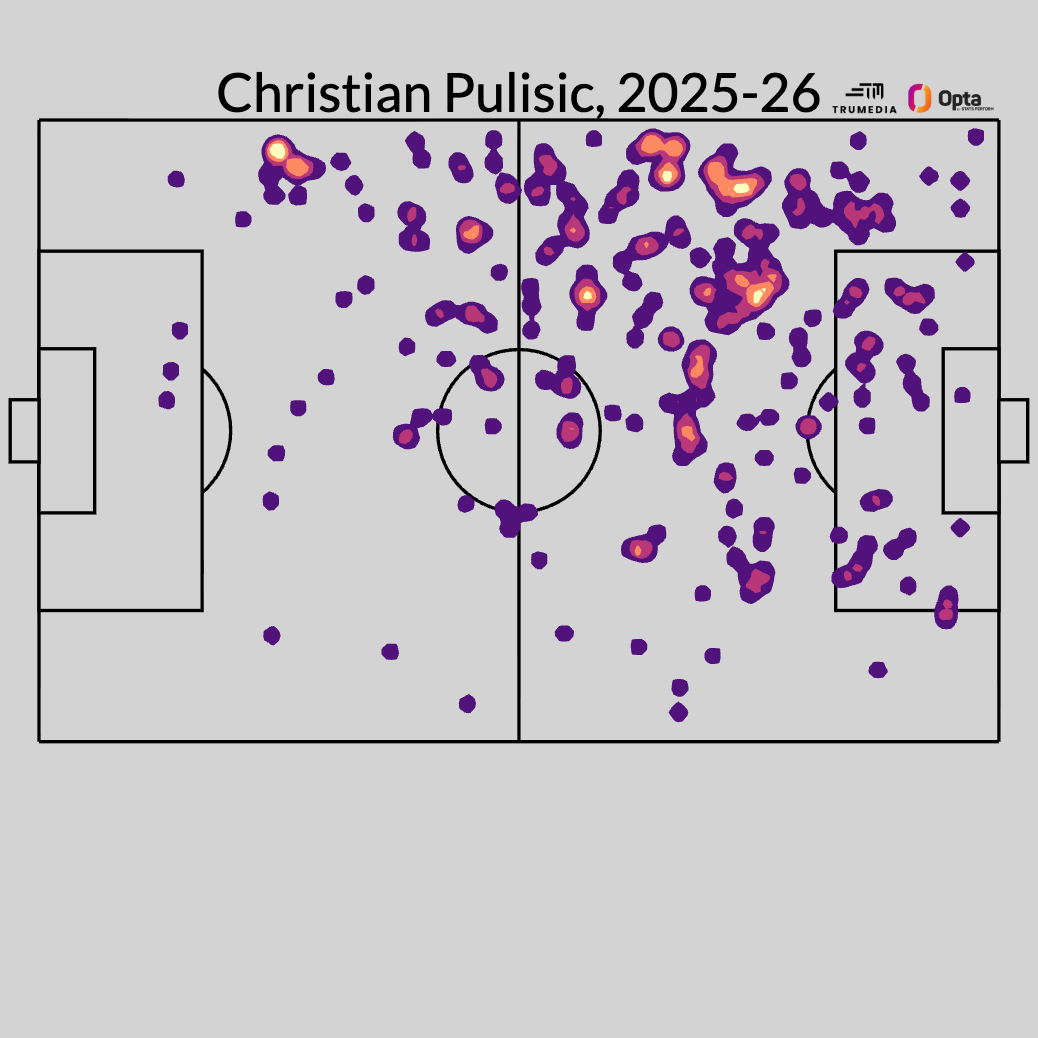
Last season, most of his touches came either centrally or out on the right:
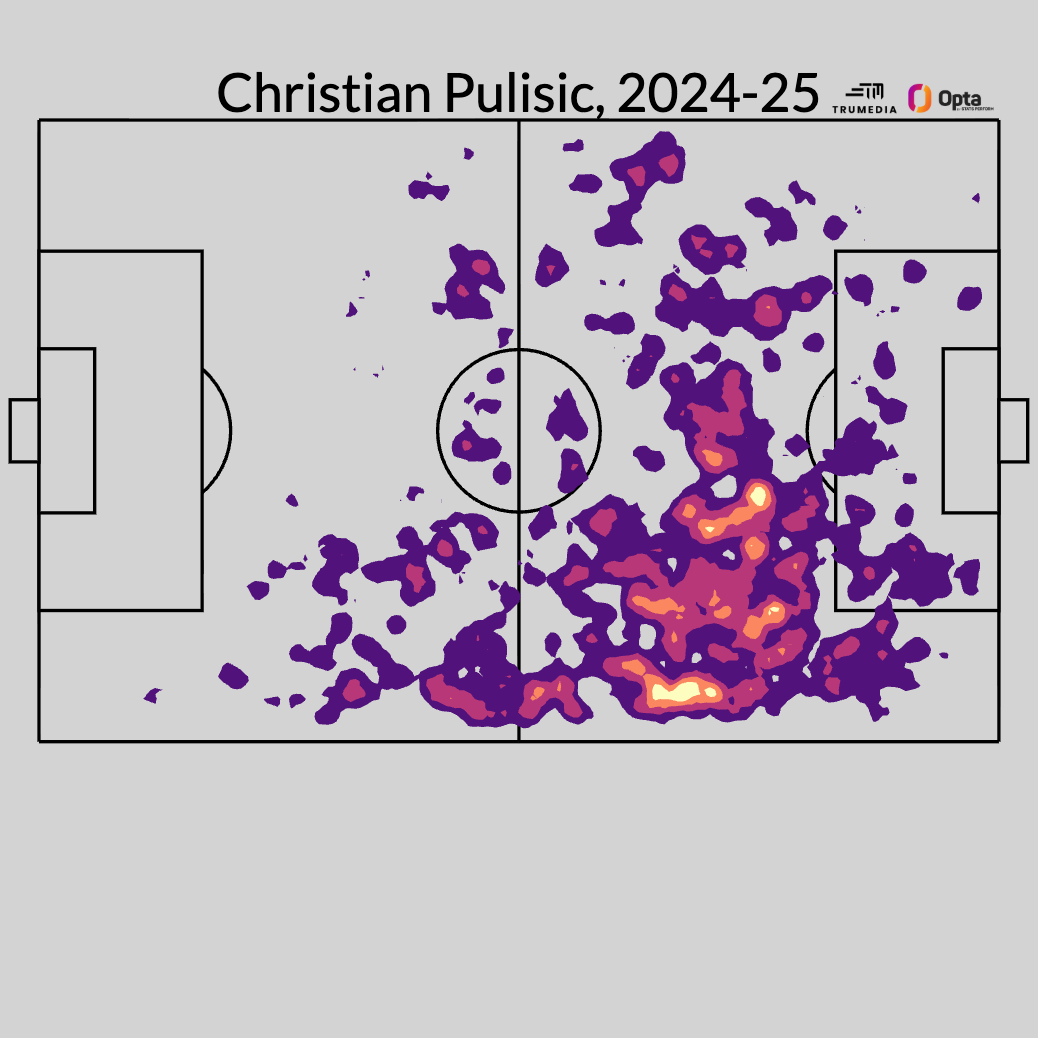
Now, we’re only talking about five total starts here. He has attempted only 11 shots. And he has generated only 14 shots for his teammates. Players have a couple of hot months all the time, and although it’s November, this is still only about a month’s worth of minutes. You don’t have to be a world-class player to put up world-class numbers over five starts.
But it’s not as if Pulisic has come out of nowhere, either. Since the start of the 2023-24 season, only Inter Milan’s Lautaro Martínez has more non-penalty goals+assists in Serie A, and only Martinez and teammate Marcus Thuram, Pulisic’s teammate Rafael Leão, and Atalanta’s Ademola Lookman have more expected goals+assists over that stretch.
It’s not inconceivable that someone such as Pulisic could maintain this level of play for a full season. Players in their primes have career seasons in which production suddenly spikes all of the time, and Pulisic is already in the second half of his peak years.
We still need to see a lot more to say that this is real, but if Pulisic were going to have a superstar attacking season at 27, it would look a lot like what we’ve seen so far: conserving his energy when his team doesn’t have possession, and then running into the box, from left to right, over and over and over again.