
Trump wants to punish media for his unpopular war
Donald Trump’s war of choice in Iran is increasingly looking like a political disaster, even as, according to some reports, 80% of Iran’s capacity to strike Israel has been eliminated. Yet the response by multiple officials in recent days suggests an administration in panic. The tell is always in the threat.
After Kristi Noem got the unceremonious boot as homeland security secretary earlier this month, the remaining sycophants in the administration are scrambling to stay in the good graces of an increasingly volatile and deeply insecure president. When policies fail and public support craters, authoritarian regimes inevitably seek a scapegoat.
In recent days, the entire apparatus of the federal government has been weaponized against reporters, transforming a political grievance into a chilling, coordinated assault on the First Amendment.
For the MAGA movement, blasting the free press is the surest way to Trump’s heart. In recent days, the entire apparatus of the federal government has been weaponized against reporters, transforming a political grievance into a chilling, coordinated assault on the First Amendment.
Over the weekend, Trump took to Truth Social to accuse news organizations of “treason” — a crime that can carry the death penalty — for allegedly spreading Iranian disinformation about the war. The supposed offense? Reporting on claims circulating online that a U.S. aircraft carrier had been destroyed in an Iranian attack. Trump insisted the story was fake and said outlets that spread it should face prosecution for treason.
There was just one problem: As CNN’s Daniel Dale noted, there is little evidence that any major American news organization actually reported on the artificial intelligence-generated video Trump was raging about. The president’s threat was based on a phantom grievance. But his threat is very real.
Federal Communications Commission Chairman Brendan Carr, an avowed partisan ally of the president, quickly joined the intimidation campaign. After Trump complained about coverage of the Iran war, Carr, who dined with him at Mar-a-Lago over the weekend, warned broadcasters that stations airing what he called “hoaxes and news distortions” might lose their licenses when renewal time comes. “Broadcasters must operate in the public interest,” he wrote on X. “They will lose their licenses if they do not.” Trump, predictably, was “thrilled” to see Carr “looking at the licenses of some of these Corrupt and Highly Unpatriotic ‘News’ Organizations.”
Put those statements together with Trump’s charges of treason and the message from MAGA to the media becomes unmistakable: Cheer the war or lose your license — and maybe your life.
The president is waging not one but two wars. There is his unpopular war against Iran, and now there is his coordinated campaign of intimidation, taken from the authoritarian playbook, against every journalist, anchor and outlet that refuses to become a state mouthpiece. The administration’s behavior is clear. They do not simply argue with journalists. They bully them — and to criminalize dissent. They use the power of the state to intimidate reporters and pressure media organizations into repeating official propaganda.
Carr’s threat is a grotesque distortion of the FCC’s mandate. He has made similar overtures before, and after pressuring ABC to briefly pull Jimmy Kimmel off the air in September and expand the equal-time rule to cover late-night comedy in February, he has obviously come to relish the role of enforcement czar. While the FCC does have real regulatory authority over broadcast licenses, its mandate is not a blank check to punish speech the president dislikes. The First Amendment and decades of precedent constrain executive agencies. Still, the mere invocation of license revocation has a powerful chilling effect.
Carr attempted to justify this authoritarian overreach by claiming that changing course would be a “savvy business decision,” citing a cynical manipulation of trust metrics. He claimed that trust in legacy media has fallen to 9% — a distortion of a 2020 Gallup poll showing 9% have a “great deal” of trust, conveniently ignoring the 31% who have a “fair amount.”
“When a political candidate is able to win a landslide election victory in the face of hoaxes and distortions, there is something very wrong,” he said. “It means the public has lost faith and confidence in the media. And we can’t allow that to happen. Time for change!”
Want more sharp takes on politics? Sign up for our free newsletter, Standing Room Only, written by Amanda Marcotte, now also a weekly show on YouTube or wherever you get your podcasts.
This desperate need to manufacture consent is borne out of a sheer panic gripping the administration. Because the truth is that Trump’s war with Iran is not popular with the American people.
A recent NPR/PBS/Marist poll found that 56% of Americans oppose U.S. military action in Iran, while only 44% support it. Just 36% approve of Trump’s handling of the conflict — worse than his own numbers during the 2020 confrontation with Tehran, when 42% approved. Other surveys paint an even darker picture for the administration. A Reuters/Ipsos poll found that 43% of Americans disapprove of the strikes against Iran while only 27% approve.
No president in modern polling history has launched a major military operation with the public already against him, as pollster G. Elliot Morris has noted. After 9/11, 90% of Americans backed the Afghanistan intervention. The Gulf War drew nearly 80% support. Even Trump’s own 2017 Syria strikes polled at 50% approval. But now, every major nonpartisan poll conducted since the strikes began shows that more Americans oppose the military action than support it.
That political reality matters because the central demand coming from this administration to the press is not that reporters tell the truth. They are being pressured to tell a particular story of Iranian weakness and American dominance — a tidy narrative of success that masks confusion, missteps and cost. When the press refuses to flatten the facts into such scripted cheerleading, the response from the administration has been predictable. Bluster from the top, regulatory bullying through the FCC and public threats to punish outlets that fail to fall in line.
Even Republican Sen. Ron Johnson of Wisconsin pushed back on MAGA’s attacks. Appearing on Fox News over the weekend, Johnson said he was “in big support of the First Amendment” and that he did not “like the heavy hand of government, no matter who’s wielding it.”
At Pentagon briefings and White House media scrums since the war started, officials have openly complained about headlines and pushed for alternative frames.
At Pentagon briefings and White House media scrums since the war started, officials have openly complained about headlines and pushed for alternative frames. On Monday, Vice President JD Vance accused a journalist of trying to create divisions within the administration. White House press secretary Karoline Leavitt has scolded reporters who ask basic questions about the war’s justification or objectives. Defense Secretary Pete Hegseth has openly berated reporters during Pentagon briefings for using headlines the administration dislikes. During one briefing last week, he complained about news banners describing the conflict as a “widening war.” That framing, he insisted, was wrong. The press should use headlines like “Iran increasingly desperate” or “Iran shrinking,” he suggested — language that might as well have been lifted from a propaganda ministry.
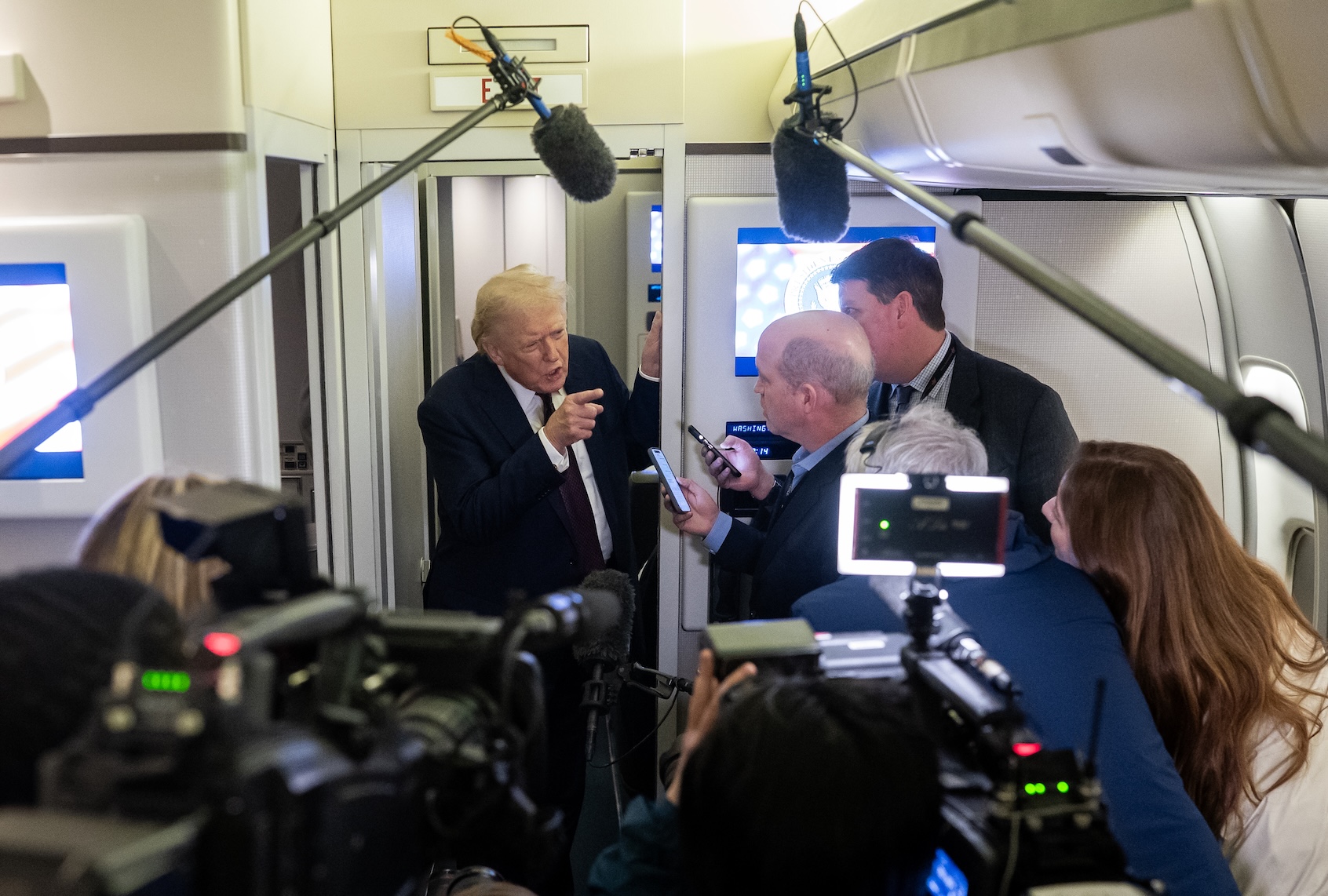
The hostility was recently on full display during a disturbing 20-minute press huddle aboard Air Force One. The president lashed out at a reporter who dared to ask a basic logistical question: why the United States was sending 5,000 marines and sailors to the Middle East amid this ongoing, widening conflict. Trump snapped at her, branding her a “very obnoxious person.” He went on to attack another reporter who asked him to comment on a controversial campaign fundraising email that featured a photo from the dignified transfer ceremony of six U.S. service members killed in his Iran war.
Upon discovering the reporter worked for ABC News, Trump exploded, calling the network “one of the worst, most fake, most corrupt.” When the reporter pressed him, asking, “Will you comment on the dead soldiers?” Trump callously replied, “You know what, ABC News, I think it’s maybe the most corrupt news organizations on the planet. I think they’re terrible.” He ended the exchange by holding a finger to his lip and hissing, “Shhhh!”
The commander-in-chief silenced a question about dead American troops to instead stroke his own bruised ego.
Those dead Americans — which now number 13 — are the answer to the question of why this crackdown is happening now. The Pentagon has estimated the cost of the war at around $1 billion per day. Meanwhile, about seven in ten registered voters are worried that the war will cause oil and gasoline prices to rise and the vast majority expect the conflict to last months or longer.
Historically, the American government’s relationship with the press during wartime has always been fraught. But we have crossed a dark, new threshold. During the Vietnam War, the embedded news media was allowed to report from the front lines. The television networks broadcast the brutal reality of the conflict into American living rooms. Although the military lost no major conventional battle in Vietnam, it lost the war at home because the public saw the truth, and the narratives of each subsequent conflict have been tightly controlled and molded by each successive administration.
But the Trump administration is going one terrifying step further. It is not merely attempting to shape the war’s narrative; it is actively injecting state-sponsored propaganda, floating fake video clips and threatening the fundamental existence of independent broadcasters who refuse to comply.
Read more
about this topic