
Jesse Jackson, civil rights icon, dead at 84
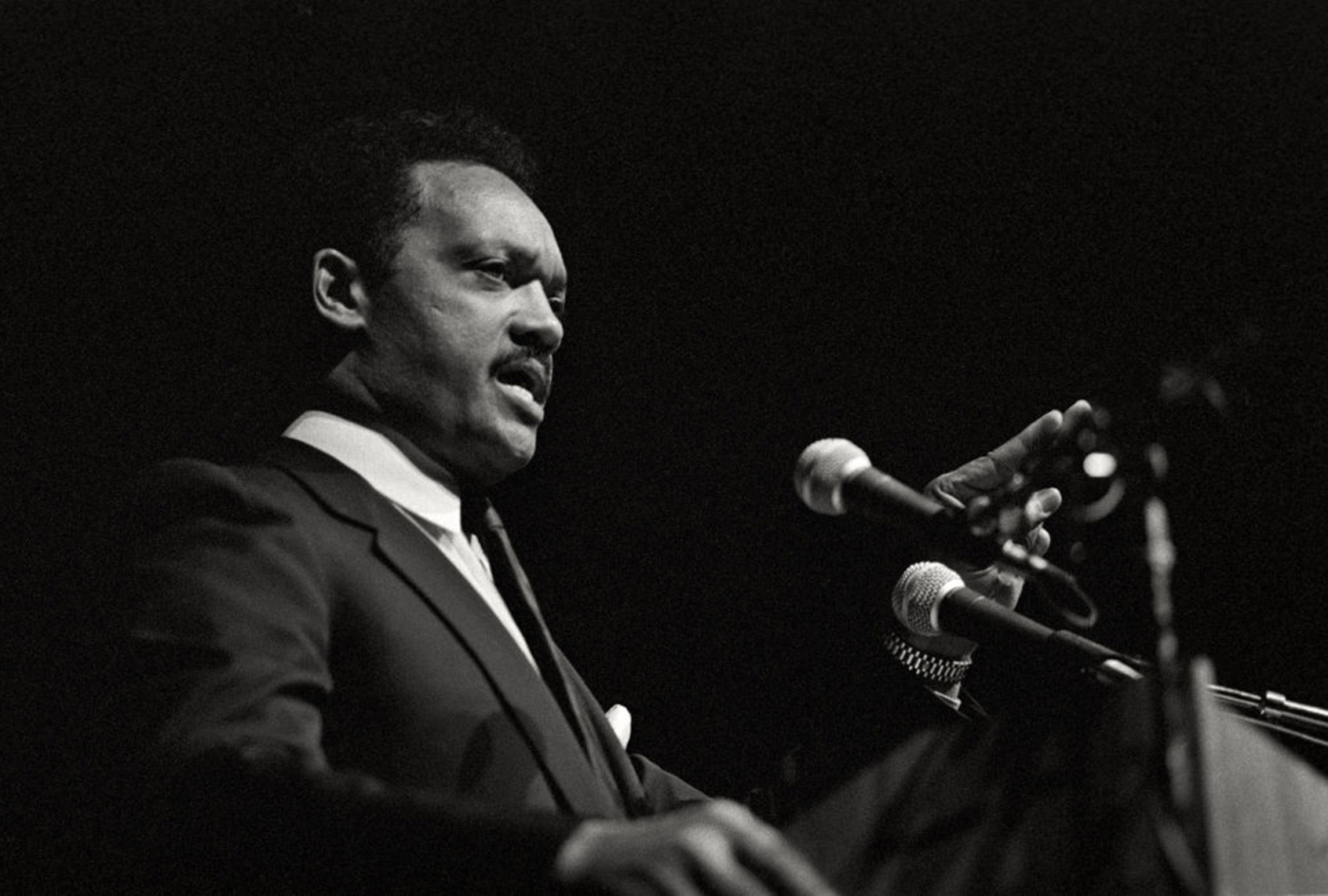
Rev. Jesse Jackson, a prominent civil rights activist, ordained minister and the first Black American to receive significant traction in a campaign for president, died Tuesday at 84.
Jackson was hospitalized in November with progressive supranuclear palsy, a rare and severe neurodegenerative condition. The condition was initially diagnosed as Parkinson’s disease in 2017. A statement from Jackson’s family says he “died peacefully” Tuesday morning.
Jackson was an impassioned orator — from an improvised speech that introduced him to Rev. Martin Luther King Jr. outside a church in Selma, Alabama to his historic 1984 speech at the Democratic National Convention in San Francisco. His poem “I Am — Somebody” became a rally cry that spread across the country from protests to Sesame Street, empowering adults and children across all social lines.
He ran for president in 1984 and founded the Rainbow Coalition, an advocacy organization that promoted the collaboration of marginalized groups. He received over 3 million votes in the Democratic primary, landing third in the contest behind Sen. Gary Hart of Colorado and the nominee Walter F. Mondale. He ran again in 1988 with more success, but lost the nomination to Massachusetts Gov. Michael Dukakis.
Though both his presidential runs were unsuccessful, it was the farthest a Black candidate made it on a national ballot prior to President Barack Obama’s historic 2008 election. Where Jackson really left his mark was at the Democratic National Convention, delivering the “Rainbow Coalition” speech that shaped the soul of the Democratic party for decades to come.
“America is not like a blanket — one piece of unbroken cloth, the same color, the same texture, the same size. America is more like a quilt: many patches, many pieces, many colors, many sizes, all woven and held together by a common thread,” he said. “We must leave racial battle ground and come to economic common ground and moral higher ground. America, our time has come. We come from disgrace to amazing grace.”
Jackson was born in Greenville, South Carolina in 1941 to a single, teenage mother Helen Burns. His father, Noah Robinson, was Burns’ married neighbor and prominent community member. Eventually, Burns married Charles Jackson who adopted Jesse. He was successful in high school, becoming the starting quarterback, class and student body president.
“We must leave racial battle ground and come to economic common ground and moral higher ground.”
Jackson attended University of Illinois on sports scholarship, but left after one year and finished his degree in sociology from North Carolina Agricultural and Technical College (now North Carolina A&T State University.) During his time in Greensboro, North Carolina, Jackson met his wife, Jacqueline Jackson, led student protests and began his involvement with the civil rights movement.
Following his graduation in 1964, Jackson attended the Chicago Theological Seminary for two years. He left before completing seminary, joining the civil rights movement full time. He eventually got ordained by a local Chicago church in 1968.
Jackson met King in Selma, Alabama and impressed him — earning him a spot as a Southern Christian Leadership Conference (SCLC) organizer in Chicago. Soon after, King appointed him as the national director of Operation Breadbasket, an SCLC program that pushed businesses to hire more Black workers.
His aptitude for garnering media attention also brought him criticism over the course of his career from allies and detractors alike. This included clashes with King himself, who he knew for only three years prior to King’s 1968 assassination.
Start your day with essential news from Salon.
Sign up for our free morning newsletter, Crash Course.
“If you are so interested in doing your own thing that you can’t do what the organization is structured to do, go ahead,” King said to Jackson in Memphis only five days before his death. “If you want to carve out your own niche in society, go ahead, but for God’s sake don’t bother me.”
Jackson was present when King was killed, standing below in the parking lot when King was shot from the Memphis hotel balcony. Stories of what happened following King’s death are not entirely corroborated, but Jackson claimed to have run back up to the balcony and held King as he was dying. He quickly left Memphis for Chicago after the assassination and arranged various television appearances still wearing a turtleneck allegedly stained with King’s blood.
Soon after King’s death, in 1971, Jackson departed Operation Breadbasket and formed Operation PUSH (People United to Save Humanity, with Save later changed to Serve.) Eventually, Jackson’s Rainbow Coalition and Operation PUSH merged into the Rainbow PUSH Coalition. After leading the organization for more than 50 years, he resigned in 2023 following his Parkinson’s disease diagnosis.
Two of his sons remain in the political sphere: Jesse Jackson Jr. served as an U.S. representative for Illinois from 1995 to 2012 and Rep. Jonathan Jackson has served since 2023 in another Illinois district. Jackson Jr. spent two years in prison after being convicted of spending campaign funds on personal expenses, but recently announced a campaign to run for his former seat in the March primary.
After Jackson’s 1988 presidential campaign defeat, he was elected in 1990 as a shadow senator for Washington, D.C. — a position created to lobby Congress for D.C. statehood. He was the district’s first shadow senator, which is largely ceremonial with no voting power or legislative authority. He did not seek reelection in 1996. Jackson was awarded with the Presidential Medal of Freedom by President Bill Clinton in 2000.
While Jackson didn’t achieve a presidential nomination, his words resonated in the party for years to come. His 1988 Democratic National Convention speech echoed the chant, “Keep hope alive,” over and over.
“Wherever you are tonight, you can make it. Hold your head high, stick your chest out. You can make it. It gets dark sometimes, but the morning comes. Don’t you surrender. Suffering breeds character, character breeds faith. In the end, faith will not disappoint,” Jackson said.
Read more
about civil rights