
Epstein files rock UK — but the real rot runs much deeper
Over the last couple of years, the long-term political parallels between the U.S. and the United Kingdom seem to have come unstuck. It’s a political-science truism that the two largest Anglophone democracies — both rooted, at least in principle, in the common law tradition and near-universal voting rights — tend to function as mirror images of each other, however approximately. Maggie Thatcher came a few years before Reagan, but they were closely allied and historically linked as figureheads of the triumphant New Right. Skip ahead a decade and Bill Clinton’s New Democrats preceded Tony Blair’s New Labour as avatars of the technocratic neoliberalism that promised to rule forever after the “end of history.”
What we see today, some years after the end of history came to a crashing end, looks very different at first glance. I would argue that the parallel still holds, in that the fundamental crisis of democracy afflicting both countries is strikingly similar. It’s tempting for Yank commentators to beat our breasts and proclaim that at least our elder siblings in Blighty are providing some accountability for the Jeffrey Epstein revelations, while the unhinged fascist regime in Washington plows straight through them like an Arctic icebreaker. That may be true, to a boring and limited extent, but it isn’t even close to the whole story. As to which of these formerly house-proud democracies is more badly damaged, that feels like a coin-flip.
It is certainly shocking, but hardly surprising, that the shamelessly corrupt Trump administration appears determined to survive the massive info-dump of the FBI’s Epstein files by admitting nothing, apologizing to no one and vigorously prosecuting its critics, protesters and other perceived enemies on threadbare charges. Whether this will “work,” in terms of larger political calculus or the midterm elections, is impossible to say. But it’s working well enough in terms of the Trump regime’s proximate goal, which is to hold as much power as possible for as long as possible. No one anywhere close to the White House has been forced to resign or been charged with a crime, and we can confidently predict that no such thing will happen.
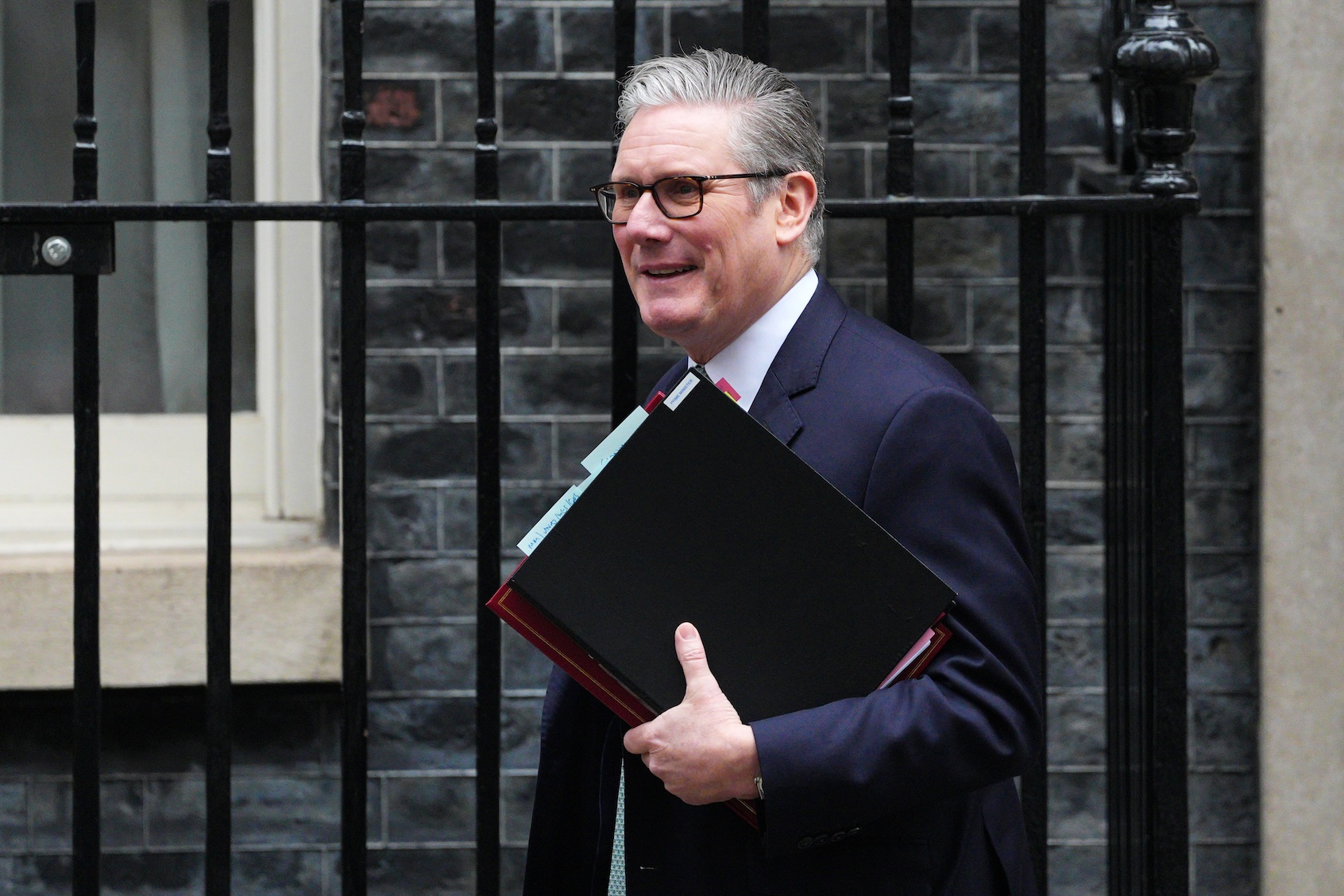
Across the Atlantic, meanwhile, the situation appears almost upside-down. Prime Minister Keir Starmer had no known personal connections to Jeffrey Epstein but has been badly damaged by the latest set of revelations, although an intra-party coup attempt last week was apparently thwarted. Just 19 months after leading the Labour Party to a huge parliamentary majority in the last general election, Starmer looks to be on borrowed time, with his rivals in Labour’s various “soft-left” or centrist factions understood to be plotting his demise.
No doubt the scandal surrounding Starmer is ugly enough to call his judgment into question. But it’s a mistake to read this episode as evidence that moral standards are just that much higher in the land of sticky toffee pudding and the BBC Proms. The high-minded outrage now directed at Starmer over his close relationship with Peter Mandelson — a longtime Labour insider who until recently was the British ambassador in Washington — is more than slightly opportunistic, if not downright cynical.
Under a previous Labour government, as it turns out, Mandelson had leaked loads of confidential financial information to his good buddy Epstein, and then lied about their friendship for years afterward. There’s no evidence Starmer knew about that, but he doesn’t seem to have vetted Mandelson all that thoroughly before appointing him as, in effect, his personal emissary to Donald Trump. (Mandelson has been credited for facilitating the relatively genial, or at least not overtly confrontational, relationship between the two leaders.)
No doubt the Epstein-scandal overflow surrounding Keir Starmer is ugly enough to call his judgment into question. But it’s not evidence that moral standards are higher in the land of sticky toffee pudding and the BBC Proms.
This was a major own-goal, to be sure, but one could say that Starmer lay down with a dog and got up with fleas. Mandelson has long been understood as a Machiavellian mastermind behind the scenery of British politics, who reveled in his media reputation as the “Prince of Darkness,” a nickname that goes back at least to the mid-1990s. His previous track record included several allegations of dodgy financial dealings, and he was well known for his “connections and friendships with the world’s super rich,” as a BBC report put it in December 2024.
That same report mentioned Mandelson’s onetime association with Russian oligarch Oleg Deripaska, along with his “former friendship with disgraced financier Jeffrey Epstein,” which Lord Mandelson (as he was at the time) “very much” regretted, while insisting that he “never had any kind of professional or business relationship with Epstein in any form.” That was a big old lie, but seriously: Cometh the hour, cometh the man. Why did anybody pretend to be surprised that this dude was a massive slimeball who cultivated other slimeballs? (Since Mandelson is gay and married to a man, almost the only thing we can say in his defense is that he presumably wasn’t involved in Epstein’s sex trafficking operation.)
Here we begin to see the true nature of Starmer’s predicament, which also reflects the broken synchronicity of British and American politics. The Mandelson scandal has infected the Labour Party and Starmer’s government with the taint of sleaze and corruption, shortly after their return to power as the supposed center-left normies who would push the U.K. into recovery after 15 years of agonizing Conservative misrule. Well before this, Starmer had become widely unpopular and was perceived as a hapless, charmless waffler, pinioned between angry anti-immigration protesters on one side and angry urban progressive types on the other.
To understand Britain’s crisis of democracy, and how it both resembles and differs from our predicament in the Land of the Free, we need to back up a bit. Donald Trump’s 2016 election victory came a few months after the Brexit vote, and never has the transatlantic “special relationship” seemed more like a joint suicide pact. Those same currents of pseudo-populism and ethnic nationalism brought Boris Johnson, the upper-class, naughty-schoolboy Anglo-Trump, to power with a whopping Conservative majority in 2019. But that moment of maximal British-American political parallel was also, as it happens, the moment when the parallel began to break down.
Johnson lasted barely three years before being forced out by his fellow Tory members of Parliament, fed up with his lies, scandals and vainglorious incompetence. It’s an enormous systemic difference: Try to imagine a universe in which Republican members of Congress, after the Ukraine scandal or the Jan. 6 insurrection or right now, could chuck out Donald Trump and install someone else purely on their own initiative. Of course we don’t know what would have happened in that universe, just as we can’t quite imagine the reverse case: If British prime ministers were directly elected, or could dominate their parties, Trump-style, by mobilizing a rabid core of loyal supporters, Johnson might have held power clear through the 2024 election, if not longer.
Try to imagine a universe in which Republican members of Congress, after the Ukraine scandal or the Jan. 6 insurrection or right now, could chuck out Donald Trump and install someone else purely on their own initiative.
But wait, there’s more, all of which points at the fact that Britain’s democracy is deeply unwell. So the Conservative Party threw Johnson overboard in a last-ditch effort to save itself from electoral disaster, which backfired in spectacular fashion after the brief regime of Liz Truss (who famously failed to outlast a head of lettuce) and the profoundly depressing reversion to “normal” right-wing politics under Rishi Sunak. That led to the well-deserved Tory-mageddon of July 2024, but the most important fact about that election wasn’t that Starmer’s Labour Party won a huge majority but that the British people, broadly speaking, lost faith in the entire system and simply didn’t care.
If that sounds hyperbolic, it really isn’t: Labour won 411 of the 650 seats in the House of Commons with 9.7 million votes (in a population of roughly 68 million), or just 33.7 percent of the total. No party in Britain’s postwar history had ever won an overall parliamentary majority with such a meager proportion of the vote. In fact, that was half a million fewer votes than Labour got under left-wing leader Jeremy Corbyn in the supposedly catastrophic defeat of 2019. Two years before that, Corbyn’s Labour had nearly scored an upset victory over the Tories and then-Prime Minister Theresa May, winning nearly 12.9 million votes.
Reflect on that a moment: The mainstream narrative of that seven-year period holds that Labour was conquered by the unshaven and unruly hard left, but learned the hard lessons of defeat and pivoted back toward the sensible center to win the next election. Every syllable of that is false. What actually happened was that voter turnout fell below 60 percent for only the second time in the U.K.’s modern political history, and both of Britain’s major parties saw their support crash to historic lows. The Tory collapse was worse by several orders of magnitude, from 14 million votes under Johnson in 2019 to 6.8 million under Sunak in 2024. So Labour won nearly two-thirds of the seats in Parliament on barely one-third of the vote, while hemorrhaging more than 3 million votes. Compared to that, the much-discussed failures of Kamala Harris’ 2024 campaign look like ruthless political genius.
It isn’t just that Starmer is perceived as an indecisive, failed leader who has now been poisoned by runoff from the Epstein scandal. It’s also clear to everyone that his governing majority was built on sand, and the tide seems to be coming in. To extend the asynchronous Anglo-American parallel just a little, Starmer’s tenuous hold on Downing Street feels like an extended remix of Joe Biden’s presidency, a tense and unsatisfactory rest stop on the slippery-slide into the political abyss. Waiting in that abyss is the anomalous, anarchic post-Trump specter of Nigel Farage and the anti-immigrant Reform UK party, which has no government experience, no coherent platform and holds only eight seats in Parliament, but has led public opinion polls for the past year.
The mainstream narrative of recent British politics holds that Labour was conquered by the unshaven and unruly hard left, but learned the hard lessons of defeat and pivoted back toward the sensible center to win the next election. Every syllable of that is false.
The U.K. may have freed itself from the European Union, at exorbitant and unnecessary cost, but what happened in British politics is just the local version of a continent-wide implosion: The supposedly stable political duopolies that governed postwar Europe for six or seven decades are now dust in the wind. In France and Italy, the formerly dominant center-left and center-right parties have shrunk into insignificance or vanished entirely. In Germany, the Christian Democrats and Social Democrats, once bitter rivals, have been forced into an awkward coalition purely to keep the far-right AfD out of power.
It can’t happen here, you say? Well, yes and no: The U.S. is virtually unique in having an extra-constitutional two-party system that for all intents and purposes is legally baked in, enshrining two private organizations — which set their own rules for participation — as the only realistic avenues to political power. Sure, third-party or independent candidates win a few seats on the margins here and there, but even so they must make a binary choice: No member of Congress, or of any state legislature, can afford not to caucus with one of the major parties.
Want more sharp takes on politics? Sign up for our free newsletter, Standing Room Only by Amanda Marcotte, also a weekly show on YouTube or wherever you get your podcasts.
But the larger question, which may take many years to unfold, is whether a version of the Anglo-European political implosion is already happening here, or has already happened. The Republican Party has been conquered from within by a zombie virus, and is now forced to reinvent its positions almost daily on the whims of its visibly addled leader. For the Democrats, the internal conflict over the party’s future path is less dramatic but no less momentous, and is simultaneously ideological, attitudinal and generational. There will almost certainly still be two parties under those names 50 years from now, absent complete civilizational collapse. But neither of them much resembles their pre-1980 identities today, and what they will look like in the future is anyone’s guess.
Keir Starmer has evidently convinced his Cabinet not to defenestrate him, at least for the moment. By week’s end the British media had shifted its attention to petrochemical billionaire Jim Ratcliffe, principal owner of the Manchester United soccer team, who cheerfully spouted a bunch of “great replacement”-style anti-immigrant rhetoric in a Sky News interview. Predictably, Starmer and Farage lined up on different sides, and Manchester’s enormous new stadium project is potentially endangered. Every online article about Ratcliffe’s racist outburst was immediately flooded with venomous and ungovernable comments, reflecting a bitterly divided society with no shared understanding of reality. That too sounds familiar, somehow.
Read more
from Andrew O’Hehir