
GOP resists call to “nationalize voting” — but Trump’s trying it anyway
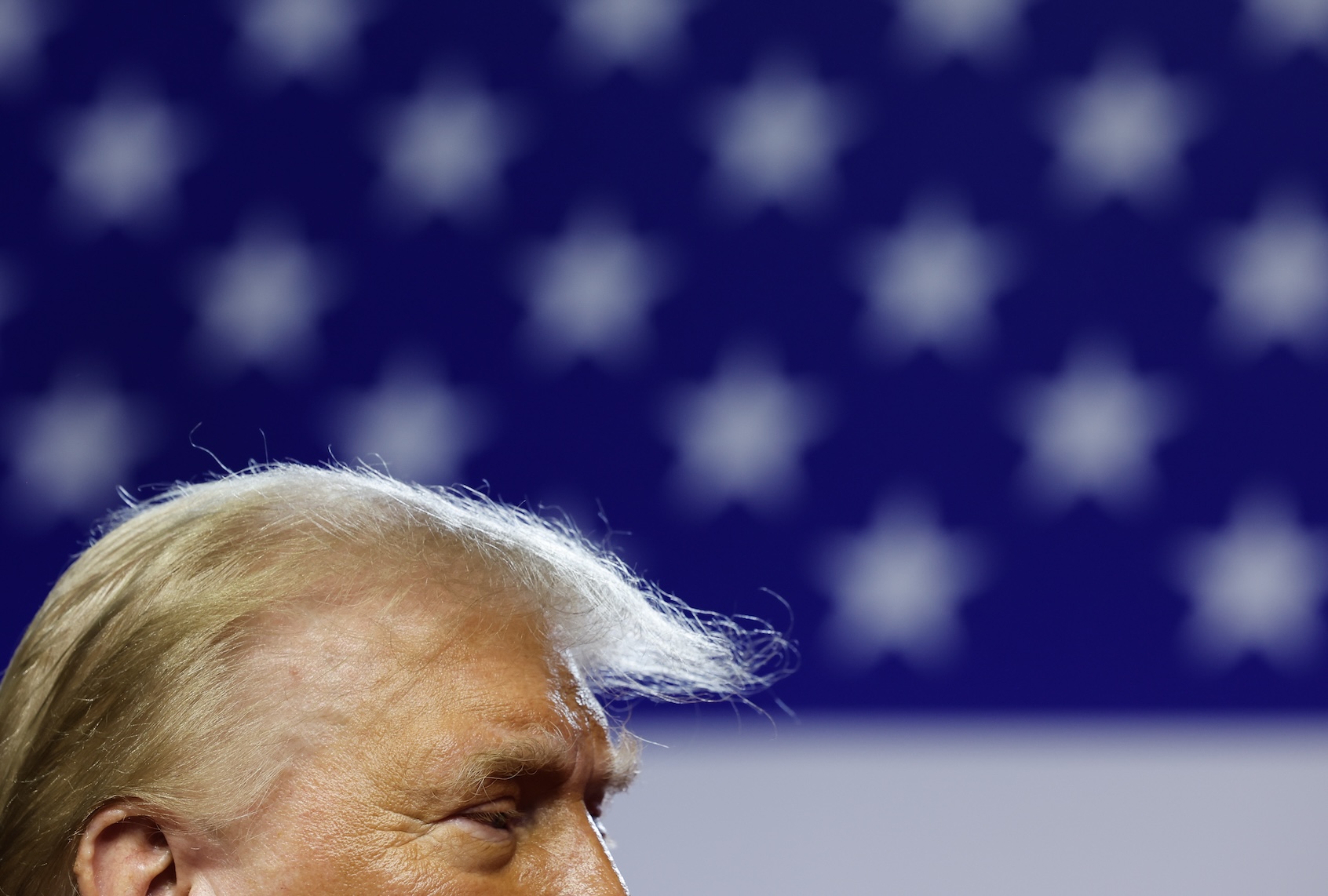
In recent days, President Donald Trump has called for Republican lawmakers to “nationalize” elections, but his actions outside Congress have sown the seeds to control federal elections long ago. On Monday, Trump joined former FBI Deputy Director Dan Bongino on his podcast where he suggested Republicans should say “‘We wanna take over. We should take over the voting in at least many, 15 places.’ The Republicans ought to nationalize the voting.”
The specifics of this plan aren’t yet clear, but it signals that Trump wants to take election administration entirely out of the state’s hands. The president has tied his calls to nationalize elections to his continued claims of voter fraud in the 2020 election. “You know, the 2020 election, I won that election by so much,” he told Bongino. “Everybody knows it.”
The White House attempted to clean up Trump’s podcast comments Tuesday, though he repeated them moments later in the Oval Office. In a press conference, Press Secretary Karoline Leavitt redirected Trump’s call for Republicans to nationalize the election toward a stalled voter ID law.
“What the president was referring to is the SAVE Act, which is a huge, common-sense piece of legislation that Republicans have supported, that President Trump is committed to signing into law during his term,” Leavitt said. “The president believes in the United States Constitution, however he believes there has been a lot of fraud and irregularities that have taken place in American elections.”
Speaking at the bill signing to end the partial government shutdown, Trump said, “If you think about it, a state is an agent for the federal government in elections. I don’t know why the federal government doesn’t do them anyway.”
“If a state can’t run an election, I think the people behind me should do something about it,” he said referring to the Republican legislators behind him at the bill signing.
“If Congress wanted to take over administering and running federal elections, Congress could do that.”
Trump did not reference the SAVE Act either in the podcast with Bongino or later when responding to questions in the Oval Office. Trump’s comments don’t address a desire for universal voter ID requirements, but a partisan “take over” for counting of votes.
The legality of this is complicated — partially because the request is quite vague.
“It is unclear what he means by that statement,” Franita Tolson, dean of the University of Southern California Gould School of Law, said. “It really depends on what nationalizing elections entails.”
The constitution explicitly gives states the power to regulate and administer the “times, places and manner of holding elections,” but Congress “may at any time by law make or alter such regulations.”
In practice, this power has taken the form of national voting regulation laws like the 1965 Voting Rights Act, the Help America Vote Act and the National Voter Registration Act, also known as the “motor voter act” because it established the ability to register to vote when receiving a state driver’s license.
It’s not clear if Congress can remove a state’s power to administer elections entirely, but Nicholas Stephanopoulos, a professor at Harvard Law School, thinks something like a nationalized electoral system is within the realm of possibility.
“There’s an awful lot that Congress can do — like Congress has basically full power over the manner of congressional elections,” he said in an interview with Salon. “If Congress wanted to take over administering and running federal elections, Congress could do that.”
“One thing Congress can’t do is prescribe voting qualifications for congressional elections like who’s entitled to vote,” Stephanopoulos said.
Start your day with essential news from Salon.
Sign up for our free morning newsletter, Crash Course.
Tolson further explained Congress’s authority to regulate elections “does not generally extend to regulating voter qualification standards, although the line between voter qualifications and manner regulations is not always clear.” She also noted that Congress has no power over state and local elections.
Senate Majority Leader John Thune, R-S.D., and Sen. Rand Paul, R-K.Y., both said that Congress should not act to nationalize voting, so movement from Congress to make federally administered elections isn’t likely.
Trump can’t directly take steps to nationalize elections, hence calling upon Republicans to do so. Nevertheless, he has already taken many steps toward strong federal involvement in elections.
U.S. Attorney General Pam Bondi is suing at least 24 states for failure to turn over their voter registration lists. Sean Morales-Doyle, director of the Brennan Center for Justice’s voting rights and elections program, told Salon that the Department of Justice has asked at least 44 states to turn over their voter rolls with unredacted data like full name, address and social security numbers.
“They’re plainly engaging in a fishing expedition … Their purpose is to conduct voter list maintenance.”
Under the Civil Rights Act of 1960, the federal government requires states to maintain copies of voter rolls, which can be requested only with “ a basis and purpose” for why they want access. Morales-Doyle explained many state election officials in the Jim Crow Era were engaged in racist election fraud schemes, and this gave the federal government power to investigate wrongdoing prior to the passage of the Voting Rights Act.
However, he thinks Bondi’s deployment of the policy is for ulterior motives. “ They’re plainly engaging in a fishing expedition,” he said. “Their purpose is to conduct voter list maintenance.”
He explained states that have turned those lists over have been told to purge voters from registration lists at the federal government’s request. Those that have refused are being sued — with some cases already dismissed.
“The DOJ cannot go beyond the boundaries provided by Congress and use these legislative tools in a manner that wholly disregards the separation of powers provided for in the Constitution,” U.S. District Judge John Carter wrote in his dismissal of one lawsuit in California.
“ They’re again explicitly saying ‘We are coming to conduct the voter list maintenance, we’re gonna do the job of the election officials,’” Morales-Doyle said. “ We are, in the words of Donald Trump, nationalizing elections — and they don’t have any authority to do that.”
Washington is among the 24 states and territories sued for refusing to turn over voter rolls.
“We have serious concerns about how federal officials want to use private and protected voter information, which the DOJ has continually refused to address,” Washington Secretary of State Steve Hobbs said in a statement to Salon.
Hobbs is also the elections committee chair at the National Association of Secretaries of State, which held a conference at the end of January. Tulsi Gabbard, Kristi Noem and Bondi were supposed to attend a “fireside chat” with Jared Borg, the deputy director of the White House Office of Intergovernmental Affairs — but only Borg showed up.
It wasn’t just Democratic leaders that were upset. Lt. Gov. Deidre Henderson, a Utah Republican, said to Borg at the Jan. 29 event, “[Bondi has] pretty much slandered all of us. To me, that’s problematic to publicly claim that secretaries of state are not doing our jobs and that the federal government has to do it for us.”
“Nearly 40 members of the National Association of Secretaries of State (NASS) serve as their state’s Chief Election Official, and each takes their constitutional responsibilities seriously,” Maria Benson, the senior director of communications for NASS, said in a statement to Salon.
“The President’s comments are contrary to the protected rights of each state enshrined in the U.S. Constitution,” Hobbs said. “State and locally run elections keep power decentralized, increase transparency and build trust among Washingtonians.”
Morales-Doyle thinks these comments and the DOJ voter roll requests are explicitly part of an effort to undermine faith and trust in elections.
“Trump is calling into question the states’s ability to run elections — he’s suggesting there’s some kind of fraud that needs to be rooted out with no evidence,” he said. “I think he’s setting up a scenario for the federal government to make outlandish claims about fraud and potentially force purges that will inevitably, in my view, lead to eligible voters being knocked off the rolls.”
Read more
about politics