
A wake-up call for white Americans
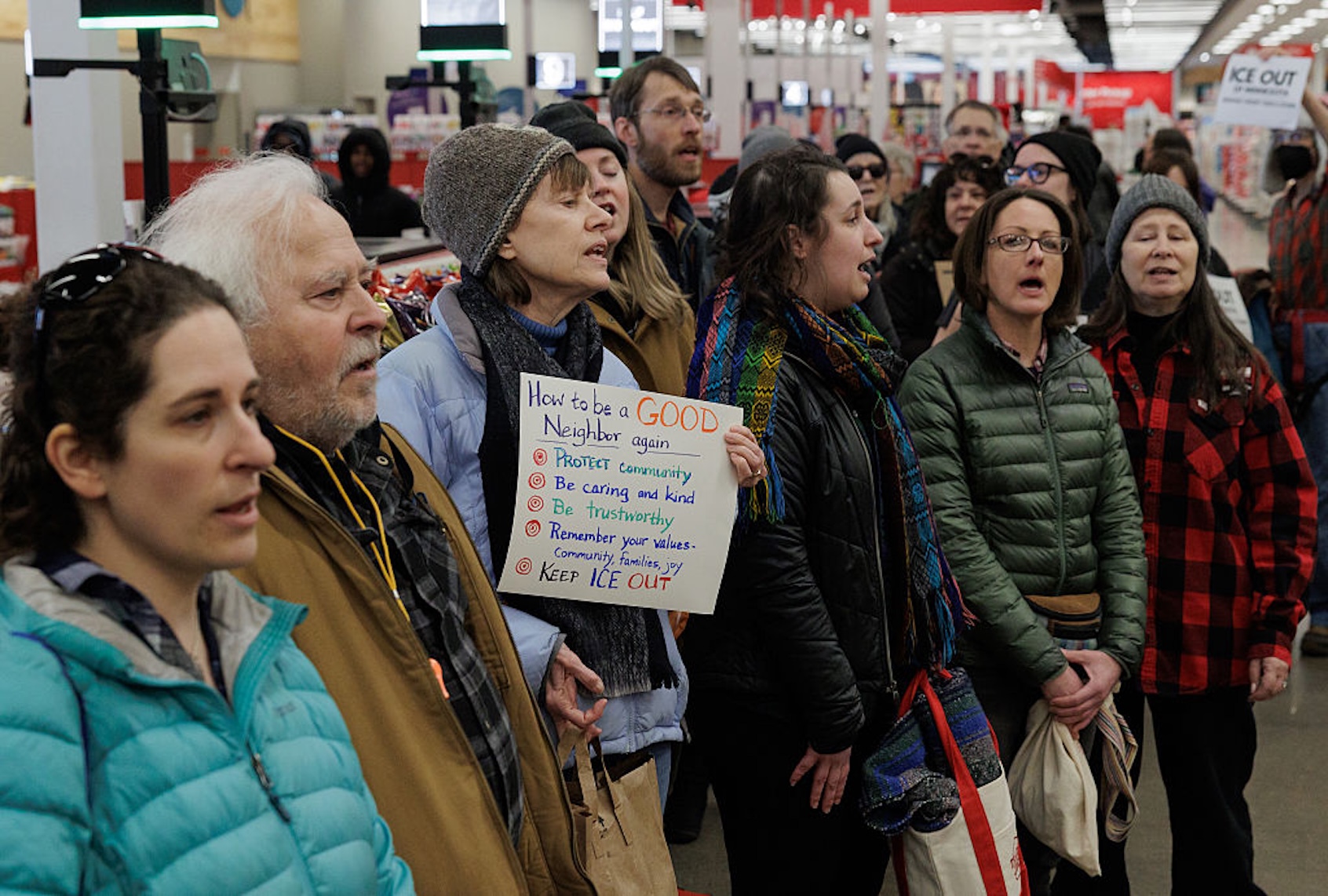
None of what we have seen over the past few weeks — not the shooting deaths of Renee Good and Alex Pretti in Minneapolis at the hands of federal officers, the seizure of children by Immigration and Customs Enforcement and Border Patrol agents, the callous disregard of civil rights and liberties from an increasingly authoritarian administration — is supposed to be happening in America. But it is.
American citizens are being arrested and brutalized for exercising their constitutional rights — recording ICE, standing nearby or simply being the “wrong” color in the wrong place. The Trump administration has labeled these Americans “domestic terrorists,” claiming they posed existential threats to heavily armed federal agents, despite clear video evidence to the contrary. Immigrants are hiding, afraid to go outside. Entire neighborhoods and communities are under siege. Even though it’s only January, at least eight people have died from their encounters with ICE.
The cognitive dissonance is dizzying. Disorientation is one of the authoritarian leader’s most powerful weapons.
The cognitive dissonance is dizzying. Disorientation is one of the authoritarian leader’s most powerful weapons.
Hours after Pretti was killed on Jan. 24, hundreds of people protested near the site in Minneapolis where he died. There, an older white woman told a reporter that “the government is not supposed to be doing these horrible things to the American people. It is unbelievable. This is something like Nazi Germany or Russia.”
I yelled at the television. “What d**n country do you live in?”
But her sentiments are common among people who are gathering at protests, community meetings and town halls all across the country.
Like many other white Americans, and too many Black and brown Americans, she seemed willfully ignorant of her own country’s history, which includes genocide and land theft against First Nations; white-on-Black chattel slavery; Jim and Jane Crow; the Black Codes; the Red Scare; violent social and political repression of LGBTQ Americans; the Palmer Raids; mass incarceration and the War on Drugs, to name just a few examples.
And then there is the language. When many protesters insist that “regular people,” “good people” and “citizens” should not be treated this way, what they often mean — consciously or not — is middle- and upper-class white people like themselves.
Historian Robin D.G. Kelley recently explained why the killings of middle-class white people like Good and Pettri by ICE and Border Patrol have provoked such widespread outrage among white Americans and “even the most seasoned organizers.”
“[Good] was a white woman and a mother — two things you’re not supposed to be when armed agents of the state put you in a body bag,” Kelley wrote. “Of course, the very idea that certain people, by virtue of their characteristics, don’t deserve to be brutalized, caged, or killed by police is the problem… Centering someone’s innocence clouds the case for abolition, which seeks to create a world where no one is caged or gunned down even if they broke the law. No matter who she was, what she looked like, her marital or citizenship status, or what she might have done in the past or even in the moment, Good had the absolute right not to be shot for driving away.”
White racial innocence, in its various forms, is exhausting for those of us on the other side of the color line. But after allowing myself a moment of exasperation with the woman on the television, I turned to the lessons of history.
The leaders of the Civil Rights Movement understood that images of those who were often referred to as “respectable white people” being beaten, arrested and even killed would move white moderates — and, crucially, white elites — to oppose Jim and Jane Crow apartheid.
Want more sharp takes on politics? Sign up for our free newsletter, Standing Room Only, written by Amanda Marcotte, now also a weekly show on YouTube or wherever you get your podcasts.
“Their simple but straightforward calculation was that Black suffering wasn’t new,” journalist Thomas Ricks wrote in “Waging a Good War,” “but white suffering was, especially when it was inflicted by Mississippi officials on middle-class college students from the North. And so [the Student Nonviolent Coordinating Committee] decided, John Lewis wrote, to bring ‘an army of Northern college students into Mississippi….If white America would not respond to the deaths of our people, the thinking went, maybe it would react to the deaths of its own children.’”
Now, 60 years later, similar images of “respectable white people” being abused by police and other law enforcement are having a powerful impact on public opinion.
Polls released in the aftermath of Good and Pretti’s killings show that a majority of Americans oppose Donald Trump’s immigration policies. According to a YouGov poll, more Americans (46%) want to abolish ICE than support it (41%). A small but growing number of Republicans also want ICE abolished or reformed with far stricter oversight.
The next step in mobilizing and movement building requires that many more white Americans who oppose the mass deportations and the Trump administration’s assault on democracy to move beyond relatively safe virtue signaling and being “allies” and embrace the role of collaborators. This means, but is not limited to, nonviolent protesting, offering refuge and other forms of aid to their immigrant neighbors, and being citizen observers and human shields like we have seen in Minneapolis and other parts of the country.
The struggle for America’s multiracial democracy needs — and has always needed — everyday white people of conscience who are prepared to make good trouble.
If I could talk to the older white woman I saw being interviewed — who appears to be what my grandmother and other elders would describe as “good white people” — I would tell her that she was in love with a country that never really existed but that she truly thought was real. Now is the time for her and others like her to broaden their lenses and accept our new reality. What is happening now to white people like her has been the norm for Black, brown and other marginalized communities throughout American history. This is the moment for us to lean into solidarity — to learn from our shared history of struggling for a better society and democracy on both sides of the color line.
A white freedom rider — a real American hero, though he would never use that language — once told me that he decided to join the Civil Rights Movement after asking himself a basic question: What type of white person do I want to be? More importantly, what type of human being do I want to be?
As Trump’s authoritarian vise continues to tighten, Americans on both sides of the color line will be forced to answer that question.
Read more
about this topic