
We bought a soccer team! What NBA greats Kerr, Nash & Co. learned owning LaLiga’s Mallorca
PHOENIX — “When Andy approached me about this, it was a no-brainer,” Steve Kerr tells ESPN. It was August 2023 and exactly the kind of offer the nine-time NBA champion wanted: to join friends at a top division team and in a place composer Frédéric Chopin claimed was the most beautiful on earth. “A wonderful opportunity,” the Golden State Warriors coach calls it. There was just one problem: right time, right place … wrong sport?
The man with the proposal, sitting smiling alongside Kerr as the rising sun reflects on Camelback Mountain, was Andy Kohlberg. The team the New York-born former tennis player — once a Wimbledon semifinalist, no less — wanted Kerr to join was RCD Mallorca. From a Spanish island 6,000 miles away, Mallorca play soccer, not basketball.
Kerr wasn’t invited to coach the LaLiga club, either … although, thinking about it, that’s not a bad idea, Kohlberg smiles. Instead, he would become part-owner alongside ex-tennis pro Kohlberg; the NBA’s two-time MVP Steve Nash; and Stu Holden, a former United States soccer international with Premier League experience.
It could be the start of a joke — a tennis player, a basketball player and a footballer walk into Mallorca — but it was serious. Deliberate, too. Sport was the key, what brought the ownership group together and bound them, the “connective tissue” in Nash’s phrase. Which sport didn’t matter, although it begins with basketball and ends in football, the two sports — accessible, universal — that Kohlberg was convinced would grow most.
– Fútbol Americas Mallorca special: Stream from 7 p.m. ET on ESPN+ (U.S.)
– Atlético Madrid vs. Mallorca: Stream LIVE 1/25 at 8 a.m. ET on ESPN+ (U.S.)
– Stream every 2025-26 LaLiga game in English and Spanish on ESPN+ (U.S.)
“The initial link is the Phoenix Suns: Steve Nash, Steve Kerr, myself and Robert Sarver were all there at various times,” Kohlberg says. “Steve Nash and Stu Holden have been very good friends for a long time. And we said: ‘Athletes understand.’ I have always believed that the winning mindset of sportsmen is similar, whether it’s basketball, football or tennis. Yes, there’s a difference in tennis as an individual sport where you don’t need to compromise but the mentality of the great athletes I played with — John McEnroe, Jimmy Connors, Ivan Lendl — was still similar to Lionel Messi, Cristiano Ronaldo, Steph Curry, Steve Nash or Steve Kerr.”
“Nice of you add my name,” Kerr says.
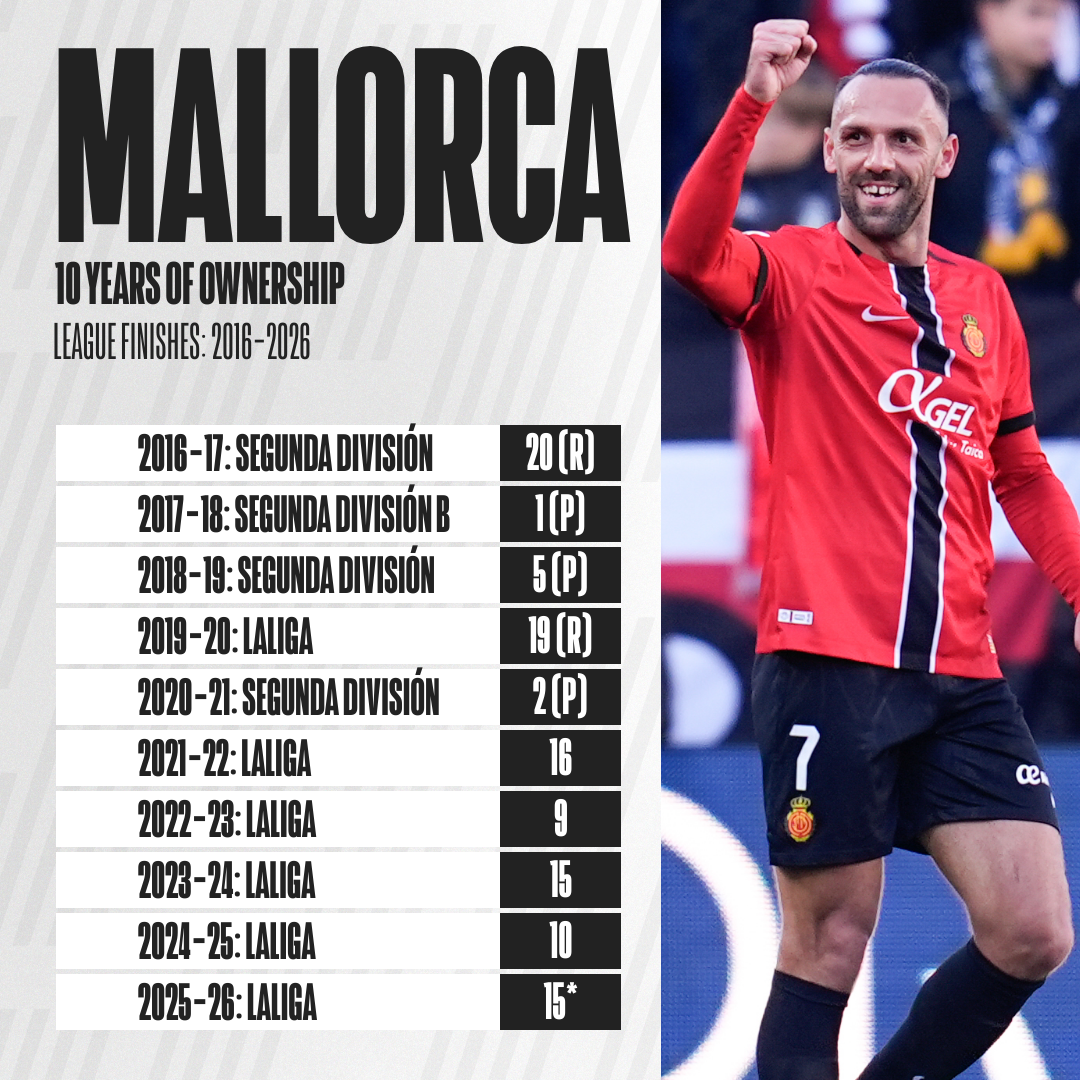
Nicer still to have brought them together here. This January marks the 10th anniversary of their $23.86 million purchase of Mallorca, with Kohlberg as president and, he says, former Suns owner Robert Sarver as the “driving force” (having bought Sarver’s stake in June, Kohlberg is now the majority shareholder). They had looked at clubs in the England’s second-tier Championship — “pretty pricey,” Nash admits — but when they saw Mallorca, struggling near the foot of the Segunda División at the time, they knew. “A gem,” Nash calls it.
“Back then, you could pick any club and think: ‘There’s a good chance we can improve this’,” Kohlberg says, “and Mallorca was a unique opportunity, because of the island as well as the club.” With a population of 1 million and 16 million annual visitors, nowhere offered the same scope for development.
It has been some ride, through two relegations and three promotions, from the second tier to the third and now in their fifth season back in LaLiga (finishing 16th, 9th, 15th and 10th so far). There was even a historic run to the Copa del Rey final in 2024 where, despite defeat and heartbreak, there was pride.
Now here they are — Kohlberg, Nash, Holden and Kerr — back in Arizona where it all began. Talking tennis, basketball, football. Life, in other words.
“I remember Steve Nash calling. ‘I’ve been offered part of a group buying a European football team: Are you interested?'” Holden says. “How often do you get a call like that? It was an instant yes.
“And why Mallorca? Have you been to Mallorca?! At the cup final, Steve said: ‘Can you remember where we were? We would never have dreamed of this when we were chasing footballs in a swimming pool'”
Eh?
“You’re down in the third division, the first day away at some small club. There’s a fence, a swimming pool over the other side, the ball is going over and into the water,” Nash explains, laughing. “And you’re thinking: ‘Pfff, it’s a long way from Barcelona.'”
These guys know ball
A long way from the basketball court, too, but the soccer connection was there. “‘Goal’ was my first word,” Steve Nash says. “My dad’s from Tottenham, just across the park from Spurs. I moved to Canada aged one and grew up in a football household. My dad played in the Conference [England’s semipro fifth tier, now the National League]. My brother played for Canada 35 times. I played properly until 12, 13. Basketball wasn’t on our family bingo card. You played ice hockey and soccer in the winter, baseball and lacrosse in the summer. Track and field, volleyball. I went to a new school in eighth grade and all the jocks played basketball. It was the time Michael Jordan came on the scene, the first Air Jordan: A pretty romantic time to be introduced to it, and I fell in love. And my friends played …”
Holden leans forward, glances at Nash and grins. “I hate to say this, but Steve could play football professionally, 100%. He likes to think he’s a No. 10 [creative attacker]; I think he’s a No. 6 [deep-lying midfielder]. A Pirlo-lite. He’s has got vision, the same way he played basketball. People know he loves soccer, but when they play with him they’re like: ‘S—, I didn’t know he was actually good!’ Could he have made the Premier League? Hmm, maybe at a Burnley.”
Nash was an outlier as a soccer-mad basketball player, but no more. “It’s fun to see people love the game now. When I came into the NBA, no one knew anything. Now they all have a team.” Holden adds: “Don’t be the fan of the indie rock band who tells everyone you knew them before they were cool.”
Kerr’s connection came later, but it’s deep. “I’m a massive sports fan, I watch everything,” he says. “I got older and expanded my horizons, really got into European football. I’m a Liverpool fan because of Mohamed Salah. I lived in Egypt for three years as a kid, just outside Cairo [where] my dad was a professor. I first saw Salah at the World Cup and was blown away. It was very fortuitous: Liverpool were entering this golden age. I visited training, had lunch with [former manager] Jürgen Klopp, met Salah and Virgil van Dijk. … I tried to play it cool.
“I’ve also gotten to know [Arsenal manager] Mikel Arteta through a Zoom with other coaches where we try to learn from each other, and I’ve spent time with Jagoba [Arrasate, the Mallorca coach]. One of my favorite things is visiting other coaches, seeing how they go about their business.”
Kohlberg says: “Steve came to Mallorca and spoke to the players, and we won 4-0. Then he went to Liverpool and they won 7-0. I texted him: ‘What did you say to these players?!'”
“I don’t remember,” Kerr laughs. “But, yeah, it was definitely me.”
1:09
Nash: Soccer background helped my NBA career
Former NBA MVP and Mallorca co-owner Steve Nash believes that growing up playing soccer gave him an advantage as a basketball player.
A culture that cuts across sports
If you made Steve Kerr the coach at Mallorca, would he succeed?
“Absolutely,” Kohlberg replies. “All he would need is an assistant who knew the tactics and he would be fine.”
“How many players are on a football team?” Kerr says.
Kerr is joking; Kohlberg is not, entirely. There is much shared across sports; their concepts and cultures guide the Mallorca project.
“I’m not sure I would have played in the NBA but for my football background,” Nash insists. “It opened things in me, ideas, that allowed me to be different. There’s 30 point guards in the NBA and they’re all incredible athletes: explosive, powerful. I wasn’t. I was more balance, coordination, rhythm, timing, creativity learnt playing football. When I started playing basketball I almost felt like I was cheating using my hands. Football gave me a great advantage: angles, spaces, timing. A lot of triangles, connective tissue. Ideas, concepts, movements.”
Kerr says: “I have a hard time recognizing formations while I’m watching, but I do recognize play in small triangles. One guy passes, the other makes a run, exactly like basketball.”
Kohlberg believes that the same attributes define a good coach across sport: “You have to be far smarter than people realize to be a good coach. A really good coach — even a tennis coach — has the same skill set; the ability to connect, communicate.”
That goes for owners, too. Asked how often during their careers they looked at owners and thought, ‘they haven’t got a clue,’ the athletes now in those shoes laugh. Mallorca’s owners actually do have a clue — an awareness of the mechanics, the demands, the pressure. Holden says: “[People might say] ‘You guys are crazy: You don’t know anything about football?’ But we know sport, life, business.”
At the Son Moix stadium the president isn’t seen by players as some random businessman, a pain in the ass who knows nothing about sport; instead, he is, Kohlberg laughs, “a pain in the ass … who used to play tennis. But Hakuho Sho, the sumo wrestler, came to talk to them. Kerr, Nash. Hopefully the players enjoy that. I figured those guys are better spokesmen than me.”
Nash says: “As an athlete, you have an opportunity to reach them, but you then have to fill it with some wisdom and sensibility.” And knowing means knowing when not to impose. “You come into ownership recognizing it’s not easy. The No. 1 thing is to learn, listen, appreciate all the factors that build success, have reverence and respect for the club, the island, the fans, the culture that has permeated for 100 years. Don’t come thinking, ‘right, we’ll show you.’ Try to be good people. Know when to step back. It’s not our place to be telling them what to do.”
Kohlberg says: “Some NBA owners go into the locker room before or after games. Having been an athlete, that’s kind of … ufff. The main thing is that we, as a leadership group, understand a winning culture. Getting a group to work together towards a common goal, rather than ‘I’m playing for my next contract,’ or ‘I’m playing for my brand,’ which is new to us as older athletes. The brand mentality, that wasn’t there.”
Kerr interjects: “We remind our young guys: ‘You know what’s best for your brand? Winning.'”
Kohlberg continues: “[San Antonio Spurs president] Gregg Popovich says: ‘We like having people who have gotten over themselves.’ [Former Suns player and general manager] James Jones used to ask players if they want the team to win. … ‘Oh yeah.’ … So you’re fine to sit on the bench for that to happen? … ‘Oh, no, no, no.’ … So which is it? One of the things Steve [Kerr] told our players was it’s important for the best players to really care about the bench, to lift them up. If the star disregards and disrespects, it creates a divisive environment.”
Sometimes it takes something exceptional to see that. The word Holden uses is “harmony” and that complicity, respect, don’t always come easy, or even the way you expect. Famously, as a player Kerr once got into a practice scuffle with Chicago Bulls teammate Michael Jordan; in due course, Jordan handed him responsibility for the championship-winning shot in 1997.
“Yeah, after I kicked his ass, he really respected me!” Kerr laughs. “Sorry, Michael, just kidding.
“You have to understand every player, their story. There’s a pressure Jordan and Steph Curry face every single day. The 15th guy on the roster’s pressure is ‘I have to get on the team, pay my bills.’ One of the reasons we have had such a great run with the Warriors [four NBA championships in seven years] is that Steph Curry has so much humanity. He understands that, somehow lives up to the standards he has set himself and has amazing compassion and empathy.
“You need values to live by, win or lose. And joy is actually a core value. But you can’t just write it on the wall. The way we go about it is to inject joy into daily rituals. That means playing music in training, allowing the players’ kids onto the practice floor after games. Win or lose, their kids are running towards them. They love that. We celebrate players’ accomplishments: weddings, births. There is a human part which transcends.”
1:26
Kerr: Criticism hard to avoid for modern athletes
Golden State Warriors coach and Mallorca co-owner Steve Kerr thinks that basketball and soccer players in the social media age are under much more pressure than when he played in the NBA.
Drafting Yamal or Mbappé? ‘We’ll take ’em!’
“I love that European football is church, a cathedral, religion,” Holden says. “It’s passed down through families.”
That imposes respect. Part of the challenge is bringing sport and business, the U.S. and Europe, together rather than pitting them against each other.
“That’s a pressure and an opportunity,” Kohlberg says, adding there are lessons to be learnt from both sides of the Atlantic. “The multisport, U.S. idea is seen in our arena renovation. But you need to balance opportunities with looking after the fan who comes with a sandwich for their grandkids. In America there’s passion, but you don’t get the same depth. What people love about sports is the connection with the community. There’s a belief in European football that it’s for everybody. We still have 10 euro [$11.50] tickets: We’re trying to do that, not price people out. That’s an ethos I think in Europe is much stronger — and better frankly — than in the U.S.”
Kerr adds: “That’s so important. In the U.S. we’ve priced out middle- and lower-income fans. It’s reflective of the American economy, the wealth gap, and it’s a shame. It’s very sad. I was the son of a professor. We were middle class. My brother and I would go with our dad to Dodgers baseball games, and it was a $10 day: $3 for a ticket, $1 for parking, bring a jug of lemonade and a sandwich. We would do it five times a summer, and I’m still a Dodgers fan. We have an entire generation now who can’t afford to attend and it’s terrible. I’d like to bring that idea from European football to the U.S.”
What about the other way around? What could European sport take from America? A draft pick, say? A system that is, dare they say it, socialist? “Controlled parity,” Holden suggests. “It can be beautiful because it can give you hope. The worst team might end up a contender.”
Imagine a scenario when a bad season was mitigated by Mallorca picking between Barcelona star Lamine Yamal or Real Madrid striker Kylian Mbappé. “I don’t think you’ll find anyone on the island who would say no,” Nash says.
Kerr laughs: “We’ll take ’em! The problem with it is the NBA season is 82 games and by the end, teams are jockeying for draft picks. They’re incentivized to lose and that makes no sense at all.”
In soccer, finishing in the bottom part of the table leads to relegation. Right now, Mallorca are three places and two points above the drop zone. “I tell people about relegation here in the U.S. and they scratch their heads: ‘What?!’ Kohlberg admits.
Kerr laughs: “I think relegation is amazing: The competition it generates every match is something we lack here.”
Nash insists: “I wish we had that in the United States, that the regular season meant something. It’s nice to be part of [in Spain], even if we’re a little too close at the moment.”
Living the dream, all over again
After all, that mobility has allowed a group of sportsmen to see an opportunity in a struggling second-division club they could change, build, revive. A decade later, they’re still there.
“We’re proud; we’ve been resilient. Hopefully we can stabilize in the top 10,” Kohlberg says. Nash adds: “We didn’t come in to flip this; it’s a part of our lives. We don’t want to be out, we want to be in. I feel grateful for 10 years of learning, humble that they accepted us into their culture.”
It gave them a chance to keep competing, too. “The honest reason was so we could continue playing,” Holden laughs. “The first few years we would train with the first team. Then it was the B team. Then the U16s. And now … for five minutes we felt pretty good and then one of our players asked me: ‘So, do you like soccer?’ I played in the Premier League, man!
“I remember showering in the coach’s locker room, the shower head falling off, calling Andy: ‘I think we have to upgrade the locker room, man.’ To walk in now is unbelievable, the stadium is incredible. We’ve created an environment reflecting where we are — a first-division club. That speaks to the mentality of professional athletes, that constant drive, wanting to be better, find an edge.
“Soccer has given me everything: a career, my friends. That’s what sport is all about. Of all the things I do in life now, this is what I most love. We can’t replicate that same buzz ever again and I’m jealous of the [players], but there’s still a competitive element, which is great. Although not being able to affect anything on the field gives me anxiety.”
Nash agrees: “That’s a crazy anxiety, compared to when you played.”
Kerr smiles. “[Former Bulls coach] Phil Jackson used to say: When your career ends, there’s a part of you that dies,” he says. “I understood because I was really nervous about retirement. I’ve been lucky: I’ve been able to stay in sport through coaching and now this.
“We’ve been friends a long time and you look forward to seeing them every day, collaborating. What Andy has done is incredible. Being part of a group that’s so well connected, so well meaning, that has created something special, makes me proud. It gives me a connection to LaLiga, to European football, and to my friends who are now on the same team as me.”