
Mainstream media helped build the myth of law enforcement
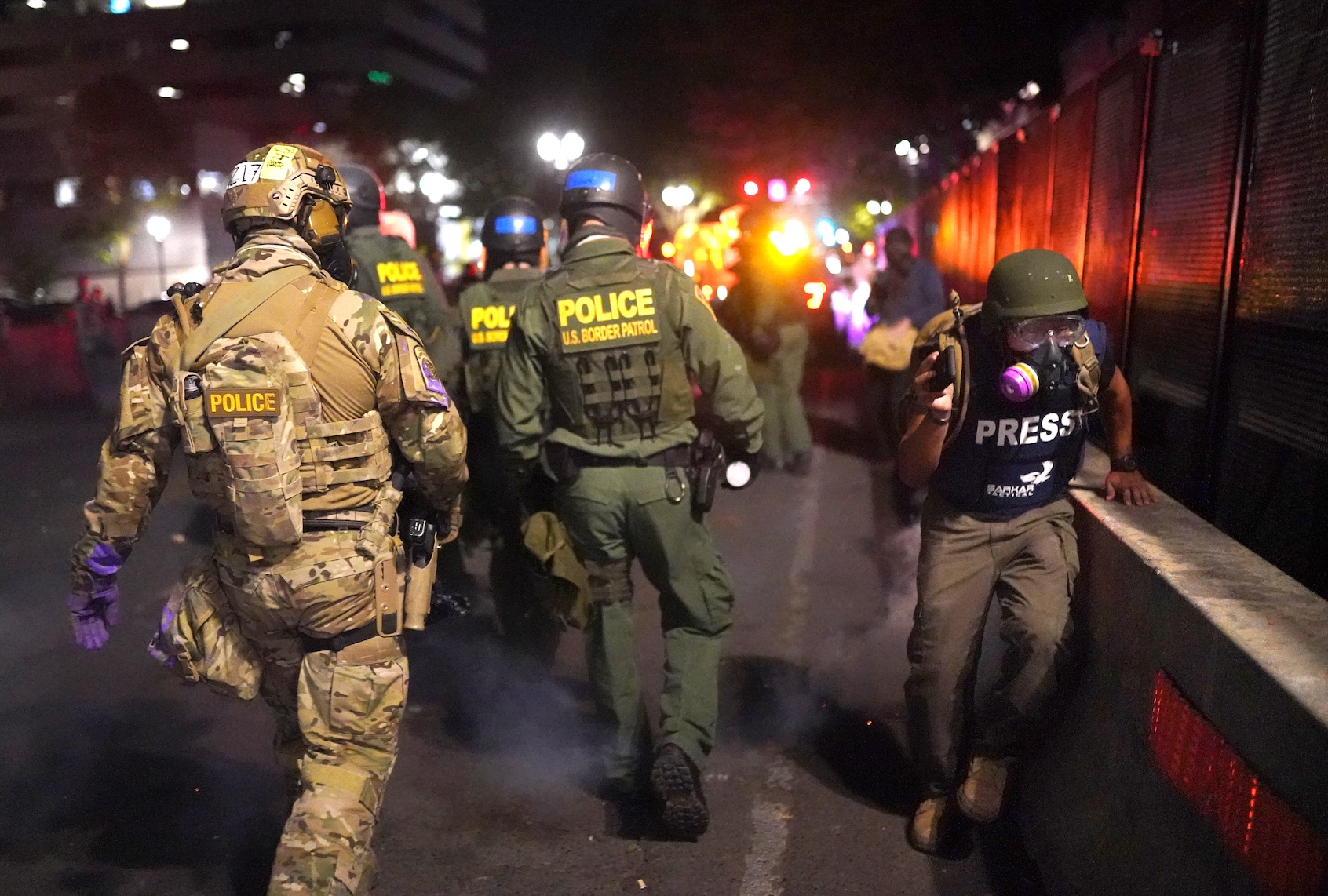
SWAT team-style raids, verbal and physical antagonism, and threats against citizen and journalists alike have long been embedded in the history of law enforcement in the United States, through both Republican and Democratic administrations. But after decades of attitudes largely sitting between grudging acceptance and hero-worship, the last ten years has seen a surge of negative attention toward policing in America, provoked by acts of extreme aggression carried out with far less subtlety than before and that has, by spreading first on social media, forced mainstream media outlets to cover it extensively.
Critics of this media coverage, like civil rights lawyer Alec Karakatsanis, say that since its conception in the United States, media’s role has been less to offer objective news and more to shape an obedient society that blames their problems on its most vulnerable, emphasizing a belief that state punishment is the solution. And even with the pressure to cover egregious behavior like the harsh treatment of immigrants by ICE, he argues, media outlets have continued to feed into the superstructure that enables misguided pro-police attitudes and normalizes such behavior.
When PBS invited Barack Obama’s former ICE director to speak about the killing of Renee Nicole Good, Karakatsanis criticized the decision as an attempt to “distract from core issues, sow confusion about whether what happened was justified, and promote more [funding] for the police/ICE ‘training’ industry.”
Karakatsanis is the founder of Civil Rights Corps, a nonprofit organization that has led litigation to free people from illegal jailing, provide funding for the most vulnerable people in society, and produced political education and narrative strategies to change society’s views on mass incarceration and family separation. Karakatsanis has authored two books, Usual Cruelty and Copaganda, which critiques “a special kind of propaganda employed by police, prosecutors and news media” that “stokes fear of police-recorded crime and distorts society’s responses to it.”
Salon recently spoke to Karakatsanis about the phenomenon he refers to as “copaganda,” and its staying power in a new age of public awareness.
This interview has been condensed and lightly edited for clarity.
The takeover of outlets like CBS and the Washington Post by some of the world’s richest people, with connections to the Trump administration, has obviously raised a lot discussion about how the mainstream media has been captured by right-wing forces. However, PBS, which has not undergone a sudden and distinct takeover, covered the ICE killing of Renee Nicole Good “shamefully,” in your words. Clearly, the framing of news stories to validate the carceral state and normalize police misconduct predates the latest, perhaps more egregious, moves by the new-look CBS and the Washington Post.
As far as I can tell, this is pretty standard media practice for as long as I’ve been following the news. When I started studying this and archiving it for my book, I was really focused on the more mainstream establishment media. I wasn’t trying to do a study of the right wing media like Fox News. I was trying to understand the role that the mainstream, or even sometimes, as it’s called, liberal media, talks about the institutions of government and repression. I don’t just mean institutions of government repression, or what I call the punishment bureaucracy which includes police, prosecutors, prisons, courts, etc., but also the multi-billion dollar industries that are parasitic on them, whether it’s the money bail industry or the private equity-owned prison telecom industry or the prison medical care industry or private prisons.
“The solution to crime is always more prisons, more police and more prosecution. This is all like flat-Earther thinking.”
So how does the media talk about all of these things? First is narrowing the focus of the public to be really afraid of only some harms committed by some people, while ignoring others. So if you watch the mainstream news media, you’re going to be really, really afraid of the most vulnerable people in our society, and you’re going to be taught to ignore much greater harms committed by people with actual power in our society, whether it’s wage theft, which is around $50 billion a year. So you see a lot more coverage of shoplifting by poor people than wage theft by wealthy people and companies, even though wage theft is about five times all of the other property crime in the United States combined.
The second thing that it does is it makes everyone extremely afraid of that narrow range of harms. We’ve seen this a lot with the lead up to the ICE crackdowns, for example. Over the course of many years, Democrats and Republicans, essentially every single mainstream news channel, punditry, op-eds, etc., have been preparing the ground for what’s happening now by using carefully-curated anecdotes of immigrants committing crimes and talking about an invasion or a wave or chaos at the border.
This news coverage, as I’ve studied, and many other people have shown with research, has absolutely nothing to do with the actual facts on the ground with respect to either crime or immigration. These narratives are entirely concocted, and they’re concocted not with relating to any kind of public safety issue, but with respect to political agendas. So whenever the government is trying to get increased funding for a militarized border or ICE or preparing for crackdown, the rhetoric changes. You see different kinds of news stories that has nothing to do with underlying issues of safety or well-being. If you look at the last 25 years, for example, every single year, the public in polling thinks that crime is up, even though in every single one of those years, except for one, overall crime was down. We are at historic lows in terms of police-reported crime. And yet, a lot of people think crime is up. That’s what this stuff does.
And the final thing that is extremely important that the mainstream news media has been doing is it tells us that the solution to all of those fears, narrowed to focus on the most marginalized people in our society, is always more and more investment in these profitable bureaucracies of control and punishment. That’s why the solution to any immigration problem is always more walls, more cages, more guns, more border officers, more ICE agents, more deportations, etc. The solution to crime is always more prisons, more police and more prosecution. This is all like flat-Earther thinking. We know from decades and decades of research, both in the United States and abroad, that all of these issues have underlying causes that are not connected to how much money we’re spending on police, prosecutors in prison, and even in fact, those things actually make the problems worse.
Even when people are trying to criticize ICE and and defend immigrant rights, they often do so in very conditional terms. They’ll frame their justifications as immigrants contributing to the economy, that if they stay they can help boost the economy, as opposed to appealing to universal human dignity. How does the conditional defense, set within a framework of their utility, contribute to the discourse that you write about?
The best propaganda is not necessarily the overt factual claims that are made in a statement. It’s sometimes the things that are assumed underneath the factual statement that people pretend is absolute truth and few people challenge. You’re responding to something that Trump is doing, but you are accepting the underlying premise of what they’re talking about that actually furthers the agenda of a right-wing movement.
Start your day with essential news from Salon.
Sign up for our free morning newsletter, Crash Course.
For example, if you respond to some of the narratives by agreeing that immigrants are dangerous, or immigration is a problem, or immigrants aren’t human beings, then you actually only contest the question of getting a warrant or something, or maybe they should be a little bit less violent. You’re actually furthering the agenda of the far-right and the agenda of cruelty and brutality and the sort of anti-science kind of approach to all of these social problems. You’re just losing your own basic morality.
What I’ve been tracking a lot is the conduct and comments of many of the mainstream Democrats over the last year — like Chris Murphy or Angie Craig and Amy Klobuchar of Minnesota or [Hakeem] Jeffries or [Chuck] Schumer. These people have all made kind of shocking and horrific comments that accept almost all of the underlying logic of what Trump is doing to immigrants, to student protesters, to unhoused people, etc. The kinds of rhetoric they’re engaging and then the votes that they’re making to support Trump’s ICE budget and the Laken Riley Act. All of this combines to validate the underlying mythologies and assumptions and intuitions of the far-right, and that ends up coming to really, really matter when you’re actually trying to fight later on.
In addition to overt decision-making that leads to harmful coverage, is there also cultural and subconscious logic behind journalists normalizing ICE, the police, and other similar institutions? What’s the role of newsroom and hiring culture or the educational and professional pipeline; how does all that frame their thinking?
It happens on multiple different levels, right? So obviously, there’s more overt corruption, where a bunch of prominent journalists are hired specifically in order to toe the party line or to say things that are good for the ownership or investors of certain companies or the media empire itself. That’s very, very common, even on sort of mainstream liberal news, where there’s a lot of stuff that is happening at a very intentional, very overt level. Then there’s a much broader sort of set of incentives, and that operates sort of subconsciously and consciously, where essentially everybody who works within these institutions understands what are the things I can say and what are the things I can’t say. This is how deeply hierarchical and authoritarian institutions function. Nobody needs to tell a journalist in a totalitarian state what kinds of things can be published and what kinds of things can’t? You know just by living in that context.
“In any society, the armed agents of the government are going to enforce the interests of the people who have power and who own things in that society.”
The same is true with many nonprofit organizations, like, if you have one huge donor, and you know that donor cares about certain issues, you don’t even have to be told, “Hey, don’t say anything that the donor disagrees with on this issue.” You just internalize that. And this is happening all over the place, in all of these institutions. And then there’s a set of issues that have to do with who is hired and what kinds of thinking and ideologies are valued at these institutions. So when the New York Times or CBS or NPR is looking to hire certain journalists, they are very much hiring journalists have a certain worldview, both consciously and subconsciously. It has to do with the demographic groups these people are coming from, with the incentives of the ownership structure, with the sort of social circles and networks that these people all come from. You then tend to have groupthink and bubbles that form, bubbles that are associated with their own kinds of mythologies and ideologies. In this a way, a ruling class consensus gets reproduced in mainstream news media.
With Bari Weiss and the Ellisons taking over at CBS and Jeff Bezos at the Washington Post, these institutions and others have adopted a more explicit right-wing turn. The intuition might be that the kind of propaganda you critiqued will be even more amplified. Will it? Or is there a potential to overreach?
With this transition from more implicit to more explicit, there’s going to be lots of different effects. Obviously, propaganda works, and that’s why you’re seeing so many extremely wealthy people, such a narrow concentration of wealth and power in our society. You see more and more of them buying up media outlets. There’s a reason why authoritarian governments all over the world put so much time and energy and attention into controlling the information and opinions that people see. And what I’m seeing with a lot of liberals is people are becoming more and more open to seeing how they can immediately identify more of this more explicit right-wing propaganda, and people have become more open, in my experience, just anecdotally, to seeing how many of the tactics that have been used in the liberal establishment media are essentially identical to what the right-wing media is using.
They’re becoming more critical consumers of this information. And there’s an opening there for, really important political education work that we can do with people to show people, that punishing the most vulnerable members of our society is not going to solve any problems.
You’ve written about how the media often signposts police as heroes — has this always been the case or was it a gradual process of building a public relations institution?
Until, I would say, after World War II, the police were very, very open about their primary functions. So their primary functions were to act as a sort of like slave patrol and crush workers in major population urban centers, and being enforcers for local political machines, and they were very, very clear about this, and nobody really thought otherwise. It’s really only in the post-World War II, Cold War era where people in power in our society thought that the kind of explicitly inequality-promoting function of police was actually hurting the U.S. in the Cold War, and actually causing a lot of problems with the Civil Rights Movement. And so they decided to embark on a much more sophisticated propaganda campaign to try to link police to what is now called public safety.
Everybody understood that this was not a primary function of police. Even current liberals don’t think this is a primary function of the security forces. In both countries that have heavy targeted propaganda, like China or Iran or Russia, and also in any society, the armed agents of the government are going to enforce the interests of the people who have power and who own things in that society. It’s just true in any society.
The primary thing to always understand is that the police are a tool that serves the interests of whoever has power in a particular society. And in modern times, the mythology of the police as being concerned about public safety has become such a pervasive mythology among the kind of liberal elite, and the kinds of people who edit news articles and our producers and newsrooms are so inculcated in this mythology, that they’re actually unable to understand the core functions of police, and unable to understand that all of these slogans that police use, and the sort of framing of police as primarily concerned with public safety is just a propaganda narrative.
All you have to do is look at what the police do. Only 4 percent of all police time in the United States is spent on what they call violent crime for many, many decades now. Until marijuana started becoming legal, the police in the United States arrested more people for marijuana possession than all violent crime combined. All you have to do is look at what these systems do, rather than what they say.
Read more
about policing in America