
What the “People We Meet on Vacation” adaptation gets right
An author’s greatest ambition, it’s often said, is to see their work adapted for the screen. Emily Henry disagrees. “I wrote the book, and I’m happy with it,” she says. “The point of an adaptation is for it to belong to someone new.”
For Henry, that person was Brett Haley, the director who brought her 2021 bestselling romance “People We Meet on Vacation” to Netflix. The film, which premiered January 9, nods to Rob Reiner’s canonical romantic comedy “When Harry Met Sally.” It follows Poppy (Emily Bader), a free-spirited travel writer, and Alex (Tom Blyth), her more tightly wound best friend — two “neurotic and annoying people” who, over a decade of summer trips, discover their own capacity for love. “I think all of us, at times, feel like we’re too much or not enough,” Henry says. “That’s what this story — and, in part, ‘When Harry Met Sally’ — is about.”
“The point of an adaptation is for it to belong to someone new.”
Henry spoke with Salon about her approach to book-to-screen adaptations and her involvement on “People We Meet on Vacation.” “It was chaos,” she recalls of the night Haley shot the film’s skinny-dipping scene. “It was surprisingly cold, and the waves were huge. The stand-ins were very brave, just waiting in their wetsuits.” Most memorable was seeing Alex and Poppy’s first meeting come to life. The scene, like much of the film, diverges from her novel. “It still felt special,” Henry says. “The heart of it is pulled straight from the book.”
You’re credited as an executive producer on “People We Meet on Vacation.” How involved were you in the creative process?
I was very lucky. The director, Brett Haley, really wanted my input, so the first thing he did when he got the job was call me. He asked which scenes I thought would be most important to readers, which quotes they were hoping to hear — all their non-negotiables. Then he asked, “What do you want from this movie?” And honestly, that was a much shorter list.

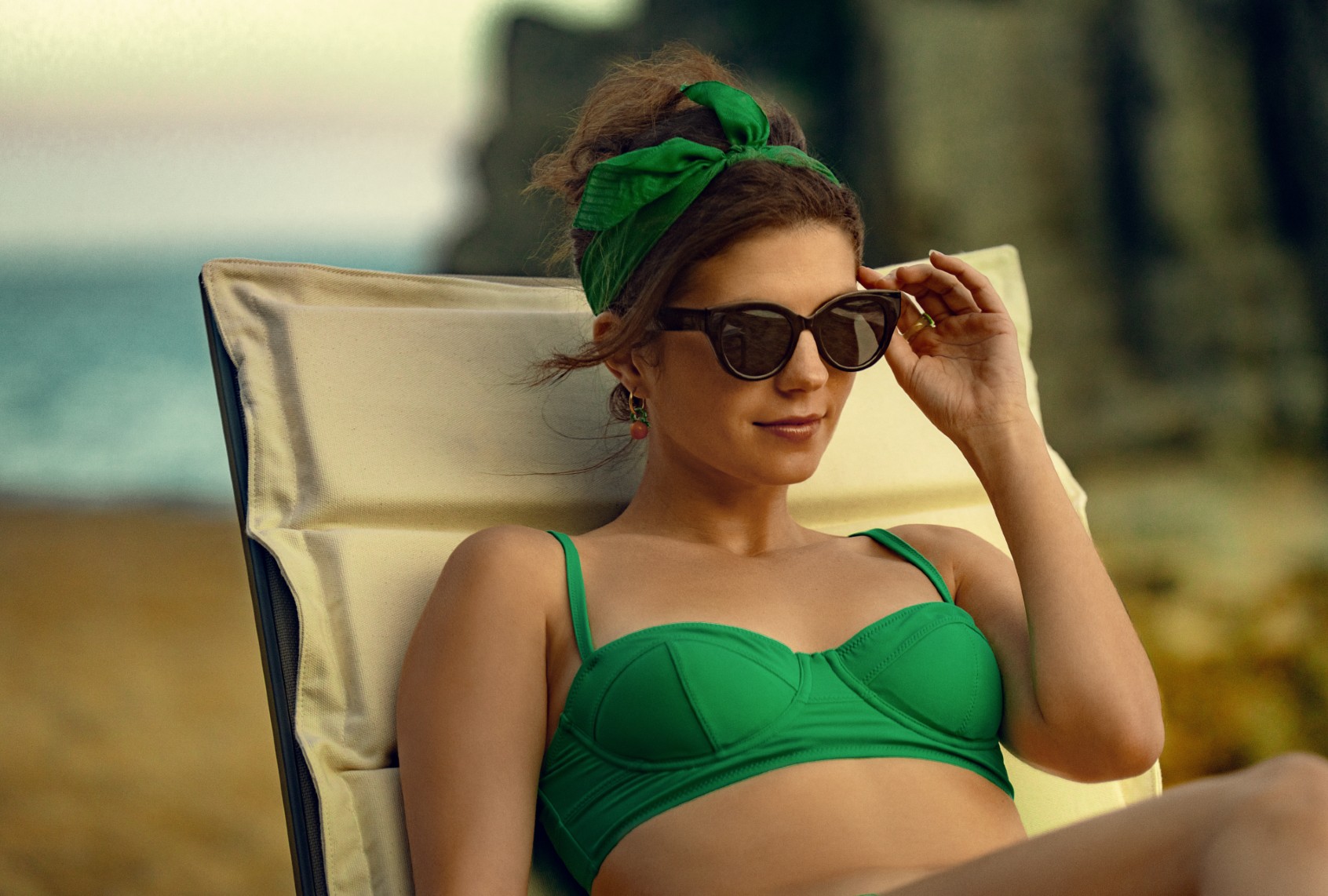
(Daniel Escale/Netflix) Emily Bader as Poppy and Tom Blyth as Alex in “People We Meet on Vacation”
That’s surprising, given this is the first adaptation of your work.
Well, I wrote the book I meant to write, and I’m very proud of it. That book will always exist on its own. With the film, my priority was protecting what readers cared about most and helping Brett make something they’d be excited to see. We were in touch almost every day for months, sometimes multiple times a day. He checked in whenever there was a casting conversation, a new version of the script, or a note that significantly changed something from the book. It was a weird, one-foot-in, one-foot-out situation: I was very involved, but mostly in the background. That kind of collaboration isn’t guaranteed — you can’t enforce meaningful consultation — so it was generous of Brett to approach it that way.
“With the film, my priority was protecting what readers cared about most and helping Brett make something they’d be excited to see.”
I think with adaptations, the focus can be so much on reaching a new audience that the author and existing readers get left behind. Brett recognized that those readers, or the existing fans, are the core audience. He’d previously adapted a beloved YA novel, so he understood that space and the importance of that relationship. He trusted that if the readers loved this film, a wider audience would, too.
What are some of your favorite book-to-screen adaptations?
“The Hunger Games” are incredible. Those books sometimes get written off just because they were so insanely popular and then triggered this huge wave of dystopian fiction, so everything tends to get lumped together. But they’re so special and poignant and powerful. And the adaptations, even with their deviations, feel very true to the books. They’re just beautiful films, which I think is hard to pull off with commercial, action-heavy YA.
There’s also the BBC adaptation of “Pride and Prejudice” with Jennifer Ehle and Colin Firth, which I usually watch in the winter, when it starts to feel oppressive outside. That one takes a completely different approach. With “The Hunger Games,” they took fantastic books and turned them into fantastic movies that aren’t exactly the same, but still capture the same core. With “Pride and Prejudice,” it’s more like, “What if we did this beat for beat?” and it’s just as phenomenal. It’s cool to see two very different approaches to adaptation turn out so wonderfully.
I’m also interested in how books are adapted for different cultural contexts, whether through language or minor plot variations. In the U.S. edition of “People We Meet on Vacation,” Alex reveals he got a vasectomy after Poppy’s pregnancy scare, just before they sleep together. That moment doesn’t appear in the U.K. edition or the film. How did that change come about?
That scene in the book felt like a huge deal and also not a huge deal. It’s significant because it says so much about Alex — he just decides to get a vasectomy — but at the same time, I have friends who’ve had them, so it’s not that uncommon. The U.K. editors, though, were jarred. They worried about Alex — vasectomies are reversible, but what if he couldn’t have kids? He seems like the kind of guy who would at least want to consider that. The team thought U.K. readers might be pulled out of the story during what’s supposed to be a sexy, intimate moment between Poppy and Alex.
It’s funny because a similar thing happened with my previous book, “Beach Read.” In the U.S. edition, January and Gus get engaged at the end, but the U.K. editors didn’t want that. Their reasoning, as communicated to me by my publisher, was: “We Brits don’t find marriage romantic.” They felt that commitment wouldn’t land with a U.K. audience the way it did in the U.S.
Want more from culture than just the latest trend? The Swell highlights art made to last.
Sign up here
I try not to write or edit based purely on how people might react. I generally stick to what the characters would do and what would honor the story. But I do have a rule: anything likely to pull someone out of the story for even a second, I try to limit. That’s one reason I often set books in fictional towns — if I put a coffee shop where there’s really a barber shop, local readers notice, and I want everyone fully immersed. So, with “Beach Read,” I didn’t care about changing the ending, because January at that point in her life doesn’t care whether she’s married. She cares about being in a loving relationship, and I don’t think it needs to be a marriage; it can be whatever she and Gus would want it to be. With “People We Meet on Vacation,” I thought about it for a while and then decided, OK, I’m fine with this.
Was Alex’s vasectomy ever considered for the movie?
It wasn’t a consideration for the movie, ever. There’s a higher threshold of plausible deniability with movies. You can put characters in ridiculous situations, and we just accept it — like, of course, they’re going to pretend they’re married and stay at his parents’ house. In my books, I try to take those scenarios and make them feel very, very grounded, which requires a lot more explanation. You have to ask: what would make two otherwise normal people do this ridiculous thing? You have to get the reader to buy into it. In a movie, for some reason, we just accept it.
“In my books, I try to take scenarios and make them feel very, very grounded, which requires a lot more explanation. You have to ask: what would make two otherwise normal people do this ridiculous thing? You have to get the reader to buy into it. In a movie, for some reason, we just accept it.”
The same goes for conversations around sex. In a book, I want to see, on a nitty-gritty level, how these characters navigate safe sex and their concerns about pregnancy — I want them to feel like real people I know. Most of my friends do think about these things. That conversation, to me, is part of the story. In a movie, it’s just like, “and now they have sex.” Are they using condoms? Is she on birth control? Are they worried? We don’t know. But I don’t think the viewer is thinking about these things the way a reader would.
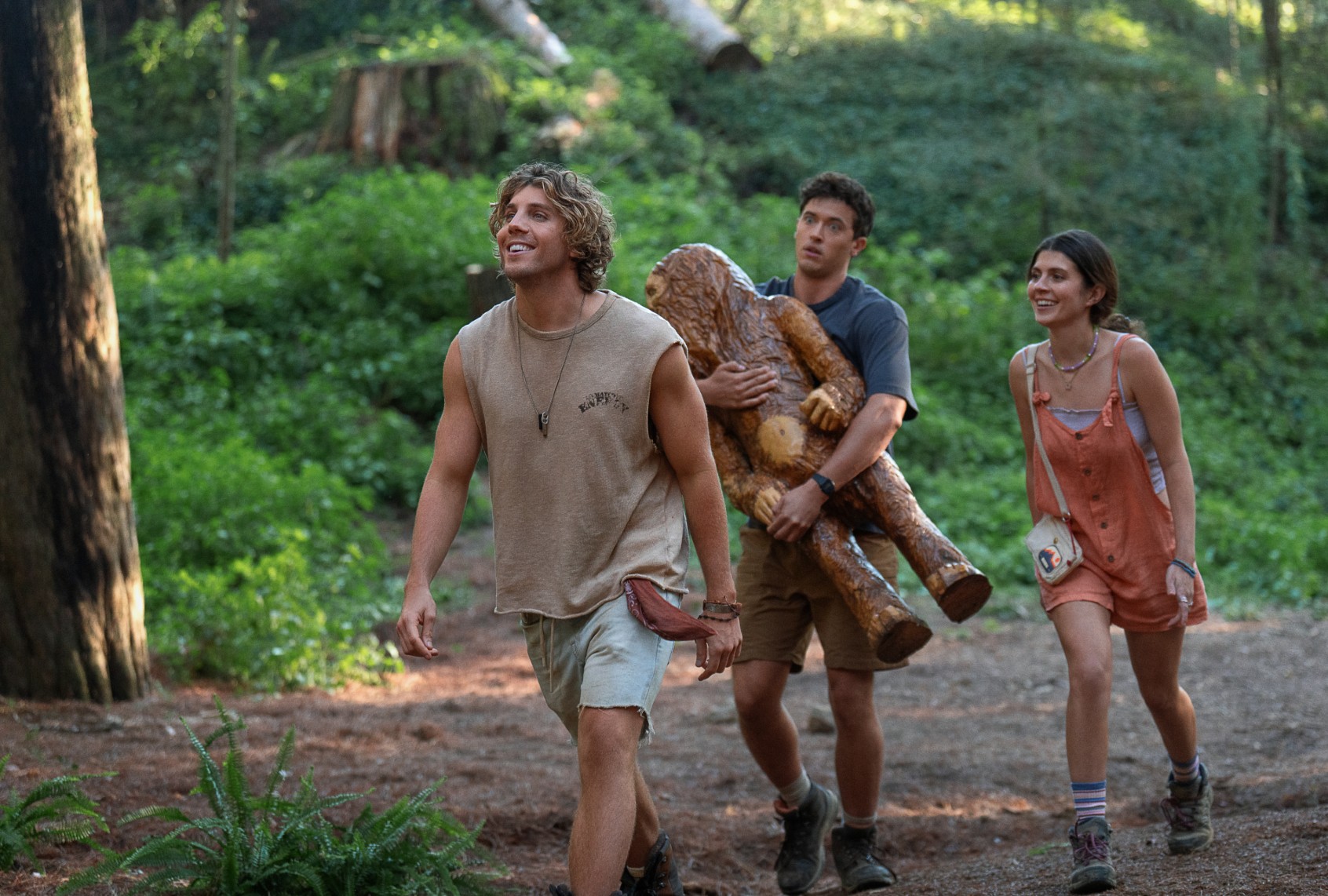
(Daniel Escale/Netflix) Lukas Gage as Buck, Tom Blyth as Alex and Emily Bader as Poppy in “People We Meet on Vacation”
You also have several more adaptations in the works, including “Beach Read,” “Book Lovers,” “Happy Place,” and “Funny Story.”
It’s exciting. I think these projects are gaining steam largely because Tom, Emily, Brett and the whole team did such an amazing job with this film. People are really eager for the next ones.
Will you be similarly involved?
I’m actually writing the scripts for “Happy Place” and “Funny Story” myself. That part of the adaptation process is an exciting new challenge. I’m also picking away at some spec scripts, because I’d love to write a movie that didn’t start as a book. But honestly, what I’m most excited about right now is just getting back to writing my books. My schedule is packed, so I won’t be able to sit down to work on the next one until mid to late January.
How does your process change when you’re writing a screenplay versus a novel?
Most of the screenplays I worked on this past year were adaptations, so it wasn’t new stuff. There are new scenes, but it’s not the same as sitting down with two completely new characters, and being swept along and surprised by them. In a novel, you get to go so much deeper into their psyches and backstory. With a screenplay, you have to convey all of that without having the characters just talk at each other, which is a fun challenge.
There are things you can only do in a book, though, and I’m itching to get back to that. I miss working with my editor and my whole publishing team. It’s really fun to crack a new story with them, develop it, and see it grow. The work I’m doing right now is so wonderful, but I’m just buzzing with the need to sit in one place for two months and hammer out a draft. I can’t wait to do it again soon.
Read more
about this topic